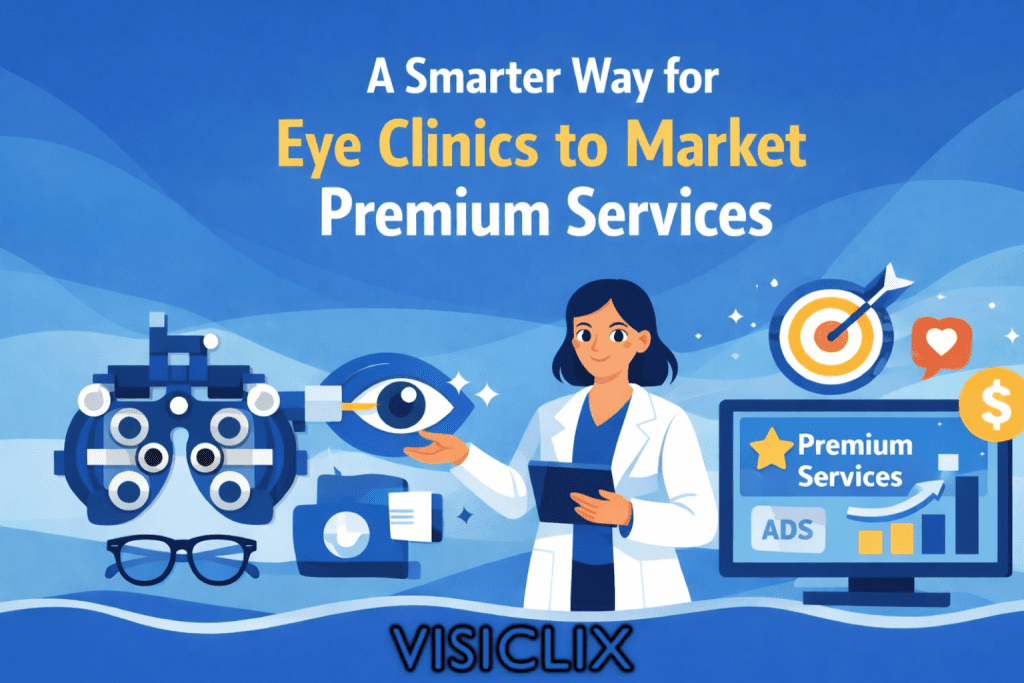
Premium services are harder to market in eye care than many clinics expect. Patients may be interested in advanced treatment options, more personalized care, and better day-to-day visual outcomes, but they are also cautious about hype, pressure, and claims that feel too polished to trust. In healthcare, strong messaging does not sound louder. It sounds clearer.
That is why premium eye care marketing messaging has to do two jobs at once. It has to communicate value well enough that patients understand why a higher-tier option exists, and it has to preserve the sense that the clinic is guiding a decision, not pushing a sale. The most effective message usually starts with what matters to the patient, explains the benefits and tradeoffs in plain language, and supports the claim with proof.
What is premium eye care marketing messaging?
Premium eye care marketing messaging is the way a clinic explains the value of higher-end services, technology, expertise, and experience so patients can understand why one option may fit them better than another. It is not just luxury branding, elegant design, or upscale wording. In practice, it is the language used on websites, landing pages, ads, consultation pages, emails, and in-office conversations to help patients make informed decisions.
In eye care, that message may apply to LASIK and refractive surgery, premium cataract lens options, specialty dry eye treatment, concierge-style exams, or boutique optical experiences. These are not interchangeable offers, but they share one common challenge: patients need enough context to understand the added value without feeling that the clinic is trying to “sell up” their health decision.
Why do eye clinics often sound too salesy when promoting premium services?
Eye clinics usually sound salesy when they lead with prestige language instead of patient relevance. Phrases such as “exclusive care,” “state-of-the-art,” or “world-class technology” are not automatically wrong, but they often ask the patient to trust the clinic’s conclusion before the clinic has explained the benefit in practical terms. That creates distance. Patients hear branding first and value second.
Another problem is that healthcare decisions involve benefits, risks, and tradeoffs. Agencies like FDA and AHRQ emphasize communication that helps people make informed decisions, which means presenting choices in a way that is understandable and balanced. When a clinic only highlights the upside, skips candidacy limits, or treats every patient like the same ideal buyer, the message starts to feel promotional rather than clinical.
What makes premium messaging feel trustworthy instead of promotional?
Trustworthy premium messaging is built on clarity, empathy, specificity, and proof. Clarity matters because health information is often harder for patients to process than clinics realize. AHRQ notes that organizations should reduce complexity and improve understanding for patients of all health literacy levels, while CDC’s plain-language guidance recommends replacing jargon with everyday words people can act on.
Empathy matters because premium care decisions are rarely just about “wanting the best.” A cataract patient may be worried about driving at night. A LASIK patient may care about convenience, sports, or work. A dry eye patient may simply be tired of burning, fluctuating vision, and temporary fixes. Messaging becomes more credible when it reflects those real-life concerns instead of assuming the patient is motivated by status.
Specificity matters because broad claims are easy to ignore. Proof matters because patients are more likely to trust what they can verify: doctor expertise, candidacy criteria, treatment explanations, outcomes, testimonials, process transparency, and balanced language about risks and benefits. When a clinic can show why an option may help, for whom, and under what conditions, it does not need to sound aggressive.
How should eye clinics describe premium services in terms patients actually care about?
The best way to describe a premium service is to translate features into daily-life outcomes. Patients do not wake up wanting a femtosecond laser, a tear film analysis, or a particular lens material. They want to read more comfortably, drive with more confidence, reduce dependence on glasses, spend less time dealing with irritation, or feel that their care is tailored to how they live.
For example, NEI explains that after LASIK, most people see well enough to stop wearing glasses or contact lenses for most daily activities. That is a stronger foundation for messaging than generic language about innovation. It lets a clinic connect the service to convenience and visual freedom without promising perfection or universal fit.
For cataract care, NEI explains that cataract surgery replaces the cloudy natural lens with an artificial lens, and lens choices can affect how patients see at different distances after surgery. That means good messaging should not simply call a lens “premium.” It should explain the lifestyle implications of the option, such as how it may support distance, intermediate, or near tasks, and where patients may still need glasses depending on the choice.
For dry eye, AAO notes that the condition can be progressive and can significantly affect quality of life. That means a premium dry eye message should focus less on fancy terminology and more on relief, consistency, root-cause evaluation, and a plan that goes beyond temporary symptom management.
What words and phrases make premium eye care sound too salesy?
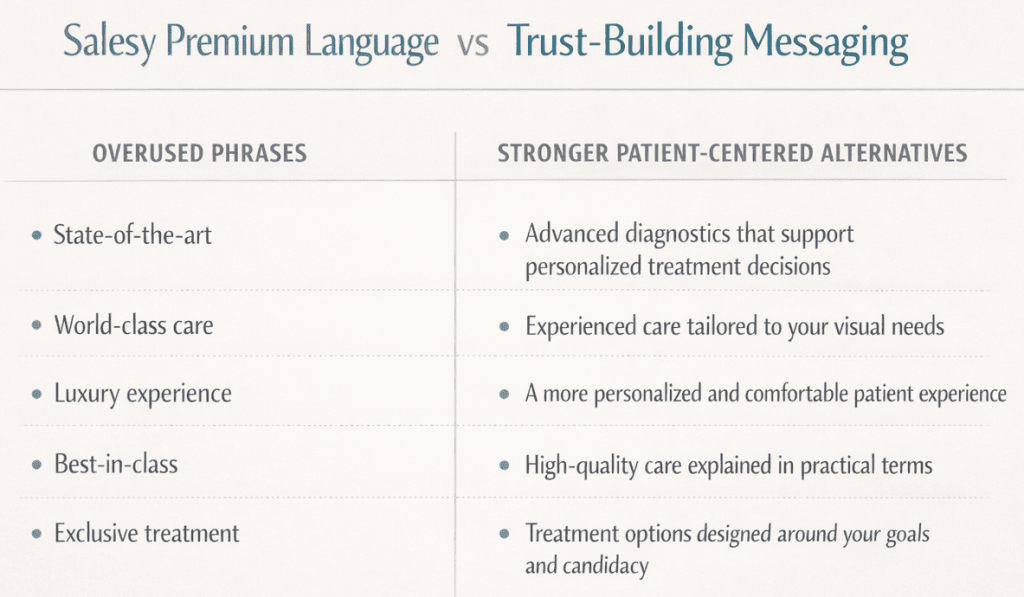
The phrases that most often weaken premium eye care messaging are the ones that sound impressive without teaching the patient anything. “State-of-the-art,” “world-class,” “bespoke,” “cutting-edge,” “luxury experience,” and “best-in-class” all tend to fall into that category when they stand alone. They are conclusions, not explanations.
These phrases also create a subtle trust problem. In healthcare, patients often expect information that helps them understand benefits, risks, and relevance. When a clinic relies too heavily on prestige language, the message can feel like branding has replaced education. Even when the clinic really does offer a superior experience, the wording can make the patient work too hard to figure out what the claim actually means.
What should clinics say instead when positioning premium services?
Clinics should replace abstract superlatives with concrete, patient-centered explanations. Instead of “state-of-the-art technology,” say that the clinic uses advanced imaging and diagnostic tools to help personalize treatment decisions. Instead of “luxury experience,” say that appointments are designed to be more personalized, more thorough, and easier to navigate from evaluation through follow-up. Instead of “premium lens options,” say that certain lens choices may help reduce dependence on glasses for specific daily tasks, depending on the patient’s eyes, goals, and candidacy. Those versions are stronger because they answer the patient’s next question: “What does that mean for me?”
This shift also aligns with how public health communicators are told to write. CDC’s plain-language resources emphasize everyday words and revised examples that improve understanding, while AHRQ’s health literacy materials focus on reducing complexity and helping patients use information in decisions. In other words, clearer messaging is not “less premium.” It is more usable.
How can eye clinics talk about higher pricing without creating pushback?
The first rule is to avoid sounding defensive. A clinic does not need to apologize for offering higher-value services. It needs to explain what is included, who the option may suit, and what the patient is evaluating beyond a price tag. That may include physician expertise, more advanced diagnostics, a more personalized treatment path, a broader visual goal, or a different level of support before and after treatment.
The second rule is to frame price in the context of decision quality. FDA’s communication guidance emphasizes helping people understand both benefits and risks so they can make informed choices. In marketing terms, that means clinics should present premium care as an option to evaluate, not a package to be pushed. When the message acknowledges tradeoffs and fit, the patient is more likely to see the clinic as a trusted advisor rather than a seller.
Why does patient-centered messaging work better for premium eye care?
Patient-centered messaging works better because premium eye care decisions are personal, not purely transactional. AHRQ’s SHARE Approach describes shared decision-making as dialogue that compares benefits, harms, and risks while exploring what matters most to the patient. That framework maps directly to better marketing language. The clinic should not begin with “why our premium option is better.” It should begin with “what outcome matters most to you?”
That approach is especially important in eye care because the same service can mean different things to different people. A younger refractive surgery patient may value convenience and active lifestyle freedom. An older cataract patient may care more about reading, night driving, or independence. A dry eye patient may be exhausted by chronic discomfort and frustrated by inconsistent relief. Messaging that mirrors those different motivations feels more helpful and more believable.
How should messaging change by premium eye care service?
How should LASIK and refractive surgery messaging be positioned?
LASIK messaging should focus on candidacy, lifestyle fit, and realistic outcomes. NEI explains that refractive surgery can help many people reduce dependence on glasses or contacts, but it also notes that certain eye conditions can raise the risk of complications and that patients should decide with their eye doctor whether LASIK or another option is right for them. Strong messaging reflects that balance. It can confidently speak to convenience and visual freedom while still respecting screening, expectations, and candidacy.
How should premium cataract messaging be positioned?
Premium cataract messaging should center on how different lens options may support different visual priorities after surgery. NEI’s cataract resources make clear that cataract surgery replaces the cloudy lens and that lens selection matters. Messaging should therefore focus on everyday outcomes such as reading, computer use, distance clarity, and reduced dependence on glasses, while making room for individualized discussion rather than one-size-fits-all claims.
How should dry eye or specialty treatment messaging be positioned?
Dry eye messaging should emphasize relief, consistency, and a more complete understanding of the problem. AAO notes that dry eye can be progressive, undertreated, and disruptive to quality of life. A premium message is most credible when it promises careful evaluation, a more tailored treatment plan, and support that goes beyond short-term symptom masking.
How should boutique optical or concierge care be described?
For boutique optical or concierge-style care, the message should focus on personalization, time, curation, and guidance. The language should feel calm and specific: more one-on-one attention, more thoughtful frame selection, a smoother visit, clearer explanations, and care designed around patient preferences. Even here, “premium” lands better when it describes a better experience rather than social status.
What proof helps premium messaging sound more credible?
The strongest proof is concrete and patient-relevant. That includes physician credentials, years of procedural experience, diagnostic process details, candidacy criteria, testimonials that mention outcomes or reassurance, and explanations of what happens before, during, and after treatment. Proof can also include balanced education about risks and limitations, because candor increases credibility.
This is where many clinics miss an opportunity. They may mention advanced technology but never explain why it matters for decision quality or patient comfort. They may quote broad praise but skip the more believable details patients care about, such as whether the doctor listened, whether options were explained clearly, and whether the patient felt informed rather than rushed. In premium healthcare marketing, reassurance is often more persuasive than excitement.
How can clinics align website copy, ads, and consultation messaging?
Premium messaging breaks down when each channel tells a different story. If an ad promises freedom, the landing page should not only talk about equipment. If the website emphasizes personalized care, the consultation should not feel scripted. If the practice positions a service as high-value, staff should be able to explain that value in plain language, not default back to vague superlatives or price-first conversations.
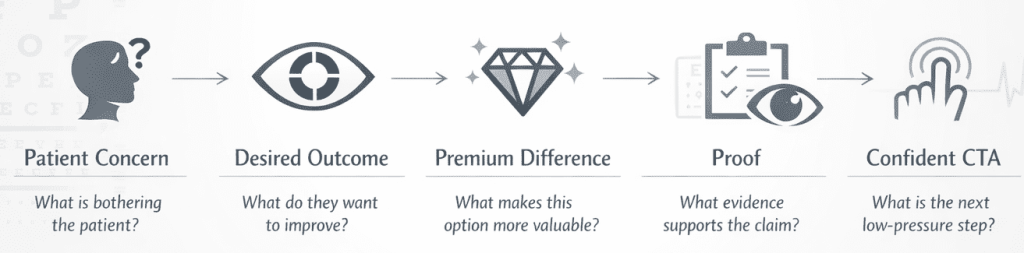
A simple way to align messaging is to use the same sequence everywhere: start with the patient’s goal, explain the option in everyday language, describe why it may help, clarify who it is for, and support the claim with proof. That structure matches the broader communication guidance from CDC, FDA, and AHRQ: make the message understandable, balanced, and useful for decisions.
Are premium eye care patients buying luxury, reassurance, or results?
Most are buying reassurance and results first. They want confidence that the clinic understands their eyes, their concerns, and their goals. They want to know what the option may improve, what the process looks like, and whether it fits their situation. A premium experience can strengthen that decision, but it rarely replaces the need for trust and clarity.
That is why the safest and strongest premium message is not “we are elite.” It is “we will help you make the right choice with clear guidance, advanced care, and a more personalized experience.” One message asks the patient to admire the clinic. The other helps the patient move forward.
How can eye clinics make premium messaging feel more human?
Human premium messaging sounds calm, confident, and clear. It does not overuse jargon. It does not hide behind polished adjectives. It speaks the way a great clinician speaks in a consult: direct, respectful, informed, and easy to follow. That approach is supported by public-sector communication standards that consistently favor plain language and comprehension over complexity.
It also leaves space for honesty. A clinic can say that a treatment may reduce dependence on glasses rather than eliminate them for everyone. It can say that a patient may be a candidate after evaluation rather than implying universal fit. In premium healthcare, measured language does not weaken the offer. It makes the offer more believable.
What are the biggest mistakes to avoid in premium eye care marketing messaging?
The biggest mistake is making the message about the clinic instead of the patient. Close behind that are leaning too heavily on prestige words, leading with technology instead of outcomes, avoiding pricing context, oversimplifying candidacy, and treating every premium service like it should be marketed the same way. These mistakes do not just reduce conversion quality. They also make the clinic sound less trustworthy.
Another major mistake is forgetting that communication is part of care. AHRQ’s patient-safety and health-literacy resources repeatedly connect understanding with better decisions and safer care. In that context, better messaging is not just a branding upgrade. It is part of helping patients feel informed enough to say yes for the right reasons.
How can eye clinics build a premium messaging framework that actually converts?
A reliable framework starts with the patient’s desired outcome. From there, the clinic explains the premium difference in plain English, supports it with proof, and closes with a confident but low-pressure next step. This works because it follows the same logic patients use when making health decisions: What is my problem, what are my options, what may this help me do, and why should I trust this clinic?
In practice, that means writing messaging that sounds like this: “If you want to spend less of your day relying on glasses, we offer refractive surgery evaluations that help determine whether LASIK or another option may be a fit.” Or: “If dry, irritated eyes are interfering with work and comfort, we use a more thorough evaluation process to identify likely causes and build a treatment plan around them.” Those messages sell less, but convert better, because they respect the patient’s intelligence.
FAQ
How do you market premium eye care services without sounding pushy?
Focus on patient outcomes, plain language, candidacy, and proof. Present premium care as an option to evaluate, not an upgrade to force.
What is the best way to explain premium cataract lenses to patients?
Explain how lens choices may affect day-to-day vision after surgery, including distance, intermediate, and near tasks, and keep the explanation tied to the patient’s lifestyle goals.
Should eye clinics use luxury language in their marketing?
Only sparingly, and only when the claim is backed by a specific explanation. In most cases, plain, patient-centered language is more persuasive in healthcare.
How do you justify premium pricing in eye care marketing?
Explain what is included, who the option may suit, and what additional value the patient is evaluating beyond price alone.
What type of messaging works best for LASIK and refractive services?
Messaging that emphasizes candidacy, convenience, realistic outcomes, and informed decision-making tends to be stronger than messaging built around hype.
How can premium healthcare marketing feel more trustworthy?
Use everyday language, address real concerns, explain benefits and tradeoffs, and support claims with credentials, process details, and outcomes.
Conclusion
Premium eye care marketing messaging works best when it is specific, calm, and patient-centered. Eye clinics do not need to sound more expensive to communicate higher value. They need to sound more useful. When the message starts with what the patient wants, explains the difference clearly, and backs it up with real proof, premium services feel easier to understand and more trustworthy to choose.
The real goal is not to make premium care sound exclusive. It is to make it feel relevant. That is the difference between messaging that creates resistance and messaging that builds confidence.
Why Visiclix is Your Ideal Choice for Premium Eye Care Marketing Messaging?
Visiclix is an ideal partner for eye clinics that want to position premium services with more clarity and less friction. Instead of relying on generic luxury language or recycled healthcare buzzwords, Visiclix can help shape messaging around what patients actually need to hear: what the service is, why it may matter, who it may help, and why the clinic is qualified to guide the decision. That leads to stronger website copy, better-performing campaigns, and more consistent communication across every patient touchpoint.
Just as importantly, Visiclix can help eye care brands keep their messaging aligned from ad click to consultation. Premium positioning only works when the promise is consistent, understandable, and credible at every stage. With a strategy built around patient psychology, plain-language clarity, and conversion-focused structure, Visiclix helps clinics talk about higher-value services in a way that feels confident, educational, and trustworthy.
Ready to Strengthen Your Premium Eye Care Messaging with Visiclix?
If your clinic offers premium services but your messaging still sounds vague, overly polished, or too close to a sales pitch, this is the right time to fix it. Visiclix can help you build messaging that explains value clearly, supports patient trust, and turns premium positioning into better-quality conversions.