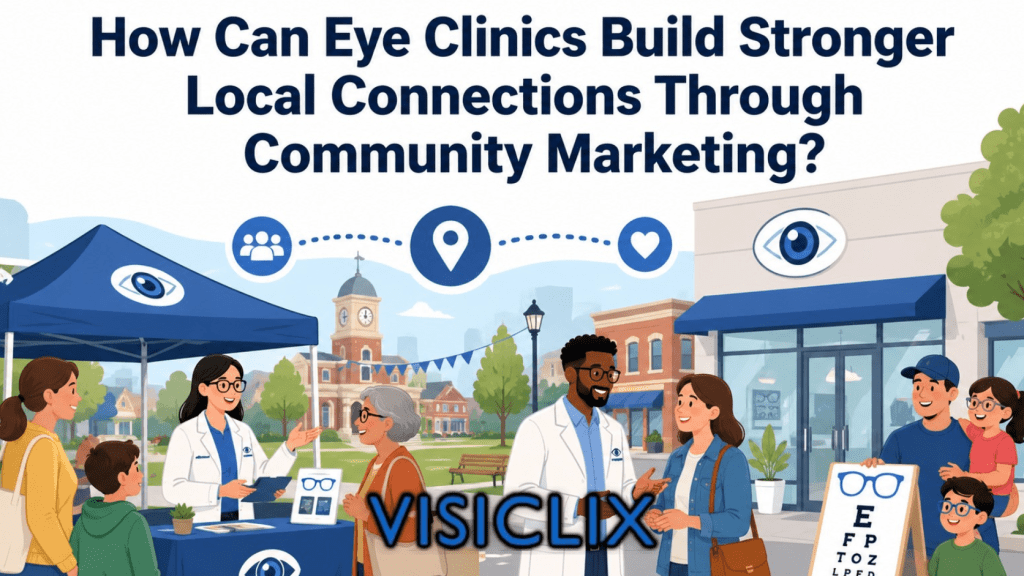
For many patients, eye care is not something they think about every week. They may remember to schedule an exam when school starts, when their glasses stop working well, when dry eye becomes frustrating, when a contact lens prescription expires, or when a medical provider reminds them to get checked because of diabetes or another health risk. That makes local familiarity extremely valuable for eye clinics.
Community marketing for eye clinics helps your practice stay visible before patients are actively searching. Instead of relying only on ads or appointment reminders, community marketing builds trust through local education, useful outreach, partnerships, events, and consistent follow-up. It makes your clinic feel like part of the community, not just another provider competing for clicks.
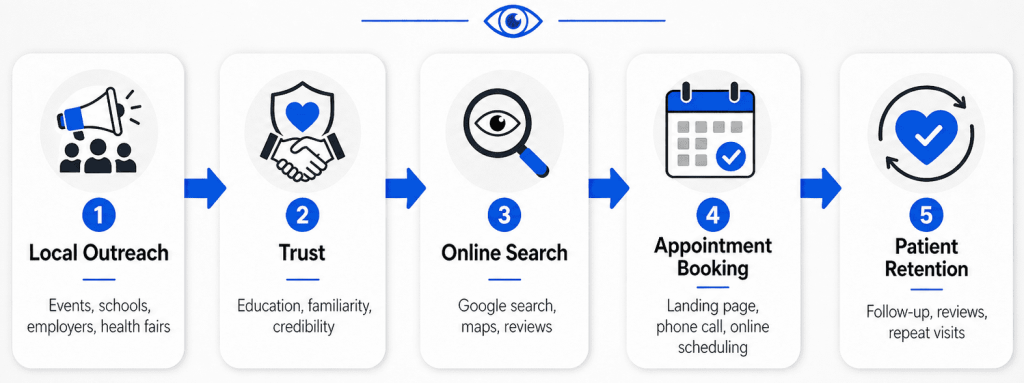
The strongest community marketing strategies connect offline trust with online action. A parent who hears your clinic speak at a school event may later search for pediatric eye exams. A senior who attends your glaucoma awareness talk may visit your Google Business Profile. An employee who scans your QR code at a workplace eye strain workshop may become part of a compliant email follow-up sequence or a PPC audience where permitted by policy and privacy rules.
Community outreach works best when it is structured. Random sponsorships rarely create measurable growth on their own. But when outreach is paired with local SEO, PPC, landing pages, reputation building, event tracking, and patient-friendly follow-up, it can help eye clinics earn more appointments and stronger local recognition over time.
What Is Community Marketing for Eye Clinics?
Community marketing for eye clinics is a local relationship-building strategy that helps practices connect with patients, families, employers, schools, senior groups, healthcare partners, and civic organizations through helpful, relevant, trust-building activities.
Unlike traditional advertising, community marketing does not begin with a hard sell. It begins with presence and usefulness. An eye clinic might provide a short talk on children’s vision, offer a workplace workshop on digital eye strain, partner with a diabetes education group, sponsor a youth sports team with protective eyewear education, or attend a local wellness fair with simple screening information and scheduling support.
The goal is not just exposure. The goal is meaningful local recall. When someone in the community eventually needs an eye exam, new glasses, contact lenses, dry eye care, cataract guidance, glaucoma monitoring, or diabetic eye care, your clinic should already feel familiar and credible.
Community marketing includes several related activities. Community outreach is the act of showing up and serving local audiences. Community engagement is the ongoing interaction that builds relationships. Community marketing connects those activities to business goals such as awareness, appointment requests, referrals, reviews, retention, and PPC campaign performance.
For eye clinics, this strategy is especially useful because vision care touches many community groups. Children need vision support for learning. Older adults need regular monitoring for age-related eye disease. People with diabetes need ongoing eye care because diabetes increases the risk of retinopathy, glaucoma, and cataracts, and the CDC notes that yearly dilated eye exams and treatment can help avoid or delay these conditions.
Why Does Community Marketing Matter for Eye Clinics?
Community marketing matters because patients often choose eye care providers based on trust, convenience, reputation, insurance fit, recommendations, and local familiarity. A clinic that is visible only when someone searches online is competing at the final decision point. A clinic that is already known in the community enters that search with an advantage.
Eye care is also highly need-based. Many patients delay exams until they notice blurred vision, lose or break glasses, experience discomfort, receive a school notice, or hear from another healthcare provider that they need an eye exam. Community marketing keeps your clinic present between those moments. It gives people reasons to remember you before the need becomes urgent.
Trust is particularly important in eye care because exams can uncover more than vision correction needs. The National Eye Institute explains that a dilated eye exam is the only way to check for some eye diseases early, before vision loss occurs, and many eye diseases may have no symptoms or warning signs. This gives eye clinics a powerful educational role in the community.
Community marketing can also support your digital channels. When people recognize your clinic name, they may be more likely to click your search ad, respond to a retargeting campaign, visit your Google Business Profile, read reviews, or book from a landing page. Offline visibility can improve online confidence.
This is especially important in competitive local markets. Many eye clinics offer similar services on paper: exams, glasses, contacts, medical eye care, dry eye treatment, and referrals. Community marketing gives your practice a more human advantage. It lets patients experience your expertise before they become patients.
How Can Eye Clinics Identify the Right Local Communities to Reach?
Eye clinics should identify the right communities by mapping local groups that already need vision care, eye health education, referral support, or practical help making eye care easier to access.
A strong community strategy does not start with “Where can we put our logo?” It starts with “Who needs help, and where do they already gather?” This prevents clinics from wasting budget on events that may look visible but do not match the practice’s ideal patient mix.
Which patient groups should eye clinics prioritize?
Eye clinics should prioritize groups that naturally align with eye health needs, appointment demand, and local referral potential. Parents of school-age children are a strong audience because vision can affect classroom performance, reading comfort, behavior, and learning confidence. The American Optometric Association emphasizes that children should receive comprehensive eye and vision examinations, and it provides education on key components of school-age eye exams.
Seniors and caregivers are another high-value audience. Older adults are more likely to need education around cataracts, glaucoma, macular degeneration, diabetic retinopathy, low vision, medication-related eye concerns, and fall-risk issues connected to vision. The American Academy of Ophthalmology notes that regular eye exams help detect age-related eye diseases, including macular degeneration, diabetic retinopathy, glaucoma, and cataract.
Adults with diabetes should also be a priority. The National Eye Institute states that diabetic retinopathy can cause vision loss and blindness, may not have symptoms at first, and makes a comprehensive dilated eye exam at least once a year important for people with diabetes.
Other strong groups include local employees, HR teams, contact lens wearers, athletes, teachers, school nurses, pediatricians, primary care providers, community health workers, nonprofit leaders, local employers, and civic organizations. Each group has a different reason to care about eye health, so each needs a tailored outreach message.
Where do these audiences already gather?
The best outreach opportunities are often found in places where trust already exists. For families, that may include schools, PTAs, daycare centers, youth sports leagues, libraries, parent groups, and local family events. For seniors, it may include senior centers, assisted living communities, churches, retirement associations, pharmacies, and caregiver groups.
For working adults, employers can be strong partners. HR departments, safety managers, office wellness committees, and local business associations may welcome education about digital eye strain, eye safety, benefits usage, and annual exam reminders. For people managing diabetes, clinics can explore partnerships with diabetes educators, primary care offices, pharmacies, support groups, and community health organizations.
Digital communities matter too. Local Facebook groups, neighborhood apps, chamber newsletters, school email lists, community calendars, and Google Business Profile updates can all extend the impact of an in-person event. Google allows businesses to use Business Profile posts to share updates, events, offers, news, photos, and videos with customers who find the profile.
The key is to join existing local ecosystems instead of forcing people into a brand-owned community. Eye clinics do not need to build a huge new audience from scratch. They need to become a trusted contributor in the communities patients already rely on.
What Community Outreach Ideas Work Best for Eye Clinics?
The best community outreach ideas for eye clinics are educational, locally relevant, easy to understand, and connected to a clear next step for care.
A strong outreach idea should answer a real patient concern. Parents want to know whether their child’s vision could affect school. Seniors want to know what warning signs matter. Employers want to reduce discomfort and improve productivity. People with diabetes want to understand how eye exams protect vision. Athletes and parents want practical safety advice.
Can eye clinics host free or low-cost vision screening events?
Yes, eye clinics can host free or low-cost vision screening events, but they should clearly explain that a screening is not a replacement for a comprehensive eye exam.
Screenings can work well at schools, workplaces, senior centers, health fairs, local wellness days, libraries, and nonprofit events. They give people a low-pressure way to engage with the clinic and learn whether they may need further care. They also create an opportunity for staff to answer basic questions, distribute educational materials, and guide interested people toward scheduling.
The message matters. A screening should not create false reassurance. The clinic should explain what the screening checks, what it does not check, and when a complete exam is appropriate. This is especially important because the National Eye Institute explains that many eye diseases can exist without symptoms or warning signs, and a dilated eye exam is needed to check for eye diseases early.
A good screening event should include simple signage, friendly staff scripts, printed education, QR codes for booking, a clear privacy-conscious contact form, and a follow-up plan. The goal is not to pressure people into an appointment on the spot. The goal is to make the next step easy for those who need or want care.
How can eye clinics partner with schools and parent groups?
Eye clinics can partner with schools and parent groups by offering practical education around children’s vision, back-to-school readiness, screen habits, eye safety, and signs that a child may need a comprehensive exam.
A school-based outreach campaign can include a parent checklist, a PTA presentation, a short teacher resource sheet, a school nurse packet, or a child-friendly handout explaining why vision matters for learning. The content should be clear and supportive rather than fear-based.
The American Optometric Association notes that children’s vision has an impact on social, motor, cognitive, and academic achievement, and it emphasizes the importance of comprehensive eye examinations for children. That gives clinics a strong educational foundation for school partnerships.
Back-to-school season is a natural time for this type of campaign, but clinics should not limit outreach to one month. Reading struggles, headaches, squinting, screen discomfort, and sports eye safety are relevant year-round. Eye clinics can create a recurring school outreach calendar that includes fall readiness, winter screen fatigue, spring sports safety, and summer eye protection.
How can eye clinics build relationships with senior communities?
Eye clinics can build relationships with senior communities by offering useful education on age-related vision changes, cataracts, glaucoma, macular degeneration, diabetic eye disease, dry eye, medication-related concerns, and when to schedule an eye exam.
Senior outreach works best when it is practical and easy to attend. Lunch-and-learns, caregiver talks, senior center presentations, retirement community wellness events, and pharmacy partnerships can all work well. The clinic should keep presentations simple, visual, and focused on everyday concerns such as night driving, reading comfort, glare, falls, medication side effects, and when symptoms should not be ignored.
The American Academy of Ophthalmology explains that regular eye exams can help detect age-related eye diseases, including cataract, glaucoma, diabetic retinopathy, and macular degeneration. The American Optometric Association also identifies macular degeneration, glaucoma, and diabetic retinopathy as conditions that can cause permanent vision loss among people over 60.
For seniors and caregivers, trust is often built slowly. A clinic may not get a large number of appointments from the first talk. But repeated presence at the same senior center, church group, retirement community, or local health fair can create familiarity that grows over time.
How can eye clinics connect with local employers?
Eye clinics can connect with local employers by offering workplace eye health education that helps employees reduce discomfort, understand benefits, and know when to seek care.
Good employer outreach topics include digital eye strain, dry eye in office environments, protective eyewear, contact lens hygiene, workplace safety, and annual exam reminders. These topics are easy for employers to understand because they connect eye health with comfort, productivity, safety, and employee wellness.
A workplace campaign can be simple. The clinic might offer a 20-minute lunch-and-learn, a printable “screen comfort checklist,” a benefits-season reminder, a QR code for appointment requests, or a co-branded internal email. For industrial or trade workplaces, safety eyewear education may be especially relevant.
The clinic should avoid making the employer partnership feel like a sales pitch. The first value should be education. The appointment pathway should be available, clear, and convenient, but not intrusive.
How can eye clinics support local sports and recreation groups?
Eye clinics can support local sports and recreation groups by pairing sponsorships with eye safety education, protective eyewear guidance, and practical resources for parents, coaches, and athletes.
Many clinics sponsor youth sports teams by placing a logo on a banner or jersey. That can help with awareness, but it is rarely enough on its own. A stronger approach is to add value. The clinic can provide a short “protect your eyes this season” handout, attend registration day, offer a coach-friendly checklist, or sponsor protective eyewear education for high-risk sports.
This works for youth sports leagues, school athletic programs, gyms, recreation centers, martial arts studios, swim clubs, and cycling or running groups. For practices that offer sports vision or specialty contact lens services, these partnerships can also create a relevant path to higher-value services.
The important point is to activate the sponsorship. A logo alone is passive. A useful educational experience creates memory and trust.
How can eye clinics use local health fairs effectively?
Eye clinics can use local health fairs effectively by setting a specific goal, preparing staff, collecting compliant contact information, and building a follow-up system before the event begins.
A strong booth should have one clear message. Examples include “Protect your sight with a yearly diabetic eye exam,” “Is your child ready to see clearly this school year?” or “Screen fatigue? Learn when it is time for an exam.” A focused message is easier to remember than a general “we do eye exams” booth.
The booth should include simple signage, a QR code to a dedicated landing page, printed education, appointment scheduling options, and a friendly staff script. Staff should know how to explain the difference between a screening and an exam, how to answer common questions, and how to guide interested attendees to the next step.
Follow-up is where many clinics lose value. If someone scans a QR code, visits a landing page, or requests information, the clinic should have a compliant follow-up process that may include email education, phone follow-up when appropriate, and PPC remarketing only when platform rules and privacy requirements allow.
How Should Eye Clinics Turn Community Events Into New Patient Appointments?
Eye clinics should turn community events into new patient appointments by creating a follow-up system before the event happens.
Awareness alone is not enough. Someone may meet your clinic at a school fair, think positively about the team, and still forget to book. The role of your system is to make the next step easy while the interaction is still fresh.
Start by setting one primary goal for each event. A school event might focus on pediatric eye exam awareness. A senior center talk might focus on cataract, glaucoma, or dry eye consultations. A diabetes group presentation might focus on annual dilated eye exams. A workplace event might focus on digital eye strain or safety eyewear.
Then create a dedicated landing page. The page should match the event topic, answer the most common questions, explain who should schedule, and include a simple appointment request form or booking link. Use a QR code at the event so attendees do not have to search manually.
Lead capture should be consent-based. If attendees provide contact information, the clinic should clearly explain how that information will be used. Healthcare organizations must be especially careful with marketing communications. HHS explains that the HIPAA Privacy Rule generally requires individual authorization for uses or disclosures of protected health information for marketing purposes, subject to limited exceptions.
Segmentation improves follow-up. A parent who wants information about children’s exams should not receive the same message as a senior interested in cataracts or a patient asking about diabetic eye disease. Create simple categories such as pediatric exams, dry eye, cataracts, contact lenses, diabetes-related eye care, and general exams.
PPC can support the follow-up, but healthcare advertisers need to follow platform policies. Google’s healthcare and medicines policy applies to health-related advertising, and advertisers using Google Ads must comply with those rules. Google also maintains a Customer Match policy for advertisers using customer data in campaigns, which is relevant when clinics consider uploading consent-based lists.
The safest approach is to build marketing workflows with privacy, consent, and policy review from the beginning. When done correctly, community outreach can feed a measurable digital funnel without making patients feel over-targeted or uncomfortable.
What Digital Marketing Should Support Community Outreach?
Every community campaign should have a digital layer so local visibility does not disappear after the event ends.
Digital support should begin before the event. Add the event to your website, publish a Google Business Profile update, post on social media, send an email to relevant patients when appropriate, and provide partners with simple promotional copy. Google Business Profile posts can be used to share events, offers, news, photos, and videos with people who find the business profile.
During the event, use QR codes that lead to topic-specific pages. Do not send everyone to the homepage. A parent at a school event should land on a children’s vision page. A senior attending a glaucoma talk should land on an age-related eye health page. A diabetes event attendee should land on a diabetic eye exam page.
After the event, publish a recap. This can be a short blog post, a Google Business Profile update, a social media post, or an email. Recap content shows community involvement and gives partners something to share. It also helps reinforce your local authority.
PPC can extend the life of the event. A clinic can run paid search campaigns around the topic, promote a related service page, or use compliant remarketing where allowed. For example, after a back-to-school outreach campaign, search ads can target people looking for pediatric eye exams or children’s glasses in the local area. After a workplace screen fatigue campaign, ads can support dry eye or comprehensive exam services.
Local SEO also matters. If your clinic repeatedly participates in school, senior, employer, or diabetes-related programs, those themes can become part of your content strategy. Pages and blog posts can answer common local questions, explain services, and help patients connect community education with appointment booking.
How Can Eye Clinics Build Local Partnerships That Last?
Eye clinics can build lasting local partnerships by creating shared value, setting clear expectations, communicating consistently, and following up after every campaign.
A lasting partnership is not a one-time sponsorship check. It is a relationship where both sides understand the value. A school wants parents to have helpful resources. A senior center wants trustworthy speakers. An employer wants wellness education. A diabetes educator wants patients to understand the importance of eye exams. Your clinic can support those goals while also building visibility.
Start by choosing partners with aligned audiences. Schools, PTAs, senior living communities, employers, diabetes education groups, primary care offices, pediatricians, pharmacies, gyms, youth sports leagues, nonprofits, and chambers of commerce can all be valuable depending on the clinic’s services and growth goals.
Then define the offer. Do not ask vaguely to “partner sometime.” Offer a specific idea: a 20-minute lunch-and-learn, a back-to-school checklist, a senior eye health presentation, a diabetes eye exam education session, or a sports eye safety resource. Specific offers are easier for partners to approve.
Ethical referral relationships are important. Eye clinics should avoid arrangements that create compliance issues or feel transactional to patients. The focus should be education, access, and patient benefit.
Document every relationship. Track the partner name, contact person, audience type, event date, topic, attendance, contacts collected, appointments requested, and next step. Over time, this creates a community marketing database that helps the clinic repeat what works and stop spending time on low-value activities.
Are Sponsorships Worth It for Eye Clinics?
Sponsorships can be worth it for eye clinics when they include visibility, engagement, and follow-up opportunities—not just a logo on a banner.
A basic sponsorship may provide name recognition, but it often does not create measurable results. The clinic’s logo may appear at a school fundraiser, sports event, gala, or community festival, but attendees may not remember the practice or understand why they should choose it. That does not mean sponsorships are bad. It means clinics need to negotiate smarter value.
A better sponsorship includes an activation. Ask whether your clinic can have booth space, a short speaking opportunity, a newsletter mention, a social media post, a QR code placement, an email inclusion, a co-branded educational handout, or a follow-up feature. These additions turn passive exposure into interaction.
The best sponsorships also match the audience. A pediatric-focused clinic may benefit from school events, youth sports, and parent organizations. A medically focused eye clinic may benefit from diabetes groups, senior centers, and primary care networks. An optical-heavy clinic may benefit from fashion, wellness, employer, or lifestyle events.
Measure sponsorships like campaigns. Track QR code visits, calls, appointment requests, partner referrals, branded search lift, Google Business Profile interactions, and new patients who mention the event. If a sponsorship cannot be measured directly, track at least the relationship value and repeat visibility.
Sponsorships are most effective when they are part of a broader outreach calendar. One logo placement is easy to forget. Repeated useful presence builds familiarity.
How Can Eye Clinics Measure Community Marketing Success?
Eye clinics should measure community marketing success using both appointment outcomes and relationship-building indicators.
Direct conversion metrics matter. Track event attendance, qualified contacts collected, appointment requests, booked exams, completed visits, cost per appointment, revenue by campaign where appropriate, and referral source data. These metrics help the clinic understand which events produce measurable patient growth.
Digital engagement metrics also matter. Track QR code scans, landing page visits, Google Business Profile clicks, calls, direction requests, email engagement, paid search activity, branded search changes, and social media interactions. Google Business Profile provides performance and engagement tools through its official help system, which can support local visibility analysis.
Reputation metrics are important too. Community campaigns may lead to more reviews, stronger word-of-mouth, and more trust in local groups. These effects can be harder to attribute than a booking link, but they still influence growth.
Partnership metrics should not be ignored. Track repeat invitations, partner feedback, referral quality, co-hosted events, newsletter mentions, and shared content opportunities. A partner that invites your clinic back every quarter may be more valuable than a one-time event with higher attendance but no follow-up.
A practical KPI framework can divide results into four categories:
| Metric Type | What to Track | Why It Matters |
| Awareness | Event attendance, impressions, partner reach, branded search | Shows whether more local people are encountering the clinic |
| Engagement | QR scans, conversations, email signups, social interactions | Shows whether people are interested enough to take a small action |
| Conversion | Appointment requests, booked exams, completed visits | Shows whether outreach is creating patient growth |
| Retention | Reviews, repeat visits, referrals, follow-up engagement | Shows whether community trust is supporting long-term value |
Community marketing is not always instant. Some patients may book months after first meeting your clinic. That is why clinics should measure both short-term appointment impact and long-term visibility.
What Mistakes Should Eye Clinics Avoid With Community Marketing?
The biggest mistake is treating community outreach as a one-time promotional tactic instead of a repeatable trust-building system.
Many clinics attend events without a clear goal. They set up a table, distribute brochures, hand out branded items, and hope people remember them. That approach may create some awareness, but it does not reliably produce appointments. Every event should have a defined audience, message, offer, landing page, tracking method, and follow-up workflow.
Another mistake is making outreach too sales-focused. Healthcare marketing must feel helpful and trustworthy. If the clinic’s message is only “book now,” people may tune out. A better approach is to educate first, answer common questions, and provide a clear path for those who are ready to schedule.
Clinics should also avoid collecting contact information casually without clear consent. This is especially important in healthcare settings, where privacy expectations are high and HIPAA considerations may apply. HHS guidance explains that the HIPAA Privacy Rule addresses uses and disclosures of protected health information for marketing purposes and generally requires authorization for marketing uses, with limited exceptions.
A common digital mistake is failing to connect outreach with local SEO and PPC. If someone meets your clinic offline and later searches online, your digital presence needs to support that journey. Your Google Business Profile, reviews, service pages, landing pages, and ads should all reinforce the same message.
Clinics should also avoid generic healthcare messaging. Eye care has specific concerns: children’s vision, dry eye, contact lenses, cataracts, glaucoma, diabetic eye disease, eyewear, eye safety, and medical eye exams. The more specific the outreach, the more relevant it feels.
How Can Eye Clinics Create a Simple Community Marketing Plan?
Eye clinics can create a simple community marketing plan by choosing one priority audience, selecting a few aligned partners, building one educational offer, creating a digital follow-up path, and measuring results.
Step 1: Choose one priority audience
Start with one audience instead of trying to reach everyone. A clinic might choose families with school-age children, seniors, adults with diabetes, local employers, or contact lens wearers.
The audience should match the clinic’s business goals and clinical strengths. A practice focused on pediatric growth might start with schools and parent groups. A medically oriented clinic might start with diabetes educators and senior communities. A practice trying to increase dry eye consultations might focus on employers, screen-heavy workplaces, and wellness groups.
Step 2: Select two or three local partners
Once the audience is clear, identify two or three organizations that already have trust with that group. For families, this could be a school, PTA, library, or sports league. For seniors, it could be a senior center, retirement community, church group, or pharmacy. For diabetes-related outreach, it could be a primary care practice, diabetes educator, support group, or community health organization.
Keep the first partnership list small. A clinic can build momentum faster by executing well with a few partners than by sending generic outreach emails to dozens of organizations.
Step 3: Build one educational offer
Create one simple, repeatable offer. Examples include a children’s vision checklist, a back-to-school exam awareness talk, a senior eye health lunch-and-learn, a diabetic eye exam education session, a screen fatigue workshop, or an eye safety presentation for athletes.
The offer should answer one core question. For example: “When should parents schedule a comprehensive eye exam?” or “Why do people with diabetes need yearly dilated eye exams?” The National Eye Institute recommends that people with diabetes get a comprehensive dilated eye exam at least once a year because diabetic retinopathy may not have symptoms at first and early detection helps protect vision.
Step 4: Create a digital follow-up path
Before the event, create a landing page, QR code, email follow-up, call tracking method, and appointment pathway. This turns the outreach idea into a campaign.
The landing page should match the educational offer. The follow-up email should provide useful information, not just a sales message. PPC campaigns should be reviewed for healthcare advertising policies, especially if using remarketing, customer data, or health-related messaging. Google’s healthcare and medicines policy and Customer Match policy should be part of that review.
Step 5: Measure results and repeat what works
After the event, review what happened. How many people attended? How many scanned the QR code? How many requested appointments? How many completed visits? Did the partner want to repeat the event? Did the topic generate questions or content ideas?
Use this information to improve the next campaign. Community marketing becomes more efficient when the clinic treats every event as part of a learning system.
What Is a Good 90-Day Community Marketing Plan for Eye Clinics?
A good 90-day community marketing plan gives eye clinics enough structure to launch quickly without overwhelming the team.
Days 1–30: Build the foundation
During the first 30 days, choose the campaign audience, topic, and partners. Decide whether the campaign will focus on families, seniors, employers, diabetes-related eye care, sports safety, dry eye, or general exam awareness.
Create the core outreach material. This may include a short presentation, handout, landing page, QR code, phone script, email sequence, Google Business Profile post, social media post, and tracking sheet.
Also train the team. Front desk staff should know how to handle event-related calls. Clinical staff should know the campaign message. Marketing staff should know how to track leads and appointment outcomes.
Days 31–60: Launch the first outreach campaign
During the next 30 days, run the first campaign. Host the talk, attend the health fair, publish the local post, send partner materials, and promote the event through available channels.
At the event, focus on helpful conversations. Ask what people are concerned about. Listen for repeated questions. These questions can later become blog posts, FAQ content, ad copy, or email topics.
Begin follow-up quickly after the event. Send educational information to people who opted in, respond to partner contacts, update the campaign tracker, and make sure appointment requests are handled promptly.
Days 61–90: Optimize and expand
During the final 30 days, review campaign performance. Compare attendance, QR scans, calls, appointment requests, completed visits, partner feedback, and digital engagement.
Then decide what to repeat. If a senior center talk led to strong engagement, turn it into a quarterly program. If a school event produced many parent questions but few bookings, improve the landing page or follow-up message. If a workplace event generated dry eye interest, support it with PPC and local SEO content.
By the end of 90 days, the clinic should have one tested outreach campaign, a small partner list, a working follow-up system, and a clearer understanding of which community channels are worth expanding.
FAQ
What is community marketing for eye clinics?
Community marketing for eye clinics is a local growth strategy that builds trust and visibility through education, events, partnerships, outreach, and digital follow-up. It helps eye clinics stay top of mind with families, seniors, employers, healthcare partners, and local organizations before patients are actively searching for care.
What are the best community outreach ideas for eye clinics?
The best community outreach ideas for eye clinics include school vision education, senior center talks, workplace eye strain workshops, local health fairs, sports eye safety partnerships, diabetes-related eye health education, and community wellness events. The strongest ideas connect a real local need with a clear path to schedule care.
How often should an eye clinic do community outreach?
Most eye clinics should aim for at least one structured community campaign per quarter, supported by smaller monthly touchpoints such as Google Business Profile posts, partner emails, social posts, or educational handouts. A consistent schedule is more effective than occasional one-off events.
Can community marketing help eye clinics get more patients?
Yes, community marketing can help eye clinics get more patients when outreach is connected to appointment scheduling, lead capture, local SEO, PPC, email follow-up, and partner relationship management. Outreach alone creates awareness, but a structured follow-up system turns awareness into measurable appointment opportunities.
How do eye clinics measure community marketing ROI?
Eye clinics can measure community marketing ROI by tracking event attendance, QR code scans, appointment requests, booked exams, completed visits, referral sources, cost per appointment, branded search lift, Google Business Profile activity, reviews, and partner referrals.
Should eye clinics use PPC with community marketing?
Yes, PPC can strengthen community marketing by reinforcing local awareness, capturing searches after events, promoting seasonal services, and supporting compliant remarketing where allowed. Clinics should review healthcare advertising policies and privacy requirements before using customer data or health-related targeting. Google’s healthcare advertising and Customer Match policies are important references for campaign planning.
Conclusion
Community marketing helps eye clinics build trust before patients are ready to book. That matters because eye care decisions are often influenced by familiarity, reputation, education, convenience, and confidence. A patient who has already seen your clinic support a school, senior center, employer, sports team, or health fair is more likely to recognize your name when it is time to schedule.
The strongest outreach strategies are specific, helpful, and measurable. Vision screenings, school programs, senior talks, workplace workshops, sports safety partnerships, and diabetes-related education can all create local visibility. But they work best when paired with landing pages, QR codes, email follow-up, local SEO, Google Business Profile updates, PPC support, and clear appointment tracking.
Eye clinics should not treat community marketing as random sponsorships or occasional event attendance. It should be a repeatable growth system. When outreach, education, partnerships, and digital follow-up work together, your clinic can stay top of mind locally and turn community trust into long-term patient growth.
Why Visiclix is Your Ideal Choice for Community Marketing for Eye Clinics?
Visiclix understands that eye clinic growth depends on more than visibility alone. Patients need to recognize your clinic, trust your expertise, and feel confident taking the next step when they need an eye exam, treatment, eyewear, or specialty care. With a strategy that connects local outreach, PPC, SEO, and conversion-focused follow-up, Visiclix helps eye clinics turn community presence into measurable patient growth.
Visiclix can help your clinic identify the right local audiences, build campaigns around high-value services, and create digital systems that support every outreach effort. From event landing pages and paid search campaigns to retargeting, local SEO, and performance tracking, Visiclix gives eye clinics the structure needed to make community marketing more consistent, more measurable, and more profitable.
Build a Stronger Local Presence With Visiclix
Ready to turn local outreach into real patient growth? Visiclix helps eye clinics create community marketing and PPC strategies that keep your practice top of mind, attract more qualified patients, and make every campaign easier to measure.
Contact Visiclix today to build a smarter local growth strategy for your eye clinic.