Patient reactivation marketing for medical practices is the process of reconnecting with inactive or lapsed patients and encouraging them to return for care through respectful, compliant outreach. It helps practices recover missed appointments, refill schedule gaps, and rebuild patient relationships without depending only on new patient acquisition.
Patients usually lapse for practical reasons. They get busy, forget to reschedule, change insurance, delay preventive care, or feel unsure about coming back after a long gap. A good reactivation strategy does not shame them or pressure them. It makes returning feel simple, safe, and helpful.
That is why the best reactivation campaigns are built around trust. They use the right data, the right message, the right channel, and the right follow-up process. For medical practices, this matters because outreach must respect patient privacy, communication preferences, and healthcare advertising rules. HHS explains that HIPAA treats marketing communications differently from treatment-related communications, while appointment reminders are generally considered part of treatment.
What Is Patient Reactivation Marketing for Medical Practices?
Patient reactivation marketing for medical practices is a strategy for identifying inactive patients and encouraging them to reconnect with the practice through relevant, respectful communication. It usually focuses on patients who have not booked, visited, responded, or completed recommended care within a defined period.
For example, a primary care practice may consider a patient inactive after 12 to 18 months without a visit. A dental office may flag patients who are overdue for hygiene appointments. A specialty clinic may focus on patients who started but never completed a treatment plan. The exact definition depends on the practice type, patient lifecycle, and service category.
Reactivation is different from general advertising because the audience already has some relationship with the practice. These patients may recognize the provider name, remember the location, or have previous trust in the clinical team. That familiarity can make reactivation more efficient than cold acquisition, but it also creates a responsibility to communicate carefully.
The goal is not simply to “sell” another appointment. The goal is to make it easier for patients to resume care when it is appropriate. That means the message should sound like a helpful reminder from a trusted provider, not a promotional blast from a business trying to fill empty slots.
Patient Recall vs Patient Reactivation: What’s the Difference?
Patient recall is routine follow-up for patients who are due for planned care, while patient reactivation focuses on patients who have become inactive, overdue, or disconnected from the practice. Both are important, but they serve different purposes.
A recall campaign usually applies to patients who are still considered active. For example, a patient may be due for an annual wellness visit, a six-month cleaning, a follow-up consultation, or a preventive screening reminder. The relationship is ongoing, and the message is usually expected.
A reactivation campaign is more focused on relationship recovery. These patients may not have returned for a long time, may have missed an appointment, or may have stopped responding to normal reminders. The tone should be softer because the patient may feel embarrassed, uncertain, or no longer connected to the practice.
A simple way to separate them is this: recall keeps active patients on track; reactivation brings inactive patients back into the care journey. Medical practices need both because recall protects continuity, while reactivation recovers missed opportunities and helps prevent patient lists from going stale.
What Is a Patient Reactivation Campaign?
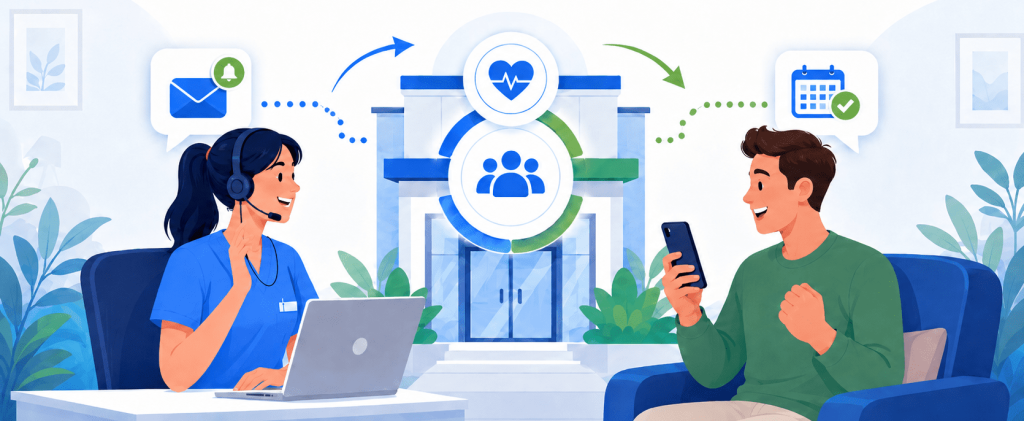
A patient reactivation campaign is a planned outreach sequence designed to reconnect with inactive patients and guide them toward booking an appointment or responding to the practice. It may use email, SMS, phone calls, direct mail, PPC, or a combination of channels.
A strong campaign starts with a clear patient segment. A message for someone who missed an appointment two weeks ago should not sound the same as a message for someone who has not visited in three years. The more relevant the segment, the more natural the outreach feels.
A campaign also needs a clear next step. That may be scheduling online, replying to a text, calling the office, confirming insurance details, or asking a question. Patients are more likely to respond when the message reduces friction instead of adding work.
The best campaigns also include internal workflow planning. If patients reply, who answers? If they ask about cost, what should staff say? If they opt out, how is that recorded? Reactivation is not only a marketing task. It also depends on front desk readiness, scheduling access, and follow-through.
How Do You Reactivate Inactive Patients?
You reactivate inactive patients by identifying who has lapsed, organizing them into meaningful groups, sending trust-safe outreach, making scheduling easy, and tracking results. The process should be structured rather than random.
Start with the patient database. Pull a list of patients who have not visited, scheduled, or completed care within the chosen timeframe. Then clean the data by checking contact details, removing duplicates, suppressing invalid numbers or bounced emails, and excluding patients who should not receive outreach.
Next, segment the list. Useful segments may include patients inactive for 6–12 months, 12–24 months, and 24+ months. You can also segment by missed appointments, incomplete treatment plans, preventive care status, preferred communication method, or service type. Segmentation helps avoid generic messages that feel irrelevant.
Then build a short outreach sequence. A common sequence may include an email, a follow-up SMS, a phone call for priority segments, and a final reminder. Each message should be easy to understand and easy to act on. Include a scheduling link where appropriate, but avoid language that feels urgent, judgmental, or overly personal.
Finally, measure outcomes. Track booked appointments, show rates, patient replies, cost per reactivated patient, revenue from reactivated patients, opt-outs, and complaints. Reactivation should improve schedule volume, but it should not damage patient trust in the process.
How Can Medical Practices Win Back Inactive Patients Without Damaging Trust?
Medical practices can win back inactive patients by using helpful, nonjudgmental outreach that respects privacy, avoids pressure, and makes returning feel easy. The tone matters as much as the offer.
Avoid messages that make patients feel guilty. Phrases like “You have neglected your care” or “You are long overdue” may be technically accurate, but they can create shame or resistance. A better approach is to say, “We’re here when you’re ready to schedule your next visit.”
Practices should also avoid including sensitive diagnosis details in outreach. Even when a message is allowed, it may still feel invasive if it reveals too much in an email preview, SMS notification, or voicemail. HHS’s minimum necessary guidance says covered entities should limit unnecessary or inappropriate access to and disclosure of protected health information.
Trust-safe reactivation messages usually share three traits. They are simple, neutral, and useful. They remind the patient that the practice is available, explain the next step, and give the patient control over how to respond.
Convenience often works better than discounts. Many inactive patients do not need a promotion; they need reassurance, scheduling flexibility, insurance clarity, or a simple way to restart the conversation.
What Are the Best Patient Reactivation Strategies for Medical Practices?
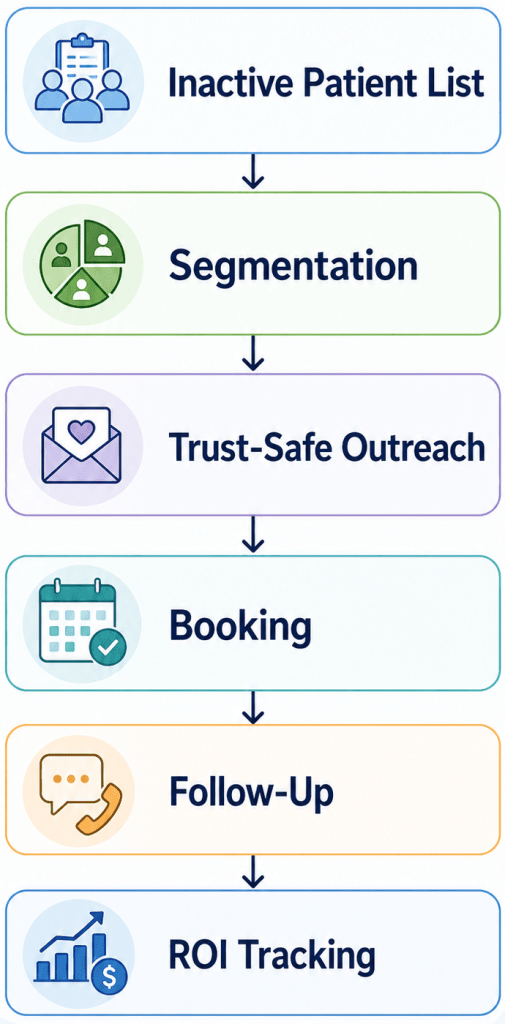
The best patient reactivation strategies for medical practices combine segmentation, personalized messaging, multichannel outreach, easy scheduling, PPC support, and performance tracking. The strongest results usually come from using these pieces together.
Segmentation is the foundation. A patient who missed a recent appointment may only need a quick SMS. A patient who has not visited in two years may need a softer message that reintroduces the practice and removes friction. A patient with an incomplete treatment plan may need a phone call from a trained team member who can answer questions.
Email and SMS work well together when used carefully. Email is better for slightly longer explanations, educational reminders, and practice updates. SMS is better for short prompts, scheduling links, and simple replies. Phone calls can help when the patient has higher care value, more complex needs, or unanswered concerns.
Direct mail can still be useful when digital contact information is outdated or when the patient demographic is less responsive to email and SMS. It can also feel less intrusive because it does not interrupt the patient in real time.
PPC can support reactivation when patients search for the practice again or look for services the practice offers. Branded search campaigns, service-based campaigns, and dedicated landing pages can help returning patients find a simple path back. However, healthcare advertisers need to be careful with targeting and ad copy because Google Ads has healthcare policies and restrictions around sensitive health topics.
What Are the Best Patient Reactivation Email and SMS Templates?
The best patient reactivation email and SMS templates are short, clear, friendly, and focused on helping patients take the next step without pressure. They should avoid sensitive details and give patients an easy way to respond.
A good template does not need to sound clever. It needs to sound safe, useful, and human. The patient should immediately understand who is contacting them, why the message matters, and what they can do next.
Soft check-in SMS template:
“Hi [First Name], this is [Practice Name]. It’s been a while since we’ve seen you, and we’re here when you’re ready. You can schedule a visit here: [Link]. Reply STOP to opt out.”
Preventive care email template:
Subject: A quick reminder from [Practice Name]
“Hi [First Name],
We’re reaching out to help patients stay current with their routine care. If you would like to schedule your next visit, you can use this link: [Link]. Our team is also happy to help if you have questions before booking.”
Missed appointment follow-up SMS template:
“Hi [First Name], this is [Practice Name]. We noticed your last appointment was not rescheduled. You can choose a new time here: [Link], or reply if you need help.”
Final reminder email template:
Subject: We’re here when you’re ready
“Hi [First Name],
We wanted to send one final reminder in case you would like to reconnect with [Practice Name]. You can schedule online here: [Link], or contact our team with any questions. We’re happy to help whenever the timing is right.”
The best templates avoid phrases that sound accusatory, overly urgent, or too specific. Do not expose sensitive health conditions in subject lines, SMS previews, or voicemail messages. For texts, practices should also pay attention to consent and opt-out expectations under applicable communication laws and internal policies.
Is Patient Reactivation Marketing HIPAA Compliant?
Patient reactivation marketing can be HIPAA compliant when practices protect patient information, minimize sensitive details, use appropriate communication methods, and work with compliant vendors. However, compliance depends on the message, the purpose, the data used, the channel, and the vendor relationship.
HHS explains that HIPAA generally requires authorization for uses or disclosures of protected health information for marketing, with certain exceptions for treatment and health care operations. HHS also states that appointment reminders are considered part of treatment and can be made without authorization.
That distinction matters. A neutral reminder to schedule care may be treated differently from a promotional campaign using protected health information to encourage a paid service. Practices should review campaign intent before launch and involve a compliance lead or legal counsel when there is uncertainty.
Practices should also evaluate vendors. If a marketing platform, texting system, CRM, call center, or analytics provider handles protected health information on behalf of the practice, a business associate agreement may be required. The practice should know what data is shared, where it is stored, who can access it, and how opt-outs are handled.
Compliance is not only about avoiding penalties. It is also about protecting patient confidence. Even a technically permissible message can damage trust if it feels too personal, too public, or too aggressive.
How Can PPC Support Reactivation Marketing for Medical Practices?
PPC can support reactivation marketing for medical practices by helping inactive patients find the practice again, promoting general appointment availability, and creating easier booking paths. It should be used carefully because healthcare advertising has stricter privacy and policy considerations than many other industries.
Branded search campaigns are often a safe starting point. If a previous patient searches for the practice name, provider name, or location, a branded ad can help them find the correct scheduling page quickly. This is especially useful when competitors are bidding on similar terms or when organic search results are crowded.
Service-based campaigns can also help when the ad copy stays general. For example, a practice may promote “annual wellness visits,” “primary care appointments,” or “dental cleanings” without implying that a specific user has a condition or medical need.
Landing pages are important. A returning patient should not have to dig through the website to book. A reactivation landing page can include appointment options, insurance information, office hours, location details, provider reassurance, and a clear scheduling button.
Practices should be cautious with remarketing and audience targeting. Google’s personalized advertising policy treats health as a sensitive interest category and instructs advertisers to remove certain advertiser-curated audiences when ads or destinations fall into that category.
What Metrics Should Medical Practices Track in a Patient Reactivation Campaign?
Medical practices should track marketing performance, appointment outcomes, revenue impact, and trust signals. Clicks and opens are useful, but they do not tell the full story.
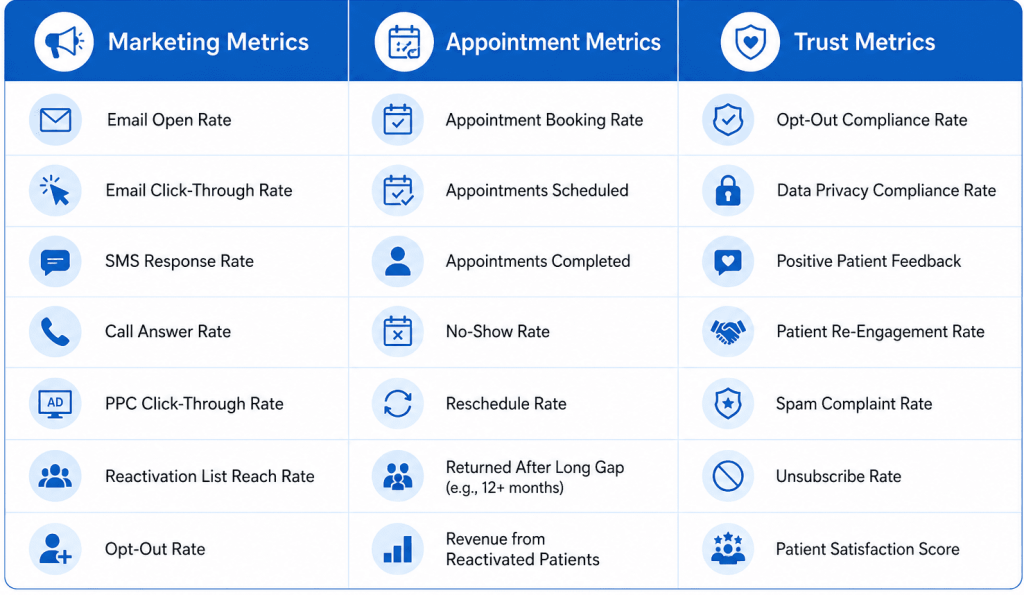
Marketing metrics include email open rate, click-through rate, SMS reply rate, call connection rate, landing page conversion rate, and form submissions. These numbers help show whether patients are engaging with the outreach.
Appointment metrics are more important for business outcomes. Track booked appointments, show rate, cancellations, completed visits, reactivation rate, and time from first message to scheduled appointment. These metrics show whether outreach is turning into real patient activity.
Financial metrics help prove ROI. Track campaign cost, cost per reactivated patient, revenue from reactivated patients, and projected lifetime value recovered. A simple formula is:
- Reactivation ROI = (Revenue from reactivated patients − campaign cost) ÷ campaign cost × 100
Trust metrics should not be ignored. Track opt-out rate, spam complaints, negative replies, unsubscribe rate, and staff-reported patient concerns. A campaign that fills the schedule but creates frustration is not a healthy long-term strategy.
When Should a Medical Practice Stop Contacting an Inactive Patient?
A medical practice should stop contacting an inactive patient when the patient opts out, asks not to be contacted, repeatedly ignores outreach, or no longer fits the campaign criteria. More follow-up is not always better.
Respecting opt-outs is essential. The FCC has stated that robocallers and robotexters must honor do-not-call and consent revocation requests as soon as practicable and no later than 10 business days from receipt.
Practices should also create suppression rules. Remove invalid phone numbers, bounced emails, duplicate records, deceased patients, patients who moved away, and patients who requested no further communication. Suppression lists protect both compliance and patient experience.
If a patient responds negatively, the practice should not keep marketing to them as if nothing happened. That may be a service recovery opportunity. A trained team member may need to acknowledge the concern, document the issue, and help resolve the problem.
The best reactivation systems know when to pause. A respectful campaign gives patients a clear path back, but it also respects their decision not to return.
FAQ
How long before a patient is considered inactive?
A patient is usually considered inactive when they have not visited, scheduled, or responded within a defined period, such as 12, 18, or 24 months. The right timeframe depends on the practice type and service cycle.
Is patient reactivation cheaper than new patient acquisition?
Patient reactivation is often more efficient than new patient acquisition because the practice is contacting people who already have a relationship with the provider. However, the final cost depends on list quality, outreach channels, staff follow-up, and campaign execution.
Can medical practices text inactive patients?
Medical practices may be able to text inactive patients when they follow HIPAA, consent, opt-out, and applicable communication rules. Messages should be brief, privacy-conscious, and easy to opt out of.
What should patient reactivation messages avoid?
Patient reactivation messages should avoid shame-based language, sensitive diagnosis details, exaggerated urgency, public disclosure of private information, and overly promotional claims. The message should feel helpful rather than invasive.
Should practices offer discounts to reactivate patients?
Discounts can work for some elective or cash-pay services, but they should not be the default strategy. Many patients are more motivated by convenience, reassurance, insurance clarity, and simple scheduling.
Can PPC be used for patient reactivation?
Yes, PPC can support reactivation through branded search, general service campaigns, and landing pages for returning patients. Practices should avoid ad copy or targeting that implies knowledge of a person’s private health condition.
How many times should a practice follow up with a lapsed patient?
A short sequence of three to five touchpoints is often enough for many campaigns. The practice should stop sooner if the patient responds, books, opts out, or asks not to be contacted.
What makes a patient reactivation campaign successful?
A successful campaign brings inactive patients back while protecting trust. It should increase booked appointments, maintain a healthy show rate, produce measurable ROI, and keep opt-outs or complaints low.
Conclusion
Reactivation marketing for medical practices is not just a way to fill open appointment slots. It is a structured way to reconnect with patients who may still trust the practice but have fallen out of the care routine.
The most effective campaigns are segmented, respectful, easy to act on, and carefully measured. They use email, SMS, phone, PPC, and landing pages strategically, but they never sacrifice patient comfort for short-term volume.
When done well, patient reactivation helps practices recover missed revenue, improve continuity of care, and strengthen relationships with people who already know the provider. The key is to make the patient feel invited back, not pushed back.
Why Visiclix is Your Ideal Choice for Reactivation Marketing for Medical Practices?
Visiclix helps medical practices reconnect with inactive patients through thoughtful, performance-driven marketing strategies. Instead of relying on generic reminders or aggressive messaging, Visiclix focuses on campaigns that protect patient trust while improving appointment volume and measurable ROI.
With expertise in PPC, campaign strategy, landing pages, and conversion-focused healthcare marketing, Visiclix helps practices turn inactive patient lists into real growth opportunities. From message planning to performance tracking, Visiclix gives medical practices a smarter way to win back patients without making outreach feel intrusive.
Visiclix also understands that healthcare marketing requires more care than ordinary lead generation. Every campaign should consider patient privacy, platform rules, message tone, and the full journey from first touch to booked appointment.
Bring Lapsed Patients Back With Visiclix
Reconnect with inactive patients through a reactivation strategy built around trust, compliance, and measurable growth. Visiclix can help your medical practice create patient-friendly campaigns that turn missed opportunities into booked appointments.