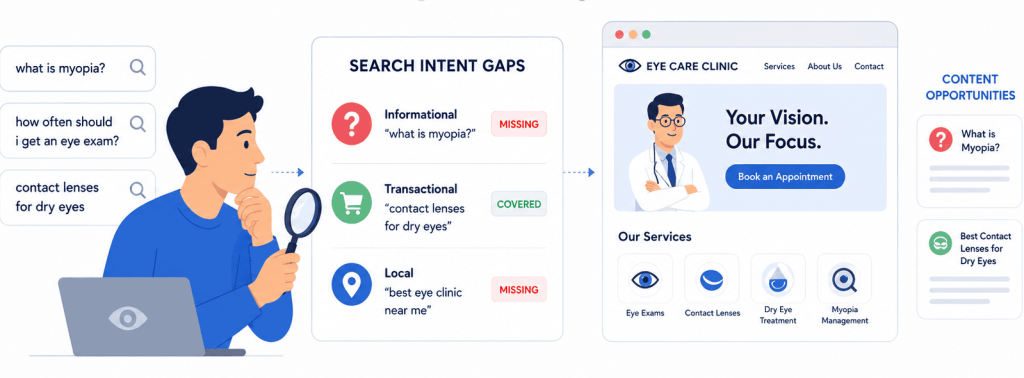
You find search intent gaps by comparing what prospective patients search for with the pages your optometry website actually provides. Review your Google Search Console queries, existing service and educational pages, and the search results for important topics. Then look for searches with no suitable page, queries landing on the wrong page, or several pages competing for essentially the same patient need.
This is the purpose of optometry search intent mapping: giving each meaningful search a clear destination instead of publishing content around keywords without considering what the patient actually wants.
For most practices, the gaps fall into three categories—missing intent, mismatched intent, and overlapping intent. Finding them shows you where new content is needed and, just as importantly, where existing pages should be improved rather than replaced.
What Counts as a Search Intent Gap for an Optometry Practice?
A search intent gap exists when a meaningful patient search does not have one clear page that properly satisfies it.
Consider the difference between “dry eye symptoms” and “dry eye treatment near me.” The first search is primarily educational. The second suggests that the patient may be looking for a provider or treatment option. Sending both searchers to the same generic page can create a mismatch.
The same applies to searches such as “pediatric optometrist near me,” “does insurance cover eye exams,” or “how does myopia control work.” Different questions. Different jobs for your content.
That is why an intent gap is broader than a keyword gap. Several keywords can represent the same underlying need. Visiclix’s guide to creating an SEO keyword map for eye care services explains how those keyword themes can then be assigned to individual pages.
How Should You Inventory Your Website Before Mapping Intent?
Start by listing the pages that already exist. Include your homepage, service pages, location pages, doctor profiles, insurance information, educational articles, FAQs, and contact or scheduling pages.
For each URL, record its topic, page type, target service, location if relevant, current search queries, intended patient need, and primary conversion action.
Then ask one simple question:
What job is this page supposed to do for the patient?
An appointment-focused dry eye service page has a different job from an article explaining why dry eye symptoms occur. Trying to make one URL perform both jobs can weaken clarity.
Visiclix explores this distinction further in its guide to service pages versus blog posts for eye care SEO, where commercial topics are separated from question-driven educational content.
How Can Google Search Console Reveal Missing or Mismatched Intent?
Google Search Console is one of the most useful places to find gaps because its Performance report shows the queries that generated impressions and clicks for your site, along with CTR and average position. You can also analyze performance by page.
Look for patterns such as:
- Valuable queries receiving impressions but few clicks
- Relevant searches ranking just outside your strongest positions
- A blog post appearing for an appointment-ready service search
- Your homepage appearing where a specialized service page would make more sense
- Multiple URLs receiving visibility for the same search theme
Suppose “myopia control near me” repeatedly generates impressions, but Google is showing a broad pediatric eye-care page. That can signal an opportunity to evaluate whether a dedicated myopia-control page would satisfy the searcher more completely.
Informational queries might reveal a different gap. “How does myopia control work?” could justify educational support content that links naturally to the relevant service page.
Practices can use Visiclix’s SEO services for optometrists to examine organic visibility more systematically. Paid-search data can help, too: Google says its search terms reporting shows the searches that triggered ads, creating another useful source of real patient language. Visiclix also provides Google Ads management for eye care practices.
How Do Search Results Show What Type of Page Google Expects?
Search the query yourself and study the pattern of results.
Are you seeing local results, individual practice service pages, educational guides, provider directories, videos, or another format? The composition of the SERP gives you practical evidence about what Google currently considers relevant to that search.
For local searches, this matters even more. Google says local results are influenced primarily by relevance, distance, and prominence, with relevance referring to how closely a business matches what someone searches for.
So, if a treatment-focused local search predominantly produces clinic and service results, another broad educational article may be the wrong asset. If a symptom-based question produces detailed educational resources, forcing that topic onto a short commercial landing page may also miss the mark.
How Can You Spot Intent Overlap and Keyword Cannibalization?
Intent overlap occurs when several pages are competing to solve essentially the same searcher problem.
Imagine an optometry website with separate URLs for “eye exams,” “comprehensive eye exams,” and “annual vision exams.” If the pages contain similar information, target similar searches, and use almost identical calls to action, there may not be enough distinction to justify all three.
Search Console can help identify cases where several URLs receive visibility for the same query theme. Also compare their titles, H1s, content, and conversion purpose.
The answer is not automatically to delete pages. You may consolidate closely duplicated content, redefine one page around a genuinely different need, strengthen internal linking, or clarify which URL should be the primary destination. Google recommends logical site structure and links between relevant pages, while its canonical guidance addresses cases involving duplicate or highly similar URLs.
Which Search Intent Gaps Should an Optometry Practice Fix First?
Not every content gap deserves the same priority.
A practical framework is:
Patient intent × business value × existing visibility × effort
Start with high-intent services that have no strong dedicated page. Then evaluate important queries landing on mismatched pages, valuable topics affected by page overlap, and pages already earning impressions but underperforming.
After that, expand into informational content supporting your core services.
A useful optometry search intent mapping process therefore prioritizes business outcomes—not simply whichever keyword has the largest estimated search volume. A specific specialty-care search from someone looking for a provider may be more commercially meaningful than a broad topic generating substantially more curiosity-driven traffic.
And once visitors arrive, the website still has to make the next step clear. Visiclix’s website design and hosting services for eye care practices can help connect search visibility with a stronger patient experience.
FAQ
How often should an optometry website review its search intent map?
Review it periodically and whenever the practice adds an important service, provider, location, insurance option, or major group of new content. Search behavior and search results can change, so intent mapping works best as an ongoing process rather than a one-time spreadsheet exercise.
Can one optometry page target more than one search intent?
Yes, when the intents are closely related and can be satisfied naturally by one page. But substantially different needs—such as learning about a condition versus finding a clinic to book treatment—often benefit from different content experiences.
What Is the Difference Between Keyword Mapping and Search Intent Mapping?
Keyword mapping assigns search terms or keyword themes to particular URLs. Search intent mapping goes one step deeper by identifying why the person is searching and determining which page type, information, and next action best serve that need.
Can Search Intent Mapping Improve Optometry PPC Campaigns?
Yes. Search-intent findings can improve landing-page alignment and help organize campaigns around different patient needs. The relationship can also work in reverse: Google Ads search-term data can reveal queries and language worth investigating for organic content opportunities.
What Should You Do With the Search Intent Gaps You Find?
A useful intent audit should leave every important patient search with a clear destination.
Sometimes that means building a new service page. Sometimes the better answer is rewriting an existing page, combining overlapping content, changing internal links, or creating a supporting article that handles an informational question separately.
Start with the services that matter most to your practice. Fix the clearest mismatches first, measure what changes, and expand from there. Google’s guidance consistently emphasizes creating content for people and organizing websites so users and search engines can understand how important pages relate to one another.
Why Visiclix Is Your Ideal Choice for Optometry Search Intent Strategy?
Visiclix specializes in digital marketing for eye-care businesses, allowing its SEO strategy to focus on the way real patients move from questions to provider searches and appointments. Rather than treating rankings as an isolated metric, Visiclix can connect content strategy with SEO, PPC, website performance, and patient acquisition. That makes it easier to distinguish between a visibility problem, a content problem, and a landing-page problem.
With optometry search intent mapping, Visiclix can help identify missing service opportunities, mismatched pages, overlapping content, and patient questions your current website is not addressing clearly. Its broader digital marketing services for eye care professionals also make it possible to coordinate organic search insights with paid campaigns and conversion strategy. The result is a website built around the searches most relevant to sustainable practice growth.
Ready to Find the Search Intent Gaps Visiclix Can Help You Fix?
Your practice may already be appearing for valuable searches without having the right pages in place to capture the opportunity. Visiclix can help evaluate your search visibility, existing content, and landing-page strategy to identify where the strongest gaps exist.