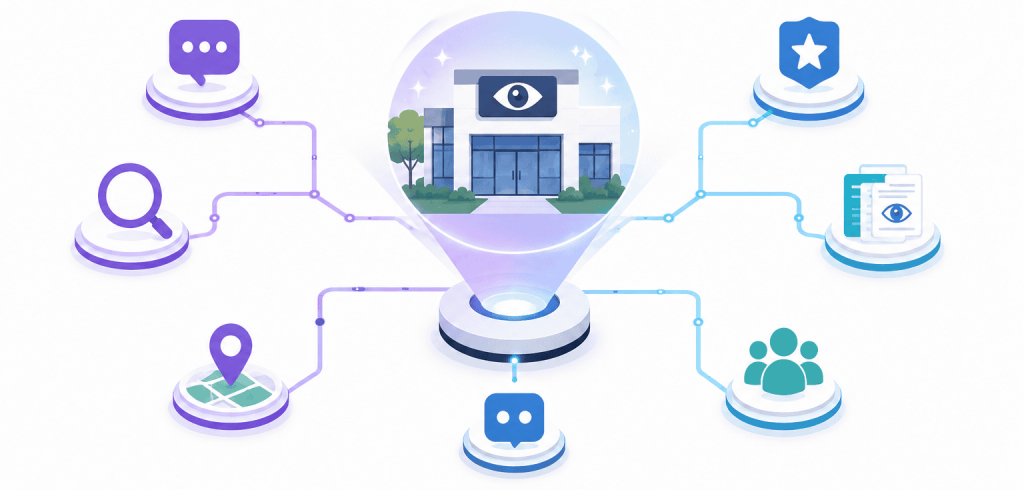
Eye clinics can improve their visibility in AI-driven patient research by making their websites easy to crawl, publishing clear answers to real patient questions, maintaining accurate clinic and provider information, and building credible signals across the web. The goal is simple: help search systems understand who your practice is, what you treat, where you operate, and why your information deserves attention.
That is the core of AI search optimization for eye clinics. It does not replace traditional SEO. Google says its generative search experiences, including AI Overviews and AI Mode, still rely on core Search ranking and quality systems, which makes strong SEO fundamentals as important as ever.
For eye clinics, this creates an opportunity to appear earlier in a patient’s research journey—sometimes before that patient has even decided which type of eye doctor or treatment they need.
How Is AI Changing the Way Patients Research Eye Care?
Patients no longer have to type a short phrase, open ten search results, and piece together an answer themselves. AI-powered search can help them explore more detailed questions, compare options, and continue researching through follow-up queries.
A patient might ask, “What kind of eye doctor should I see for recurring flashes and floaters?” Then: “What tests should I expect?” Then: “How do I choose a clinic near me?”
Google says AI Mode can handle nuanced questions that previously might have required multiple searches, while AI Overviews can summarize complex topics and provide supporting links for further exploration.
That makes early-stage educational content more valuable. Clinics should think beyond ranking for “eye doctor near me” and consider the entire research path that leads someone toward an appointment.
Visiclix explores this specifically in its guide to showing up in Google AI Overviews for optometry patient searches.
What Signals Matter Most for AI Search Optimization for Eye Clinics?
No single factor guarantees inclusion in an AI-generated answer. Instead, clinics need a collection of signals that make their website easier to discover, interpret, and trust.
Clear Relevance
Every important page should clearly communicate its purpose. A cataract surgery page should explain the procedure, candidates, consultation process, recovery considerations, and relevant doctors—not simply mention that the clinic offers cataract surgery.
Demonstrable Expertise
Eye-care content can influence health decisions, so credibility matters. Google advises giving particular attention to experience, expertise, authoritativeness, and trust for topics that could affect health or safety. Provider biographies, credentials, medical reviewers, original explanations, and transparent authorship can all make content more useful to patients.
Consistent Business Information
Your clinic name, address, phone number, hours, website, and service information should remain accurate across your website and external profiles. Google specifically recommends keeping Business Profile information current for visibility across Search experiences.
A strong reputation management and local citation strategy can support that consistency while helping clinics manage reviews and third-party listings.
What Content Helps an Eye Clinic Become More Useful to AI Search?
Useful content follows the questions patients actually ask.
Instead of creating another broad page called “Eye Care Services,” build deeper resources around real decisions:
- What causes sudden blurry vision?
- When are flashes and floaters an emergency?
- Who is a good candidate for LASIK?
- What happens during a cataract consultation?
- When should someone see an ophthalmologist instead of an optometrist?
- What should a patient bring to a first eye appointment?
Answer the question quickly, then add context. Explain the “why,” provide practical examples, clarify important limitations, and identify when professional care is appropriate.
This approach aligns with Google’s recommendation to create unique, useful, people-first content rather than simply reproducing information already available elsewhere.
Content also needs an effective patient experience after the click. Fast pages, intuitive navigation, mobile usability, and obvious appointment paths should work alongside the educational content. Visiclix’s website design and hosting services for eye care practices focus on those elements.
Visual content idea: Create an “AI Patient Research Journey” graphic showing:
Patient question → AI/search discovery → educational content → clinic validation → appointment decision
How Can Local Eye Clinics Strengthen Their Entity and Location Signals?
For a local clinic, being understood online means clearly establishing three things: who you are, what you do, and where patients can receive care.
Start with a verified, complete Google Business Profile. Keep the practice category, location, phone number, operating hours, website, and other information accurate. Google says local results are primarily influenced by relevance, distance, and prominence, while complete business information can help it better understand how a business matches a search.
Then reinforce those details on the clinic website. Build legitimate location pages, detailed doctor profiles, specialty pages, and treatment pages. Connect related pages with useful internal links.
Structured data can also help Google understand business details, but it should accurately reflect visible information rather than being treated as a shortcut. Google’s LocalBusiness documentation, for example, supports information such as business hours, telephone details, and location data.
What Technical SEO Issues Can Keep an Eye Clinic Out of AI-Driven Search?
Before an eye clinic can earn meaningful visibility, search engines need access to its content.
Google’s minimum technical requirements include allowing Googlebot to access the page, returning a working HTTP response, and providing indexable content. For inclusion as a supporting link in Google’s AI search features, a page must also be indexed and eligible to appear in regular Search with a snippet.
Common problems include blocked crawling, orphaned treatment pages, weak internal linking, duplicate location pages, outdated information, or important content that search systems cannot easily access in textual form.
And no, clinics do not need a secret “AI schema.” Google explicitly states that no special schema.org markup or new AI-specific machine-readable file is required for AI Overviews or AI Mode.
A broader digital marketing strategy for eye care should therefore treat technical SEO, content, local visibility, reputation, and conversion as connected parts of the same patient-acquisition system.
How Should Eye Clinics Measure AI Search Visibility and Patient Impact?
Visibility alone is not the business outcome.
Start with search indicators such as impressions, landing-page visibility, branded-search activity, rankings for patient questions, and referrals from relevant search or AI platforms. As of 2026, Google is also rolling out a dedicated Generative AI performance report in Search Console that can show impressions from AI Overviews and AI Mode. Availability is still being expanded, so not every property may see it yet.
Then connect those signals to actual patient acquisition: calls, appointment requests, consultation forms, conversion rates, and qualified inquiries by service line.
Paid search can complement this strategy when a patient reaches a high-intent stage. Visiclix’s Google PPC services for eye care practices focus on patient-intent targeting, optimized landing pages, conversion measurement, and campaign ROI.
Visual content idea: Add a simple scorecard:
AI/Search Visibility → Website Engagement → Patient Inquiry → Appointment
FAQ
Can an eye clinic guarantee that an AI search system will recommend it?
No. A clinic can improve its discoverability, relevance, authority, and technical accessibility, but legitimate marketers cannot guarantee inclusion in a particular AI-generated result. Google similarly states that meeting its requirements does not guarantee crawling, indexing, or serving.
Is AI search optimization different from traditional SEO?
It changes some of the search experiences patients encounter, but the fundamentals overlap heavily. Google specifically says established SEO best practices remain relevant to its generative AI features.
Does an eye clinic need special schema for AI search?
No special AI schema is required for Google’s AI Overviews or AI Mode. Standard structured data can still help search engines understand a page when it accurately represents visible content.
Do patient reviews matter for AI visibility?
Reviews are valuable for patients and local search credibility, but they should not be presented as a universal direct ranking factor for every AI system. Google does confirm that review quantity and positive ratings can contribute to local prominence and local ranking.
How often should an eye clinic update its content?
Update content when something meaningful changes—medical guidance, physicians, services, technology, locations, policies, or patient questions. Avoid changing pages merely to create artificial freshness. Useful accuracy matters more.
Staying Visible as Patient Search Keeps Changing
Eye clinics do not need to chase every new acronym attached to AI search. They need a digital presence that clearly communicates expertise, answers meaningful patient questions, reinforces accurate clinic information, and makes taking the next step easy.
A useful test: if a potential patient were researching one of your priority treatments through an AI-assisted search today, could they quickly understand who you are, why they should trust you, and how to schedule care?
If not, there is work to do.
Why Visiclix Is Your Ideal Choice for AI Search Optimization for Eye Clinics?
Visiclix specializes in digital marketing for optometrists, ophthalmologists, and eye-care practices, bringing SEO, web design, reputation management, paid search, and patient acquisition together rather than treating them as disconnected tactics. That industry focus helps align search strategy with the questions, services, and decisions that actually matter to eye-care patients.
More importantly, visibility should lead somewhere. Visiclix builds strategies around measurable practice growth, helping eye clinics connect stronger search presence with useful content, conversion-focused websites, reputation signals, and campaigns designed to generate patient inquiries and appointments.
Help More Patients Discover Your Practice With Visiclix
AI is changing how patients discover and evaluate eye-care providers. Your practice’s digital strategy should be ready for that shift.
Contact Visiclix to review your current online presence and identify opportunities to strengthen your clinic’s search visibility, patient journey, and digital growth strategy.