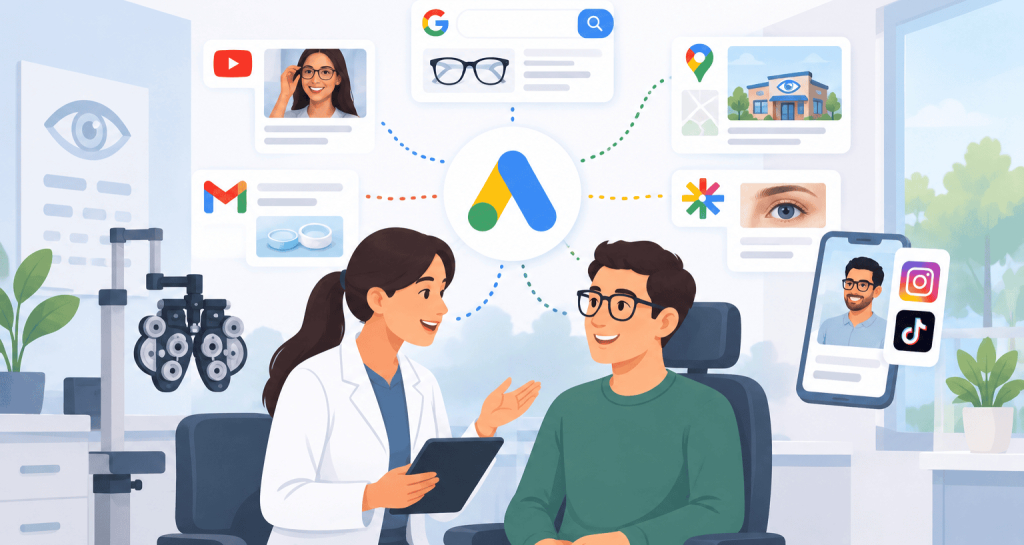
Performance Max for optometrists can help practices reach prospective patients across Google’s advertising ecosystem while automating bidding, audience discovery, creative delivery, and campaign optimization around specific conversion goals. Instead of managing separate campaigns for every channel, an optometry practice can use one campaign to appear across Search, Maps, YouTube, Display, Discover, Gmail, and other eligible Google inventory.
That broader reach can be valuable, but automation alone does not guarantee better patients or lower acquisition costs. Results depend on what the campaign is told to optimize for, the quality of its conversion tracking, its creative assets, landing pages, and the controls placed around irrelevant traffic. For that reason, Performance Max is usually better viewed as part of a broader Google Ads strategy rather than an automatic replacement for well-performing Search campaigns.
What Does Performance Max Automate Inside Google Ads?
Performance Max automates many of the decisions involved in distributing an advertising budget across Google’s inventory. Google AI can assist with bidding, audience selection, creative combinations, attribution, and determining where ads are most likely to contribute to a campaign’s defined conversion goal.
For an optometry practice, that might mean showing one combination of messaging to a patient searching for vision care and another creative treatment to someone encountered through YouTube or Display inventory.
The key distinction is that automated does not mean unattended.
The practice still has to define what success looks like. If the campaign is optimized around low-value website actions, Google may learn how to generate more of those actions rather than more qualified patients. Good automation starts with good instructions, accurate data, and ongoing review.
Where Can Performance Max Reach Potential Optometry Patients?
Performance Max can reach potential patients across Search, Maps, YouTube, Display, Discover, and Gmail through one campaign.
That matters because patients do not always move directly from a search query to an appointment. Someone may first encounter educational content, notice the practice again while browsing online, then search for the practice or a specific eye care service later.
Search and Maps can be particularly useful when a patient has immediate intent, such as looking for an eye exam or an eye doctor nearby. YouTube can support awareness and education around services that patients may need explained before they act. Display inventory can extend visibility beyond the search results.
This is where a broader creative strategy becomes important. Practices can support their paid search efforts with targeted display advertising and video advertising that communicate services visually instead of relying entirely on text ads.
How Should Optometrists Set Up Performance Max to Attract Better Leads?
A strong Performance Max for optometrists campaign should be built around patient-quality signals, not every action that happens on the website.
Choose conversions that reflect patient value
Google recommends using meaningful lead-generation goals such as contact requests, submitted forms, booked appointments, qualified leads, and converted leads. It also recommends optimizing toward deeper funnel conversions when enough reliable data is available.
For an optometry practice, a scheduled appointment may be considerably more valuable than someone simply viewing the contact page. Treating both actions as equal can send poor signals to the bidding system.
Give Google useful signals
Audience signals can help Google understand which types of users may be valuable, although they are suggestions rather than rigid targeting restrictions. Performance Max may still serve ads outside those audiences when its models predict a conversion is likely.
Search themes can also give Google additional information about the queries patients may use. Google currently allows up to 50 search themes per asset group.
Build service-specific creative
Creative should reflect what the practice actually wants to grow. Eye exams, dry eye care, pediatric eye care, specialty lenses, myopia management, and other services may require different benefits, imagery, and calls to action.
Then make sure the destination supports the message. A professionally structured eye care website and landing-page experience can help turn paid traffic into meaningful patient inquiries instead of sending visitors to a generic page with no obvious next step.
How Can Optometrists Prevent Performance Max From Wasting Ad Spend?
Optometrists can control wasted spend by reviewing search behavior, excluding irrelevant traffic, managing branded searches, controlling landing-page expansion, and monitoring where campaigns are actually generating results.
One major change from earlier versions of Performance Max is the level of control now available.
Campaign-level negative keywords can prevent PMax ads from appearing for unwanted queries on Search and Shopping inventory. Brand exclusions can also help practices separate branded searches from broader acquisition efforts.
Final URL expansion deserves attention too. It is enabled by default and can direct traffic to a page Google determines is more relevant to the user’s intent. That can improve relevance, but a practice can turn it off or exclude specific URLs when certain pages should not receive paid traffic.
Performance Max also provides channel performance reporting, giving advertisers visibility into how different Google channels contribute to campaign goals.
So, not entirely hands-off. Someone still needs to review what the automation is doing and decide whether those decisions support the practice’s business goals.
Which Metrics Show Whether Performance Max Is Bringing in Real Patients?
The most useful Performance Max metrics are the ones closest to actual patient acquisition.
Clicks and form submissions provide context, but they do not tell the whole story. An optometry practice should look further down the funnel at measurements such as:
- Qualified patient inquiries
- Booked appointments
- Cost per qualified lead
- Cost per booked appointment
- Lead-to-appointment conversion rate
- Phone call quality
- Conversion value
- Search-term performance
- Channel-level contribution
Google recommends using accurate conversion tracking and, where possible, feeding deeper lead-quality information back into its systems. For value-based bidding, it advises using a conversion goal close to the final sale when that goal has sufficient conversion volume.
The principle is simple. If the algorithm only knows who filled out a form, it learns to find form fillers. If it receives reliable signals about who became a qualified patient, it has better information for future optimization.
When Should Optometrists Use Performance Max Alongside Search Campaigns?
Performance Max is often most useful when a practice already has dependable conversion tracking, meaningful campaign goals, strong creative assets, and enough budget to test expansion beyond tightly controlled keyword traffic.
Google specifically describes Performance Max as a complement to keyword-based Search campaigns. When an eligible exact-match Search keyword is identical to the user’s query, the Search campaign is prioritized over Performance Max.
That gives optometrists room to use both.
Search can maintain tighter control around highly valuable patient queries, while Performance Max explores additional opportunities across Google’s inventory. The decision should ultimately come down to qualified-patient economics rather than which campaign generates the cheapest click.
Testing also requires patience. Google recommends allowing Performance Max to run for at least six weeks in general optimization guidance, while its lead-generation guidance notes that learning may take one to two weeks or as long as six weeks for more complex or lower-volume campaigns. Frequent major changes during that period can interfere with learning.
Performance Max therefore works best as one piece of a coordinated digital marketing strategy for eye care practices.
FAQ
Is Performance Max better than Google Search Ads for optometrists?
Not automatically. Search campaigns provide strong keyword-level control for high-intent searches, while Performance Max can expand reach across several Google channels. Many practices can benefit from using the two together and comparing them based on qualified leads, appointments, and acquisition cost rather than clicks alone.
Can Performance Max target patients near an optometry practice?
Yes. Performance Max campaigns include location settings, and eligible campaigns can reach users through Google Maps as well as other Google inventory. Practices should still review geographic settings carefully so the campaign reflects the area they can realistically serve.
Can optometrists add negative keywords to Performance Max?
Yes. Google supports campaign-level and account-level negative keywords for Performance Max. These negative keywords apply to Search and Shopping inventory and can help prevent ads from serving for irrelevant queries.
How long should an optometry practice test Performance Max?
Google generally recommends giving a Performance Max campaign enough time to learn before judging results. Its optimization guidance recommends at least six weeks, although learning duration can vary based on conversion volume, account complexity, and campaign inputs.
Does Performance Max replace manual Google Ads management?
No. Google automates many bidding, targeting, and creative decisions, but marketers still need to manage conversion goals, budgets, creative inputs, exclusions, landing pages, reporting, and lead quality. Human oversight remains important because the platform cannot independently determine whether a lead was truly valuable to the practice unless it receives meaningful data.
Is Performance Max Worth Testing for Your Optometry Practice?
Performance Max can be worth testing when an optometry practice wants to expand beyond traditional keyword-driven advertising and already has the measurement foundation needed to tell Google what a valuable patient looks like.
Before moving significant budget, review your Search performance, conversion tracking, appointment data, landing pages, creative assets, and current patient acquisition costs. Then test with a defined objective. The goal is not to automate more advertising simply because the technology exists. It is to use automation where it produces measurable patient growth.
Why Visiclix Is Your Ideal Choice for Performance Max for Optometrists?
Visiclix specializes in digital marketing for eye care practices, giving its team context that a general advertising agency may need time to develop. Its Google Ads approach considers patient search intent, campaign targeting, landing-page relevance, conversion performance, and appointment growth rather than treating PPC as an isolated traffic source.
That eye care focus is especially valuable when automation enters the mix. Performance Max still needs clear goals, reliable measurement, strong creative, and continuous evaluation. Visiclix can combine those elements with broader paid media and website strategy so campaign decisions stay connected to the outcomes that matter most: qualified inquiries, booked appointments, efficient acquisition costs, and sustainable practice growth.
Ready to Put Performance Max to Work With Visiclix?
Want to know whether Performance Max fits your current Google Ads strategy? Contact Visiclix to discuss your campaigns, patient acquisition goals, and opportunities to use paid search automation more effectively.