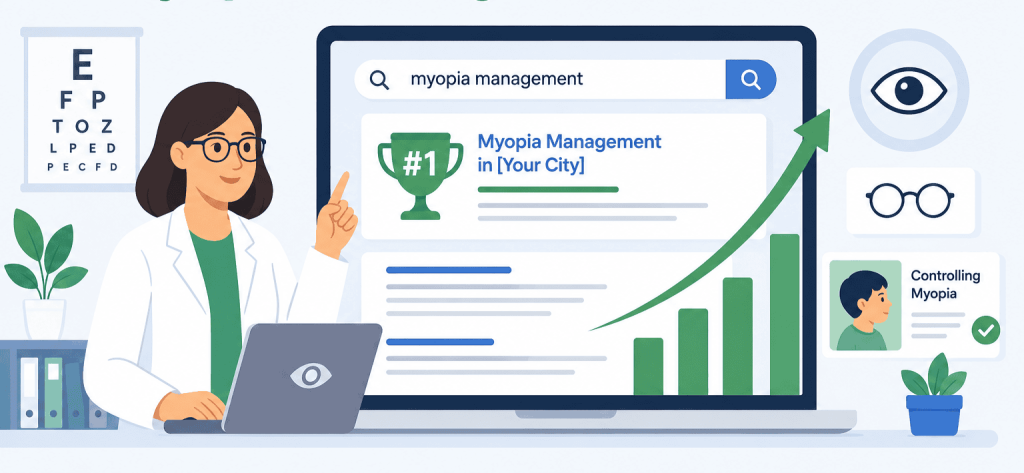
Optometry practices can rank for myopia management searches by creating a dedicated service page, answering the questions parents ask before choosing treatment, strengthening local search signals, and showing clear clinical expertise. Effective myopia management SEO brings these elements together so search engines can understand the service and families can confidently take the next step.
That distinction matters. Some parents are researching childhood myopia for the first time. Others already know about Ortho-K, atropine, or specialized contact lenses and are ready to compare providers. A strong search strategy must support both groups without turning the website into a collection of repetitive, keyword-heavy pages.
What Search Intent Should Optometry Practices Target?
Optometry practices should target searches across the entire patient journey—from early education to appointment-ready local queries.
Educational searches may include questions such as “What is myopia control?” or “Why is my child’s prescription getting worse?” Treatment-focused searches tend to mention Ortho-K, atropine, myopia-control contact lenses, spectacle lenses, axial length, or treatment costs. High-intent searches often include phrases such as “near me,” a city name, “specialist,” “consultation,” or “eye doctor.”
Each group needs a different kind of answer. A parent learning about progression needs reassurance and plain-language education. Someone comparing providers wants treatment options, credentials, costs, location information, and an obvious way to schedule.
Google recommends creating helpful, reliable content primarily for people rather than publishing pages designed only to manipulate rankings. It also encourages website owners to consider who created the content, how it was produced, and why it exists.
Which Pages Does a Myopia Management SEO Strategy Need?
A successful site needs one central service page supported by narrower treatment, location, cost, and educational resources.
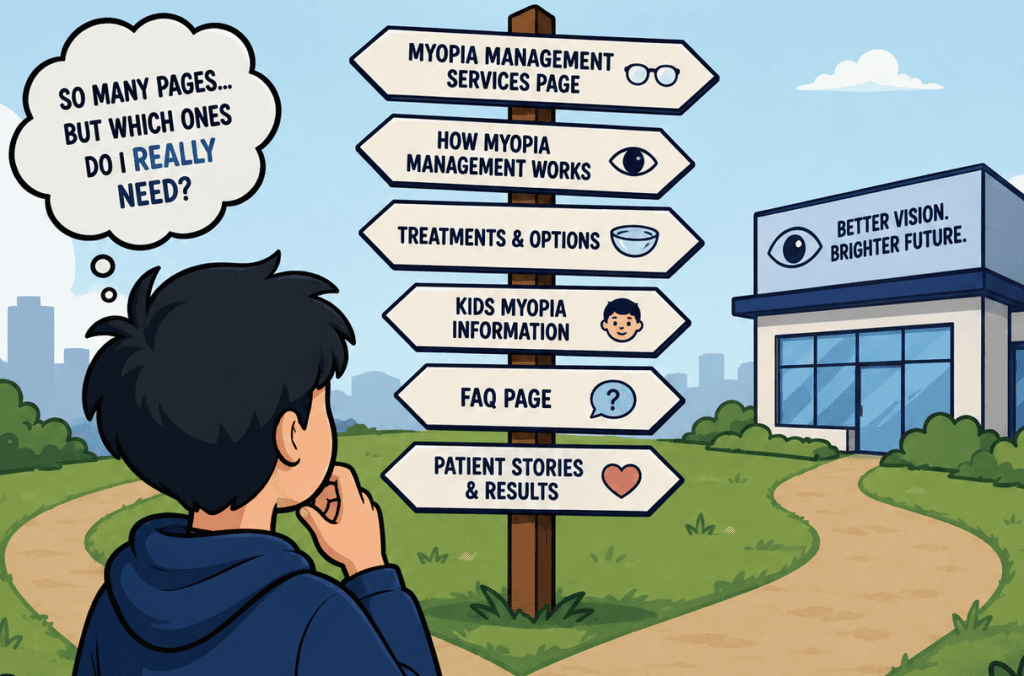
The main service page should provide a complete overview of the practice’s approach. Supporting pages can then explore individual options, such as Ortho-K, low-dose atropine, soft multifocal contact lenses, or specialized spectacle lenses. A cost or financing page may answer commercial questions, while educational articles can address progression, monitoring, candidacy, and follow-up care.
This structure prevents one page from becoming overloaded. It also helps the practice match a wider range of searches without publishing several pages that compete for the same topic.
Google’s SEO guidance recommends organizing websites logically, grouping related information, using descriptive URLs, reducing duplication, and linking to useful resources. A professional SEO strategy for optometrists can help determine which pages deserve separate treatment and which topics should remain consolidated.
How Should the Main Service Page Be Optimized?
The main page should immediately explain what the service is, who may benefit, and what parents should do next.
Near the top, include a concise explanation of myopia management in parent-friendly language. Follow it with the treatments the practice offers, the evaluation process, provider qualifications, monitoring approach, common questions, and a visible consultation call to action.
Helpful page elements may include:
- A descriptive title tag, meta description, and single H1
- Original photographs of the provider, office, and relevant equipment
- Clear explanations of treatment benefits, limitations, and candidacy
- Provider credentials and links to detailed biographies
- Cost, insurance, or financing information when available
- Testimonials presented in accordance with healthcare advertising rules
- Click-to-call buttons and a short appointment form
The page must also work well on a phone. Parents may abandon even strong clinical content when navigation is confusing, text is difficult to scan, or the appointment process feels cumbersome. Visiclix’s website design and hosting services focus on combining usability, performance, and professional presentation for eye care practices.
How Can Local SEO Reach Nearby Parents?
Local SEO helps connect a practice with families who live within a realistic traveling distance and are actively looking for care.
Start with an accurate, verified Google Business Profile. The practice’s name, address, phone number, hours, website, services, and primary category should remain complete and consistent. Add original office and team photographs, respond professionally to reviews, and link the profile to the most relevant page—not automatically to the homepage.
Google states that local results are primarily influenced by relevance, distance, and prominence. Complete and accurate business information makes it easier for Google to understand a business and match it with relevant local searches.
Practices serving several communities may create location pages, but each page should provide genuine local value. Include the office serving that community, travel information, provider availability, distinctive services, and locally relevant patient questions. Merely replacing one city name with another creates little value.
Consistent listings and thoughtful reputation management can further reinforce local credibility.
What Trust Signals Make Myopia Content More Credible?
Medical content becomes more credible when readers can identify who wrote it, who reviewed it, and what evidence supports it.
Every substantial clinical page should include a named author or reviewer, relevant professional credentials, and a review or update date. Claims about treatments should link to primary research, systematic reviews, recognized professional organizations, or established clinical guidance.
Balanced language is equally important. Explain which patients may be suitable, what monitoring involves, and why outcomes can vary. Avoid implying that one treatment works identically for every child.
A Cochrane living systematic review found evidence that several optical and pharmacological interventions may slow refractive progression and axial elongation, while also noting variation among studies and treatment results. That nuance belongs in patient education. Accurate content builds more confidence than exaggerated promises.
How Can Supporting Content Build Topical Authority?
Supporting articles allow the practice to answer focused questions that cannot be covered thoroughly on one service page.
Useful topics may include:
- When should a child be evaluated for myopia management?
- What happens during a myopia consultation?
- How are Ortho-K and soft myopia-control lenses different?
- Why do optometrists measure axial length?
- How often are follow-up appointments needed?
- What happens when treatment is discontinued?
- Is myopia management covered by insurance?
- How can parents compare treatment options?
Each article should answer its heading immediately, expand with practical context, and link to the central service page. Where appropriate, connect related articles to one another. Natural internal linking helps visitors continue their research and gives search engines clearer information about the relationship between pages.
Not every question requires a separate article. Closely related questions can be combined into one authoritative resource rather than divided into thin posts.
Which Technical and Conversion Elements Turn Visibility Into Appointments?
Search visibility produces limited value when visitors cannot load, understand, or act on the page.
The site should be mobile-responsive, secure, crawlable, and easy to navigate. Compress oversized images, use descriptive page titles, repair broken links, and make important information available as text rather than embedding everything inside graphics.
Appropriate structured data can give Google explicit information about the business, including its location, hours, and other details. Google recommends validating structured data and ensuring that marked-up information is accurate, visible to users, and accessible to its crawlers.
Conversion details matter just as much. Use a clear consultation CTA, click-to-call functionality, short forms, visible contact information, and reassuring language for parents who are still deciding. For practices seeking immediate visibility while organic pages mature, Google Ads management can support the same service with targeted paid campaigns.
How Should Practices Measure Search Performance?
Practices should measure qualified patient activity—not keyword positions alone.
Track organic visits to myopia pages, visibility for priority searches, Google Business Profile interactions, phone calls, form submissions, booked consultations, completed evaluations, and patient acquisition by source. Conversion rate by landing page can reveal whether visitors are finding the information they need.
A myopia management SEO campaign may produce more traffic while still underperforming commercially. For example, a general educational article may attract readers nationwide even though the practice serves one local area. Strong reporting separates informational visibility from appointment-ready demand.
Visiclix tracks search rankings, organic traffic, conversions, backlink quality, and engagement as part of its broader optometry SEO services.
Frequently Asked Questions
How long does it take to rank for myopia management searches?
The timeline depends on the website’s current authority, technical condition, local competition, content quality, and existing reputation. New pages may begin appearing relatively quickly, but meaningful and stable growth usually requires ongoing improvement rather than a one-time update.
Does every treatment need a separate webpage?
A separate page is appropriate when the treatment has distinct search demand and enough original information to support a useful resource. Closely related options can remain on one page when splitting them would create thin or repetitive content.
Can one service page rank in multiple cities?
It can appear for searches across a broader service area, particularly when the practice has strong local relevance and authority. Dedicated city pages should only be created when the practice can provide unique, location-specific information.
Should practices use both SEO and Google Ads?
Yes, when budget and capacity allow. Organic search can build sustainable visibility, while paid campaigns can generate more immediate exposure and provide useful information about which searches produce consultations.
What Should Your Practice Do Next?
Begin with the patient experience. Can a nearby parent find the practice, understand the available services, verify the provider’s expertise, and request an appointment without confusion?
Audit the central service page first. Then improve supporting content, local listings, technical performance, internal links, and conversion tracking. One connected system. Not a collection of isolated tactics.
Why Visiclix Is Your Ideal Choice for Myopia Management SEO?
Visiclix specializes in digital marketing for optometrists, ophthalmologists, and eye care practices. Its approach connects keyword research, content, website design, local visibility, user experience, paid advertising, and performance reporting. According to its company information, the team brings more than 25 years of digital marketing experience and develops custom strategies rather than relying on a single template.
For myopia management SEO, that industry focus helps translate complex clinical services into clear, patient-centered digital experiences. Practices can coordinate organic search with digital marketing packages, reputation support, website improvements, and paid campaigns while monitoring measurable outcomes. The result is a strategy aligned with the practice’s services, market, capacity, and growth goals.
Build Your Myopia Search Presence With Visiclix
Help more families discover your services before they choose another provider. Contact Visiclix for a free consultation to evaluate your website, local visibility, content structure, and patient conversion path.