
A patient intake marketing workflow is the system that connects a healthcare organization’s marketing promise with the real intake experience patients receive after they click an ad, call the office, book online, or submit a form. It includes the message that attracts the patient, the landing page that sets expectations, the call or form path that captures intent, the follow-up process that moves the patient toward scheduling, and the reporting that shows whether marketing activity actually produced a booked appointment.
This workflow matters because patient acquisition does not end at the click. A practice can have strong PPC campaigns, persuasive landing pages, and a healthy volume of inquiries, but still lose patients if the next step is slow, confusing, disconnected, or difficult to complete on mobile. Intake is one of the first real moments where a patient tests whether the practice can deliver the convenience, clarity, and trust promised in the ad.
For healthcare marketers, the goal is not simply to generate more leads. The goal is to create a smoother path from search intent to scheduled care. A strong patient intake marketing workflow helps align PPC strategy, landing page messaging, staff follow-up, scheduling, forms, compliance, and attribution so the practice can turn qualified interest into measurable patient growth.
What is a patient intake marketing workflow?
A patient intake marketing workflow is the structured process that turns a marketing-generated inquiry into a qualified, scheduled, and properly tracked patient opportunity. It is different from a standard patient intake process because it begins before the form is completed. It starts with the expectation created by the ad, search result, social post, referral source, or landing page.
A traditional patient intake process usually focuses on collecting patient information. That may include contact details, medical history, insurance information, consent forms, appointment reason, and provider preferences. Those steps are important, but they only explain what happens after a patient has already decided to engage.
A patient intake marketing workflow looks at the full journey. It asks whether the ad accurately reflects the service being offered, whether the landing page answers the patient’s most urgent questions, whether the call-to-action matches how the practice actually schedules patients, whether the form is easy to complete, whether staff follow up quickly, and whether the final appointment is tracked back to the campaign that generated it.
This is why intake should be treated as part of acquisition, not just administration. NexHealth describes patient intake as a foundation for building new patient relationships and notes that intake can be treated as the final step in acquisition and onboarding. That same idea becomes even more valuable when connected to PPC performance, because every lost call, abandoned form, or delayed follow-up can weaken the return on marketing spend.
How does patient intake fit into the healthcare marketing funnel?
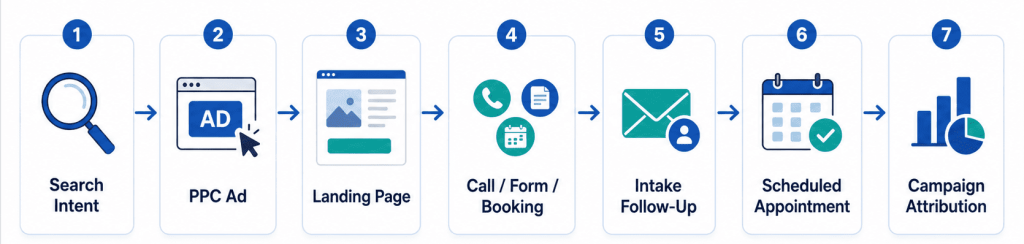
Patient intake fits into the healthcare marketing funnel as the conversion bridge between patient intent and scheduled care. It is the point where a prospective patient stops browsing and starts taking action.
At the top of the funnel, the patient may search for a symptom, treatment, provider type, location, insurance question, or appointment availability. In the middle of the funnel, they compare trust signals such as reviews, credentials, service pages, accepted insurance information, location convenience, and appointment options. At the conversion stage, they click, call, book, submit a form, or begin intake.
The intake workflow determines whether that intent keeps moving forward. Jotform’s healthcare intake UX article makes this point clearly: many teams can see ad performance, landing page conversions, and appointment requests, but the experience often breaks down after someone clicks to book. Long forms, unclear steps, mobile friction, and lack of confirmation can cause patients to leave before scheduling is complete.
That makes intake part of the funnel, not a separate back-office task. From the patient’s perspective, intake is not paperwork. It is the first operational proof that the practice is organized, responsive, and easy to work with. When intake feels confusing, the patient may question the quality of the entire practice experience.
Why do marketing expectations shape patient intake success?
Marketing expectations shape patient intake success because patients judge the intake experience against the promise that brought them in. If an ad promotes fast access, convenient scheduling, specific treatment availability, or an easy next step, the intake process has to support that promise.
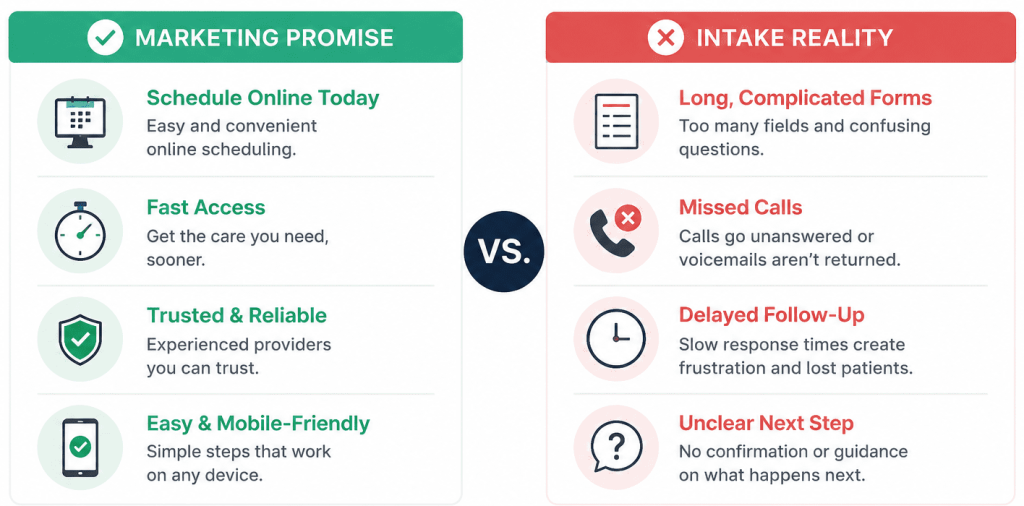
For example, a campaign that says “schedule online today” creates a clear expectation: the patient should be able to find availability, submit basic information, and receive confirmation without unnecessary friction. If the patient lands on a generic page, fills out a long form, receives no immediate next step, and waits days for a callback, the campaign may still record a lead, but the workflow has failed the patient.
The same issue happens when ad messaging and front-desk reality are misaligned. If PPC ads promote a service line that requires special screening, referral documentation, insurance verification, or provider-specific routing, intake staff need to know that before the lead comes in. Otherwise, patients may be asked repetitive questions, transferred multiple times, or told something that contradicts the landing page.
Better patient intake workflows start with better marketing expectations. Healthcare marketers should not write ads in isolation from intake capacity. They should understand appointment availability, payer mix, service eligibility, scheduling rules, provider coverage, and follow-up standards before launching high-intent campaigns.
What breaks when marketing and patient intake workflows are disconnected?
When marketing and patient intake workflows are disconnected, qualified patients can drop off after they have already shown intent. The practice may think it has a traffic problem, but the real issue may be a conversion leak inside intake.
A common breakdown is message mismatch. The ad promises one path, while the intake team offers another. A landing page may invite patients to request a consultation, but the staff may treat every inquiry like a general appointment request. A campaign may focus on a specific specialty, but the form may not ask the right routing questions. A paid search campaign may produce phone calls, but missed calls may never be tied back to the keyword, ad, or service line that generated them.
Another common breakdown is form friction. Patients may be asked to provide extensive information too early, complete forms that are not mobile-friendly, or answer questions that do not seem relevant to their immediate need. Jotform highlights this as a hidden funnel issue: patients may abandon when forms are long, poorly structured, not built for mobile, or unclear about how long the process will take.
Operational gaps create additional problems. Manual intake can increase errors, delay documentation, and create more work for front-desk staff. TeleVox notes that traditional intake can create data-entry issues, repeated follow-ups, insurance verification burden, and workflow challenges that affect both patients and staff.
Disconnected attribution is another major issue for PPC teams. If the campaign dashboard shows clicks and form fills, but the practice cannot see which leads became scheduled appointments, marketing decisions become incomplete. Evolve’s patient intake page focuses on call attribution, form-fill analysis, keyword-level source tracking, and reporting on metrics such as first-time callers, missed calls, and voicemail calls. That is the type of visibility marketing teams need when intake performance affects revenue.
How can healthcare marketers design a better patient intake marketing workflow?
Healthcare marketers can design a better patient intake marketing workflow by mapping the full journey from ad click to scheduled appointment, then removing the points where expectation, friction, staffing, or reporting breaks down.
How do you map the patient journey from ad click to appointment?
Start by documenting every step a patient takes after searching for care. Include the keyword or audience that triggered the campaign, the ad message, the landing page, the CTA, the call path, the form path, the booking path, the confirmation message, the staff follow-up, the scheduling outcome, and the attribution field used for reporting.
The goal is to see the journey the way the patient sees it. A patient does not care whether marketing owns the ad, operations owns the phone call, and administration owns the form. They experience all of it as one brand interaction.
A strong map should answer practical questions. What does the patient expect after clicking? What information do they need before committing? How quickly does someone respond? What happens if a form is incomplete? Who owns missed calls? What source data reaches the intake team? What happens when the patient is not a fit for that provider, location, payer, or service line?
How do you align ad messaging with intake capacity?
Align ad messaging with intake capacity by only promising what the practice can consistently deliver. PPC ads should reflect real appointment availability, actual service eligibility, location coverage, insurance realities, provider capacity, and follow-up speed.
For example, if same-week appointments are only available for certain providers or locations, the campaign should be specific enough to avoid overpromising. If a treatment requires screening before scheduling, the landing page and form should make that clear. If a practice prefers phone calls for urgent needs but online forms for routine consultations, the CTA should guide patients accordingly.
This alignment improves lead quality. It also protects the intake team from handling avoidable confusion created upstream by unclear or overly broad campaigns.
How do you reduce friction in forms and booking steps?
Reduce friction by asking for the minimum information needed to move the patient to the next step. Intake does not have to collect everything at once. In many cases, a shorter first-step form can capture intent, then additional details can be gathered after appointment confirmation or during a secure pre-visit intake flow.
High-performing intake experiences are usually mobile-first, clearly structured, and easy to understand. They explain why information is needed, how long the process will take, and what happens next. Jotform identifies progressive flows, relevant questions, mobile-first design, and clear next steps as important traits of high-converting intake experiences.
This does not mean removing important clinical, billing, or compliance questions. It means sequencing them intelligently. A patient who is still deciding whether to book may only need to provide enough information for routing, eligibility, and callback. A patient who has confirmed an appointment can complete a more detailed intake packet.
How do you improve speed-to-lead and follow-up?
Improve speed-to-lead by giving every inquiry a clear owner, response standard, and fallback path. Calls, form submissions, booking requests, chat inquiries, and ad lead forms should not sit in separate systems without accountability.
Healthcare practices should define what happens within the first few minutes, first hour, and first business day after a patient inquiry. Missed calls should trigger a callback workflow. Incomplete forms should trigger a reminder or staff alert. High-intent service-line inquiries should be routed to the right team instead of a general inbox.
Automation can help, but it should support human responsiveness rather than replace it entirely. Automated SMS, email confirmations, reminders, and incomplete-form nudges can reduce manual work, while staff handle higher-value conversations that require judgment.
How do you connect intake data back to campaign performance?
Connect intake data back to campaign performance by tracking more than clicks and leads. PPC teams should know which campaigns generated phone calls, which calls were answered, which leads were qualified, which patients scheduled, which patients showed up, and which service lines produced meaningful value.
Google Ads provides tools for measuring phone call conversions from ads and websites, including conversion measurement for calls and call-related performance signals. Google also offers lead form assets that allow advertisers to collect information directly from ads in eligible campaign types.
For healthcare, these tools must be configured carefully with privacy, platform policy, and compliance requirements in mind. The point is not to collect unnecessary sensitive data. The point is to create enough source visibility to understand whether campaigns are producing scheduled, qualified patient opportunities.
What should a high-converting patient intake workflow include?
A high-converting patient intake workflow should include clear expectations, easy action steps, fast follow-up, secure information handling, and reporting that connects marketing activity to scheduling outcomes.
The workflow should begin with a relevant ad and landing page. A patient searching for a specific service should not be sent to a generic homepage with no clear next step. The page should confirm service fit, location, appointment path, insurance basics where appropriate, trust signals, and what the patient should expect after submitting information.
The intake path should be mobile-friendly. Many patients will interact with forms, calls, confirmations, and reminders from their phones. Jotform’s article emphasizes that fast, intuitive, mobile-first experiences are now baseline expectations and that mobile friction can hurt intake completion.
The workflow should also include secure digital forms, appointment-type logic, EHR or practice management integration where appropriate, insurance verification steps, automated reminders, staff alerts, and clear follow-up ownership. Veradigm describes digital intake workflows that assign relevant forms based on appointment type, support self-service digital check-in, and help capture patient data into the EHR to reduce manual work and transcription risk.
From a marketing perspective, the workflow should also include source tracking. At minimum, the team should be able to review lead source, campaign, ad group or service line, call/form outcome, scheduled appointment status, and incomplete intake follow-up. Without those details, marketers may optimize for lead volume while missing the more important question: which campaigns generate patients the practice can actually serve?
Which patient intake metrics should marketing teams track?
Marketing teams should track patient intake metrics that show what happens after the lead is generated. Clicks, impressions, cost per click, and form submissions are useful, but they do not reveal whether the intake process is converting interest into appointments.
The most useful metrics include click-to-call rate, form start rate, form completion rate, call answer rate, missed call rate, voicemail rate, speed-to-lead, lead-to-scheduled appointment rate, scheduled-to-show rate, intake abandonment rate, cost per lead, cost per scheduled patient, and cost per completed first visit.
For PPC teams, the most important shift is moving from lead volume to lead outcome. A campaign with a low cost per lead may still perform poorly if those leads rarely schedule. A campaign with a higher cost per lead may be more profitable if patients are qualified, appointment-ready, and easier for the intake team to convert.
This is why intake metrics should be reviewed by both marketing and operations. Marketing can adjust keywords, ad copy, landing pages, audience targeting, and budget allocation. Operations can improve call handling, form structure, follow-up timing, staff routing, and appointment availability. The strongest gains usually come when both teams review the same data together.
How does compliance affect patient intake marketing workflows?
Compliance affects patient intake marketing workflows because healthcare teams must be careful about what they collect, where they collect it, how it is transmitted, who can access it, and how it is used for marketing or reporting. This is especially important when intake forms, call tracking, analytics tools, landing pages, CRMs, and ad platforms touch patient information.
Under HIPAA, covered entities and business associates must handle protected health information according to applicable privacy and security requirements. HHS explains that business associate contracts must establish permitted uses and disclosures of protected health information, require safeguards, address reporting of unauthorized uses or disclosures, and flow certain obligations down to subcontractors when applicable.
Online tracking requires special attention. HHS guidance states that HIPAA rules apply when regulated entities collect information through tracking technologies or disclose information to tracking technology vendors in a way that includes protected health information. This matters for healthcare landing pages, analytics pixels, appointment request forms, and retargeting workflows.
Google Ads also has healthcare-related advertising policies. Google’s Healthcare and medicines policy sets rules for healthcare and medicine ads, while its personalized advertising rules restrict certain health-related personalized ad practices. Google’s customer data policies also matter when advertisers upload or use customer data for ad products.
A compliant intake marketing workflow should collect only what is necessary at each step, use approved and secure systems, clarify vendor responsibilities, avoid unnecessary sensitive data in ad platforms, and involve legal or compliance review where protected health information may be collected or transmitted. This article is not legal advice, but the operational takeaway is simple: marketing, intake, IT, and compliance should design the workflow together.
How can PPC campaigns improve patient intake quality?
PPC campaigns can improve patient intake quality by attracting patients who are more likely to be a fit for the practice’s services, locations, payer requirements, and scheduling capacity. Better intake does not begin at the form. It begins with targeting, messaging, and expectation-setting.
High-intent keywords should match actual services the practice can provide. Service-specific campaigns should send patients to service-specific landing pages. Ads should avoid vague promises and should direct patients toward the most appropriate next step, whether that is a call, booking form, consultation request, or insurance-related inquiry.
Negative keywords can help reduce poor-fit traffic. Location targeting can prevent inquiries from patients outside the practice’s realistic service area. Ad copy can clarify appointment type, provider category, treatment focus, or next-step expectations. Landing pages can answer common objections before the patient contacts the office.
PPC teams should also optimize based on downstream intake outcomes. Instead of asking only which campaign generated the cheapest lead, they should ask which campaign generated the highest scheduled-patient rate, which source had the lowest abandonment rate, which keywords produced calls staff could convert, and which landing pages reduced repetitive questions.
Google Ads call conversion tracking and lead form assets can support this kind of measurement, but healthcare advertisers should configure them carefully to respect privacy, policy, and data-handling requirements.
When should a healthcare practice audit its patient intake marketing workflow?
A healthcare practice should audit its patient intake marketing workflow whenever marketing spend increases but scheduled appointments, completed first visits, or patient acquisition ROI do not improve at the same pace.
A workflow audit is especially important when the practice sees high PPC spend but low booked appointments, strong landing page conversion rates but weak scheduling outcomes, many missed calls, slow response times, inconsistent lead source tracking, high form abandonment, or staff confusion about campaign offers.
An audit should also happen before launching a major PPC expansion. If a practice adds budget before fixing intake leaks, it may simply pay for more unconverted demand. More traffic will not solve a broken follow-up process, unclear appointment path, or form that patients do not complete.
The audit should review the full journey. Look at ad copy, landing page promises, CTA placement, form length, mobile usability, phone routing, missed-call handling, staff scripts, appointment availability, confirmation messages, reminder workflows, and campaign attribution. The goal is to identify where patients lose confidence or where staff lose visibility.
What does an optimized patient intake marketing workflow look like in practice?
An optimized patient intake marketing workflow looks like a clear, connected path from search intent to scheduled care.
A patient searches for a specific service. They see a PPC ad that matches their need without overpromising. They click to a landing page that confirms the service, explains who it is for, gives relevant location or availability context, and shows one clear next step.
The patient chooses to call, book, or submit a short form. If they call, the practice can see the source or campaign context and route the call appropriately. If they submit a form, they receive confirmation and a clear explanation of what happens next. If the form is incomplete, the system or staff follow up quickly.
The intake team receives the patient’s request, service line, location preference, and source information. Staff can use that context to respond with fewer repetitive questions and better alignment. If insurance verification or clinical screening is required, the patient is told what is needed and why.
After the appointment is scheduled, the outcome is tracked back to the marketing source. The team can then review which campaigns produced qualified inquiries, which landing pages supported scheduling, which forms caused drop-off, and which intake steps need improvement.
This is where the workflow becomes a growth asset. It gives marketing better data, gives operations clearer priorities, and gives patients a smoother path to care.
What are the biggest mistakes to avoid when building a patient intake marketing workflow?
The biggest mistake is treating intake as separate from marketing. When marketing owns clicks and operations owns everything after the click, no one owns the full conversion journey. That creates blind spots where qualified patients can disappear.
Another mistake is optimizing for leads instead of scheduled patients. Form fills are not the final goal. Phone calls are not the final goal. Even appointment requests are not the final goal if they never become confirmed visits. Marketing performance should be judged by downstream quality, not just front-end activity.
Using generic landing pages for high-intent traffic is another common issue. A patient searching for a specific treatment, provider type, or location expects a relevant experience. A generic page can increase confusion and force the intake team to answer questions the landing page should have handled.
Other mistakes include asking too much information too early, failing to track calls by source, allowing missed calls to go unresolved, ignoring mobile usability, using the same intake path for every service line, and reviewing campaign performance without reviewing intake outcomes.
Healthcare teams should also avoid adding tools before defining the workflow. Software can improve speed and visibility, but only if the practice has already clarified ownership, routing, required data, response standards, and reporting goals.
How can healthcare teams improve patient intake workflows without overwhelming staff?
Healthcare teams can improve patient intake workflows without overwhelming staff by fixing the highest-friction steps first, then using automation to reduce repetitive work.
Start with the most visible leaks. Review missed calls, incomplete forms, slow follow-up, unclear landing page promises, and repetitive patient questions. These areas usually reveal where expectations are unclear or where staff are spending time compensating for workflow gaps.
Next, standardize the intake process by service line. Create simple routing rules, call scripts, form logic, and follow-up steps based on the patient’s intent. A cosmetic consultation, behavioral health inquiry, urgent dental need, and routine primary care appointment may each require a different path.
Automation should support the staff experience. Appointment reminders, incomplete-form nudges, confirmation messages, digital forms, and source alerts can reduce manual work. Veradigm describes digital intake tools that automate appointment preparation, support self-service check-in, and send patient data into the EHR to reduce manual documentation.
Finally, create a weekly review rhythm between marketing and operations. Marketing should bring campaign and source data. Intake staff should bring real-world patient objections, call patterns, form issues, and scheduling barriers. Together, both teams can decide what to adjust next.
FAQ
What is the difference between patient intake and a patient intake marketing workflow?
Patient intake is the process of collecting patient information, forms, insurance details, consent, and appointment-related data. A patient intake marketing workflow includes those steps, but also connects them to PPC ads, landing pages, calls, follow-up, scheduling outcomes, and attribution.
Why does patient intake matter for PPC performance?
Patient intake matters for PPC performance because paid traffic only creates value when qualified leads become scheduled patients. If calls are missed, forms are abandoned, follow-up is slow, or campaign source data is lost, PPC performance can look better in the dashboard than it actually is for the practice.
How can healthcare practices reduce intake abandonment?
Healthcare practices can reduce intake abandonment by shortening first-step forms, designing for mobile, explaining what happens next, confirming submissions quickly, following up on incomplete forms, and matching the intake path to the patient’s intent.
What intake metrics should be included in a healthcare marketing dashboard?
A healthcare marketing dashboard should include lead volume, call answer rate, missed call rate, form completion rate, speed-to-lead, lead-to-scheduled appointment rate, scheduled-to-show rate, intake abandonment rate, cost per lead, and cost per scheduled patient.
Should patient intake forms be connected to Google Ads or call tracking?
Patient intake outcomes should be connected to marketing reporting when it can be done in a compliant and privacy-conscious way. The goal is to understand which campaigns produce qualified scheduled patients, not to send unnecessary sensitive health information into advertising platforms.
How often should a healthcare practice review its intake workflow?
A healthcare practice should review its intake workflow at least monthly if it is actively investing in PPC. Higher-spend campaigns, new service-line campaigns, or practices with high call volume may benefit from weekly review.
Can better intake improve cost per patient acquisition?
Yes. Better intake can improve cost per patient acquisition by increasing the percentage of qualified leads who become scheduled patients. When more existing leads convert, the practice may generate more patient volume without increasing ad spend.
Conclusion
A patient intake marketing workflow connects the promise made in healthcare marketing with the real experience patients receive when they take action. It brings PPC, landing pages, forms, calls, scheduling, follow-up, compliance, and attribution into one coordinated conversion path.
This matters because healthcare growth is not only about generating more inquiries. It is about helping the right patients move from intent to appointment with less friction and more confidence. When intake is slow, unclear, or disconnected from marketing, practices can waste ad spend even when campaigns appear to be producing leads.
The strongest healthcare marketing teams treat intake as part of the funnel. They align campaign messaging with operational capacity, design mobile-friendly next steps, respond quickly, track outcomes beyond the lead, and use intake data to improve campaign performance. Better patient intake workflows start with better marketing expectations.
Why Visiclix is Your Ideal Choice for Patient Intake Marketing Workflow?
Visiclix understands that healthcare PPC success depends on what happens after the click. A campaign may generate traffic, calls, and form fills, but the real return comes from turning qualified interest into scheduled patients. Visiclix helps healthcare organizations align ad strategy, landing page messaging, conversion tracking, and intake expectations so marketing performance is measured by meaningful outcomes, not surface-level activity.
Visiclix also helps identify the hidden workflow gaps that can limit patient acquisition. These may include missed calls, unclear CTAs, poor lead routing, slow follow-up, weak source tracking, or landing pages that create expectations the intake team cannot fulfill. By connecting marketing insight with intake optimization, Visiclix helps practices build a clearer, more accountable path from PPC investment to patient growth.
Improve Your Patient Intake Marketing Workflow With Visiclix
Ready to find out where qualified patient leads are slipping through the cracks? Visiclix can help you review your PPC campaigns, landing pages, call paths, form flows, and intake attribution to uncover the hidden friction limiting your growth.
Schedule a patient intake marketing workflow review with Visiclix and turn more healthcare marketing inquiries into scheduled patient opportunities.