Retargeting works because it reaches people who already know your brand. That familiarity is a strength, but it also creates risk. If the same person sees the same ad too often, performance can flatten, costs can rise, and the campaign can start feeling intrusive rather than useful.
That is why the strongest retargeting best practices are not just about audience targeting. They are about exposure control and message variety. In practical terms, that means setting thoughtful frequency caps, rotating creatives with purpose, and measuring whether repeat impressions are actually moving people closer to conversion. Google defines frequency capping as a way to limit how many times the same person sees your Display or Video ads over a set period, and its current guidance notes that frequency capping is available for Display and Video campaigns but not Demand Gen campaigns.
What are retargeting best practices for frequency caps and ad rotation?
The best retargeting campaigns do three things well. First, they match frequency to buying intent. Second, they vary the creative before the audience gets tired of it. Third, they judge success with conversion-focused metrics, not just clicks.
This matters because retargeting audiences are not all equal. A cart abandoner, a pricing-page visitor, and a casual blog reader should not be treated the same way. Google Ads allows advertisers to set caps at the campaign, ad group, or ad level in Display campaigns, while responsive display ads and dynamic remarketing formats let marketers provide multiple assets that Google can combine and optimize across impressions.
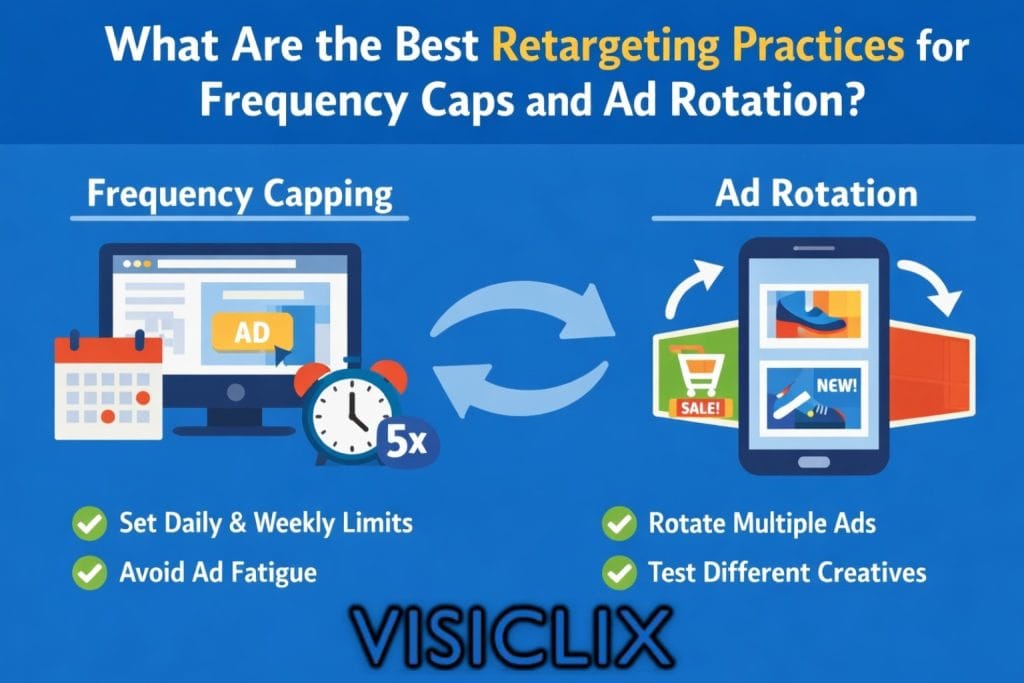
In other words, good retargeting is controlled repetition. Caps manage how often someone sees your ads. Rotation manages what they see across those impressions. When both are aligned, campaigns stay visible without becoming stale.
Why do frequency caps matter in retargeting campaigns?
Frequency caps matter because familiarity has diminishing returns. Early impressions often help a prospect remember the brand, revisit an offer, or return to a product. Later impressions can still help, but only if they remain relevant. Once exposure keeps climbing while engagement or conversion quality stalls, the campaign starts wasting spend.
Google’s own campaign controls reflect this tradeoff. Its help documentation explicitly frames frequency capping as a tool to manage the number of impressions shown to the same person, and Meta’s help center similarly describes frequency controls as a way to balance the tradeoff between reaching more people and showing ads more often.
That tradeoff is where many advertisers go wrong. They assume more reminders always create more conversions. In reality, extra impressions are only useful when the audience is still qualified and the message still feels timely. Otherwise, higher frequency often just means more spend on people who have already decided, already converted, or already tuned out.
How do frequency caps work in retargeting?
Frequency caps limit impressions over a selected time frame, such as per day, per week, or per month. In Google Ads Display campaigns, you can set caps manually or let Google optimize how often ads show, and you can apply the cap at the campaign, ad group, or ad level. Google also notes that impression counting may rely on third-party cookies by default and use first-party cookies as an approximation where needed.
| Audience stage | Intent level | Recommended frequency cap | Creative messaging focus | CTA style |
|---|---|---|---|---|
| Blog visitors | Low | Light — 1 to 2 impressions per 7 days | Educational, problem-aware, value-driven. Focus on pain points, trends, and helpful insights. | “Learn more” / “See how it works” |
| Product viewers | Medium | Moderate — 3 to 5 impressions per 7 days | Solution-aware messaging. Highlight product benefits, differentiators, use cases, and trust signals. | “Explore features” / “Compare options” |
| Pricing-page visitors | High | Higher — 5 to 8 impressions per 7 days | Conversion-focused. Address cost, ROI, objections, urgency, testimonials, and guarantees. | “Start now” / “Book a demo” |
| Cart abandoners | Very high | Aggressive but short window — 2 to 3 impressions per day for 3 to 7 days | Recovery messaging. Emphasize urgency, reminders, incentives, friction reduction, and reassurance. | “Complete purchase” / “Return to cart” |
| Existing customers | Retention / expansion | Low to moderate — 1 to 4 impressions per 14 days | Loyalty, onboarding, upsell, cross-sell, and customer success. Keep it helpful, not pushy. | “Upgrade” / “Discover more” / “Refer a friend” |
A table showing how cap intensity and creative messaging should differ
That gives advertisers a few layers of control. A campaign-level cap can keep overall exposure under control. An ad-group cap can help separate audiences with different intent. An ad-level cap can be useful when one specific creative is over-serving.
The strategic point is simple: caps are not there to suppress performance. They are there to prevent lazy delivery. A cap forces the campaign to earn repeated exposure instead of taking it for granted.
What is a good frequency cap for retargeting ads?
There is no universal “best” number, because the right cap depends on intent, buying cycle, audience size, and creative strength. Still, there is a reliable principle: the closer the user is to conversion, the more short-term repetition they can usually tolerate.
A blog visitor who read one informational article is a light-intent audience. They typically need a softer cadence and a longer window. A pricing-page visitor or cart abandoner has stronger commercial intent, so a tighter time window with somewhat higher short-term frequency can make sense. Google’s data segment setup also supports this logic because you can define different segment rules and membership durations for different audience types, rather than keeping everyone in the same retargeting pool.
A practical rule is to avoid one-size-fits-all caps. Use lighter exposure for low-intent visitors, stronger exposure for high-intent visitors, and immediate exclusion or suppression where a user has already converted.
How should you set frequency caps by audience intent?
Start with intent, not platform defaults.
For top-of-funnel visitors, use modest frequency and longer membership duration. These users may recognize your brand, but they are rarely ready for aggressive repetition. Your job is to stay present without dominating their browsing experience. Google allows you to define how long users remain in a data segment through membership duration, which makes it possible to keep lighter-intent users in a longer, lower-pressure nurture sequence.
For mid-funnel users, such as comparison shoppers or repeat site visitors, frequency can be stronger because they have shown clearer evaluation behavior. These audiences usually respond better when the message changes over time: proof, differentiators, testimonials, or offer clarity.
For bottom-of-funnel users, such as cart abandoners or demo starters, you can usually accept a denser exposure pattern over a shorter period. The opportunity window is smaller, so the urgency is higher. But this only works well if you exclude converters quickly. Google’s lifecycle guidance also emphasizes first-party customer data and customer detection for more durable audience management, which supports better suppression and segmentation after conversion.
When should you tighten or loosen your retargeting frequency cap?
Tighten the cap when frequency is climbing but CTR, conversion rate, or assisted conversions are not improving. That pattern usually means your audience is seeing enough of the campaign already, and more impressions are producing little additional value.
Tighten it when one creative has obviously worn out, too. Meta explicitly defines creative fatigue as a situation where an audience has seen the same creative too many times and becomes less likely to engage, which can raise cost per result.
Loosen the cap when your audience is highly qualified, your buying cycle is short, and reach is being choked too early. You might also loosen it when you have multiple strong creative variations and a compelling offer sequence that gives repeated exposure a real reason to work.
The key is not to change caps based on instinct alone. Change them when the metrics show that current exposure is either too heavy to be efficient or too light to stay competitive.
What is ad rotation in retargeting?
Ad rotation is the practice of serving multiple ads or creative combinations to the same qualified audience over time instead of relying on one repeating message. Google defines ad rotation as a setting that controls how often ads in an ad group are served relative to one another.
In retargeting, rotation matters because the audience already knows you. The challenge is not just to be seen again; it is to be seen again in a way that still feels useful. One ad might remind someone of a product they viewed. Another might add social proof. A third might present a stronger CTA or time-sensitive offer.
This is also where asset-based formats help. Google’s responsive display ads and dynamic remarketing options let advertisers upload multiple headlines, descriptions, images, logos, and videos, then automatically generate combinations across placements.
Why is ad rotation important for retargeting best practices?
Ad rotation prevents repetition from becoming monotony. Repetition alone can increase recall, but repetition without variation often loses attention. Google’s marketing guidance has found that higher frequency paired with storytelling variety, such as video sequencing, can produce stronger lift than low frequency alone; in one Google analysis, frequencies of three or more produced substantially higher absolute brand lift than frequencies of one or two in campaigns using video ad sequencing.
That finding does not mean every retargeting campaign should simply raise frequency. It suggests something more useful: repeated exposure works better when the creative experience evolves. Even in performance-focused retargeting, variety improves the odds that another impression will contribute something new rather than just repeat what the user has already ignored.
Meta’s creative fatigue guidance points to the same practical reality. When the same audience sees the same creative too many times, engagement can drop and costs can rise.
How many retargeting ads should run in a rotation at one time?
Most campaigns benefit from a focused set of variations rather than a huge creative pile. Too few creatives create fatigue quickly. Too many split data and delay learning.
A sensible working range is enough creative variety to support at least a few distinct message angles at each audience stage. For many retargeting programs, that means a reminder angle, a proof angle, and an offer or action angle. The exact count depends on audience size and spend. Smaller audiences cannot support endless testing. Larger audiences usually need more variation to avoid wearout.
Google’s responsive display ad system is built around multiple assets and combinations, but that does not remove the need for discipline. The platform can assemble combinations, yet the advertiser still decides whether the asset pool includes enough variety in headlines, descriptions, images, logos, and calls to action.
How should you rotate creatives across the retargeting funnel?
Rotation should follow intent progression, not randomness.
For lighter-intent audiences, start with reminder creatives. Reintroduce the brand, the category, or the problem you solve. For evaluation-stage users, move into proof-oriented creative: testimonials, review signals, differentiators, or category-specific credibility. For bottom-of-funnel users, rotate to stronger action-oriented ads such as demos, consultations, free trials, pricing reassurance, or cart recovery. Dynamic remarketing can also personalize the content based on products or services previously viewed, which is especially useful for lower-funnel recovery.
This sequencing matters because the same message is not equally persuasive at every stage. A user who just learned your brand needs clarity. A user who already visited pricing needs a reason to decide.
What creative elements should you rotate first in retargeting campaigns?
Start with the elements most likely to change the user’s decision. In many campaigns, that is the offer, headline, CTA, proof point, or primary visual. If the landing page angle is too generic, changing the ad alone may not fix the problem, so message-to-page alignment should be reviewed alongside creative tests.
Google’s display asset guidance reinforces this asset-first approach. Responsive display ads depend on combinations of headlines, descriptions, images, logos, and videos, and Google explicitly recommends using strong, varied assets to improve performance.
The right sequence is usually simple. Test message angle before minor wording tweaks. A different promise or proof point often moves performance more than a tiny headline edit.
How do frequency caps and ad rotation work together?
This is the real heart of retargeting optimization.
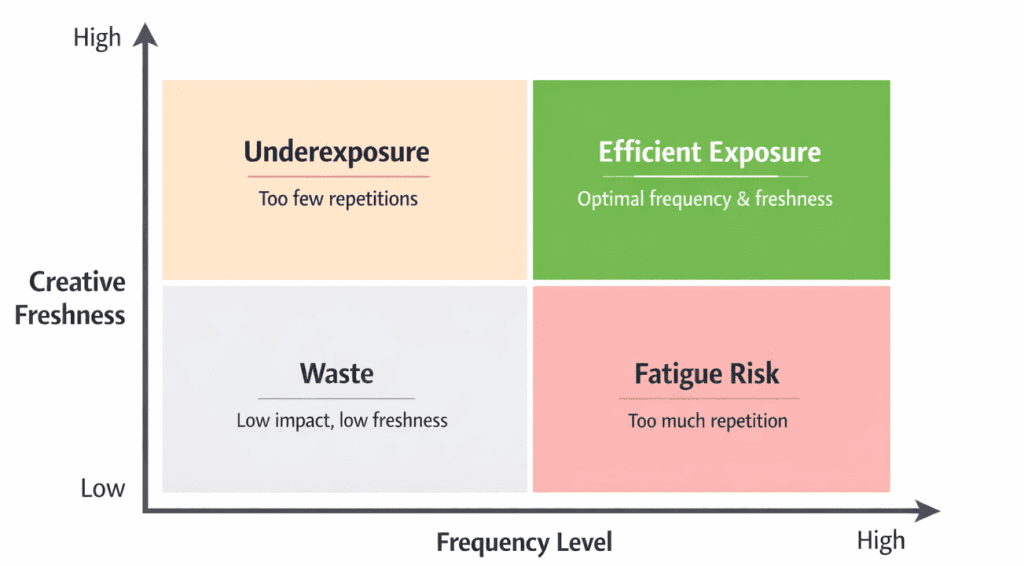
Frequency caps answer one question: how much exposure is enough? Ad rotation answers a different question: what should the user experience during that exposure? If you only manage caps, you may reduce annoyance but still serve stale messaging. If you only rotate creative, you may improve freshness but still overwhelm the audience.
The strongest setup uses both controls at once. Keep exposure within a reasonable range for the audience’s intent, then make sure those impressions are distributed across creative angles that reflect where the user is in the journey. Google provides the campaign controls for capping and the ad/asset systems for variety; your strategy decides how those two systems should complement each other.
In practice, that usually means a qualified audience gets several chances to respond, but those chances do not all look identical.
What mistakes hurt retargeting performance the most?
The first major mistake is using one cap for every audience. This ignores intent and usually leads to either underexposure for high-intent users or overexposure for low-intent ones.
The second is rotating too little creative. When an audience sees the same ad again and again, fatigue follows. Meta’s own guidance makes clear that creative fatigue can reduce engagement and increase cost per result.
The third is making changes too quickly. Rotation and creative testing need enough data to reveal whether the problem is the offer, the audience, or the exposure level. Killing creative too fast can be just as damaging as letting it run too long.
The fourth is poor audience hygiene. Google’s data segment tools let you define membership duration and audience rules, while customer lifecycle guidance emphasizes stronger first-party data and customer detection. If converted users stay in prospecting-style retargeting pools too long, the campaign wastes impressions and distorts learning.
Which metrics should you track to optimize caps and rotation?
Track frequency, reach, CTR, conversion rate, CPA, and creative-level performance. Those metrics tell you whether the campaign is visible, whether people still respond, and whether creative variation is helping.
But do not stop there. For retargeting, view-through and path analysis are often essential. Google Ads describes view-through conversions as conversions that happen after a user sees, but does not click, a display or video ad before later converting. Google Analytics 4 also provides attribution-path reporting to help you understand customer paths, compare attribution models, and examine path length up to 20 touchpoints.
That matters because retargeting frequently assists conversions rather than closing them with a single click. If you only evaluate last-click results, you may tighten caps too early or pause creative that is still doing useful work upstream.
How often should you refresh retargeting creatives?
Refresh creative when performance decay tells you to, not just because the calendar says so. Falling CTR, rising CPA, weak assisted conversions, or frequency growth without incremental results are stronger signals than an arbitrary two-week or monthly schedule.
That said, a regular review cadence is still smart. Asset-based display systems work best when advertisers keep feeding in strong, varied assets. Google’s responsive display ad guidance is explicit that performance depends on the quality and variety of the assets you provide.
A good operating rhythm is to review fatigue and creative contribution regularly, then refresh the message angle before the audience fully tunes out.
Are automated platform settings enough for retargeting optimization?
Not by themselves.
Automation is helpful for delivery, asset combination, and some serving decisions. Google’s responsive display formats automatically combine assets, and some campaign settings can optimize impression delivery or ad serving.
But platforms cannot fully determine your commercial priorities. They do not know which audience deserves tighter suppression, which offer aligns with your sales process, or whether a rising frequency trend is acceptable for a short buying window but harmful for a long one. Those are business decisions.
The winning approach is hybrid. Use automation for execution efficiency, but keep human control over segmentation, exclusions, creative strategy, and interpretation of performance signals.
How can B2B and longer sales-cycle brands approach retargeting differently?
B2B brands usually need more patience and more message variety. The path to conversion is longer, more stakeholders may be involved, and the first meaningful conversion is often not a sale but a softer action such as a content download, webinar registration, or demo request.
That changes cap and rotation strategy. Instead of pressing every audience with direct-response ads, B2B retargeting often works better when it sequences educational, proof-based, and conversion-oriented creative over time. Google Analytics attribution reporting is particularly useful here because longer journeys usually require path-level analysis rather than simplistic last-click judgments.
It also makes first-party data more important. Google’s customer lifecycle guidance and data segment tools both support a more durable, segmented setup for reaching existing customers, lapsed users, or high-value accounts with different message cadences.
Can retargeting work without annoying your audience?
Yes, but only when it is built around relevance and restraint.
Retargeting becomes annoying when it confuses persistence with persuasion. Smart campaigns do the opposite. They limit exposure, align the message with real user intent, suppress converters quickly, and refresh creative before fatigue takes over. Google and Meta both provide tools that support those goals, but the real advantage comes from using them intentionally.
That is the practical meaning of retargeting best practices. It is not “follow people everywhere.” It is “show up enough to matter, but not so much that the message loses value.”
FAQ
What is the best frequency cap for retargeting?
There is no single best number for every campaign. The right cap depends on audience intent, buying cycle, and creative strength. Higher-intent audiences can usually support more short-term exposure than low-intent visitors, while low-intent audiences generally need lighter cadence and longer nurture windows. Google Ads supports manual caps across Display campaigns so advertisers can adjust exposure by audience instead of using one blanket setting.
How many times should a user see a retargeting ad?
Enough times to remember and reconsider the offer, but not so many that performance stalls or the ad becomes repetitive. The answer should come from your metrics: if frequency rises while CTR, CPA, or assisted conversion value worsens, the user is probably seeing too much of the campaign.
Does ad rotation improve retargeting performance?
It often does, because it reduces creative fatigue and lets you match message angle to stage of intent. Google’s ad rotation and asset-based ad systems support creative variation, while Meta’s guidance notes that repeated exposure to the same creative can lower engagement and increase costs.
How many creatives do I need for a retargeting campaign?
You need enough variation to avoid fatigue and support different message angles, but not so many that spend gets spread too thin. Most programs should include multiple creatives or asset combinations built around reminder, proof, and action-oriented messaging.
What causes retargeting ad fatigue?
Ad fatigue is typically caused by high repetition with low message variety. Meta defines creative fatigue as the point where an audience has seen the same creative too many times and becomes less likely to engage, often increasing cost per result.
Should cart abandoners have a different cap than blog visitors?
Yes. Cart abandoners and pricing-page visitors usually show stronger purchase intent and can justify denser short-term exposure. Blog visitors usually need lower-pressure retargeting and more educational sequencing.
How do I know when to refresh retargeting ads?
Refresh when performance signals fade. The clearest signals are rising frequency, dropping CTR, weaker conversion efficiency, and lower assisted-conversion contribution. Review creative-level results regularly instead of waiting for a fixed calendar date.
What metrics matter most in retargeting optimization?
At minimum, monitor frequency, reach, CTR, conversion rate, CPA, and creative-level performance. For fuller measurement, include view-through conversions and attribution-path analysis, since retargeting often influences conversions without winning the last click.
Conclusion
The best retargeting campaigns do not rely on constant repetition. They use disciplined repetition. Frequency caps protect efficiency and brand experience. Creative rotation keeps repeat exposure useful instead of stale. Audience segmentation keeps those controls aligned with real buyer intent.
That is what separates average retargeting from strong retargeting. Not more impressions. Better-managed impressions.
Why Visiclix is Your Ideal Choice for Retargeting Optimization?
Visiclix is built for advertisers who want retargeting to produce measurable business results, not just more ad delivery. The difference is in the operating discipline. Instead of treating every site visitor the same, Visiclix can structure retargeting around audience intent, buying stage, and conversion value so your campaigns do not waste budget on low-impact repetition. That leads to smarter caps, cleaner exclusions, and more meaningful creative sequencing.
Just as important, Visiclix approaches retargeting as a performance system rather than a single setting inside an ad platform. That means evaluating frequency alongside creative fatigue, assisted conversions, path length, and audience quality so optimizations are tied to actual revenue impact. For brands that want retargeting best practices applied with strategy, not guesswork, Visiclix brings the kind of rigor that helps campaigns stay efficient while still converting.
Ready to Improve Retargeting Performance with Visiclix?
If your retargeting campaigns are overserving, underperforming, or relying on stale creative, Visiclix can help you fix the real issue. A smarter retargeting strategy can tighten caps where needed, improve rotation across the funnel, and turn repeat impressions into stronger conversion outcomes.