Q1 is one of the best windows of the year for vision insurance marketing because many members are starting a new benefit year, checking what their plan covers, looking for in-network providers, and planning eye exams or eyewear purchases. Major vision brands explicitly guide members to review benefits, find doctors, check allowances, and use member portals at the start of a benefit cycle, while public-health sources continue to stress that comprehensive dilated eye exams help detect problems early. Put together, that gives marketers a rare mix of urgency, relevance, and clear next actions.
The opportunity is even stronger because Q1 intent is not generic. People are not just browsing. They are asking practical questions: What does my plan cover? Can I book an eye exam now? How much will frames or contacts cost out of pocket? Which providers are in network? Those questions create exactly the kind of high-intent search and landing-page behavior that PPC, lifecycle email, and conversion-focused content can capture efficiently. Google Ads documentation also reinforces that responsive search ads and Smart Bidding are designed to match messages more closely to user queries and optimize toward conversions when tracking is configured correctly.
What makes Q1 such an important season for vision insurance marketing?
Q1 matters because it combines timing with motivation. At the beginning of a benefit year, members are more likely to log in, review coverage, search for doctors, and think about how to use allowances for exams, glasses, or contacts. VSP and EyeMed both emphasize benefit review, provider search, claims visibility, and coverage understanding as core member actions, which tells marketers what users actually want during this period.
It is also a strong season because the product itself connects to both cost savings and preventive care. Vision plans are not just about discounted eyewear. The National Eye Institute and CDC both note that comprehensive dilated eye exams help detect eye disease early, sometimes before symptoms are obvious. That means Q1 campaigns can pair financial value with health value, which is usually more persuasive than running price-only ads.
For marketers, that creates a practical advantage: the quarter offers multiple credible hooks at once. You can speak to fresh benefits, early-year planning, family care, network access, and preventive exams without stretching the narrative. Competitors often talk about digital channels in general terms, but the Q1 angle gives vision insurance marketing a sharper reason to act now instead of later.
How does a vision insurance reset shape customer behavior in Q1?
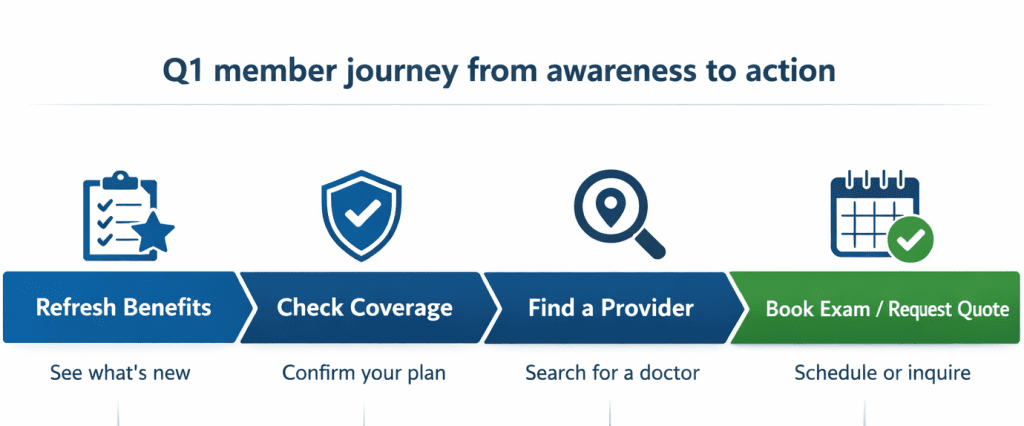
A benefits reset changes behavior by moving people from passive awareness to active checking. When a new plan year starts, members often want to confirm their allowance, understand copays or deductibles, find an in-network doctor, and decide whether to schedule care now or delay. VSP’s benefit guidance and EyeMed’s member resources both reflect this pattern by centering coverage review, provider search, and benefit use.
That matters for campaign strategy because the search journey becomes more specific. Instead of broad informational queries, users move toward action-based behavior: checking benefit details, viewing claims history, searching for providers, and comparing covered versus out-of-pocket costs. Google’s conversion measurement guidance is relevant here because it reminds advertisers to define and track the exact actions that matter, such as appointment requests, benefit checks, calls, form submissions, and quote starts.
The safest way to message this is to use urgency without overgeneralizing. Many members do begin a new benefit year in January, and vision carriers publish “new benefit year” guidance, but plan timing can vary. Strong Q1 messaging should encourage people to check their own plan details rather than assume every policy resets the same way. That keeps the copy persuasive without becoming misleading.
Who should vision insurance marketers target first during the Q1 reset window?
The first audiences to target are existing members, newly enrolled members, lapsed exam-bookers, families with dependents, employer benefit audiences, and broker or partner channels. These groups are closest to action because they either already have benefits, have recently gained coverage, or influence how benefits are communicated and used. EyeMed and VSP both put heavy emphasis on helping members understand coverage and find care, which supports a member-first Q1 strategy.
Existing members are usually the fastest win. They do not need a full category education campaign; they need clarity, reminders, and easy next steps. Campaigns aimed at this segment should focus on benefit review, in-network provider search, exam booking, and allowance usage. A landing page that quickly explains coverage pathways will usually outperform a generic brand page because it matches the member’s immediate task.
Prospects who are still comparing plans or evaluating carriers should be handled differently. They may be more interested in value explanations, network breadth, online access, claims simplicity, or what is included for eyewear and contacts. Employer and broker audiences also need a different angle again: they care about utilization, communication support, simplicity for employees, and measurable engagement. That is why segmentation matters so much in Q1. One seasonal message is rarely enough for every audience.
What are the best Q1 campaign themes for vision insurance marketing?
The strongest Q1 themes combine urgency, usefulness, and low-friction action. “New year, new benefits” works because it aligns with how members think at the beginning of a plan cycle. “Use your vision benefits wisely” works because it frames the audience as smart planners rather than passive patients. “Book your first eye exam of the year” is effective because it ties a health action to a specific next step, backed by public-health guidance on the value of regular eye exams.
Another strong theme is maximizing allowances for glasses or contacts. EyeMed’s FAQ and member resources explain core benefit concepts such as allowances, coverage use, and network search, which gives marketers a practical basis for content and ad copy. People respond well to campaigns that help them understand what part of a purchase is covered and what they may still pay out of pocket.
Family planning is also a useful Q1 angle. Early in the year, parents often organize healthcare tasks, school schedules, and dependent benefits together. A family-focused theme can speak to routine care, convenience, and the value of getting ahead of avoidable delays. For employer and broker audiences, the better theme is benefit education: simple, seasonal communication that helps employees understand how and when to use their plan.
How can marketers turn the “benefits reset” message into campaigns that convert?
A reset message only converts when it leads to a clear action. In practice, that means every ad, email, and landing page should answer one immediate question and drive one immediate next step. Search ads can capture demand from people actively looking for coverage details, eye exams, or in-network providers. Emails can remind existing members to check benefits and book care. Retargeting can bring back visitors who viewed a benefit page but did not complete a form or appointment flow.
The landing page is where many seasonal campaigns fail. If the page does not explain coverage plainly, people hesitate. Strong Q1 landing pages should reduce friction by showing a short benefit summary, a provider-finder pathway, a clear call to book or verify benefits, and reassurance that the user can check exact plan details before committing. That mirrors how major carriers structure member experiences, with self-service tools for coverage review and doctor search.
Paid social can support the same message, but the creative should not try to do too much. Social works better when the copy is built around one compelling idea, such as “Check your refreshed benefits,” “Book your exam early,” or “See what your plan covers this year.” The goal is not to explain every plan detail inside the ad. The goal is to move the user into a page that makes the next step feel easy and worthwhile.
What content offers work best in Q1 for vision insurance marketing?
The best Q1 offers are educational, specific, and immediately useful. A “What does my vision plan cover this year?” guide works because it addresses the first question many members ask. A simple benefit checklist works because it gives users a quick path to action: review coverage, confirm network status, book an exam, compare eyewear options, and check claims or past use. Carrier resources from EyeMed and VSP show that members actively need help with exactly these tasks.
Provider-finder content is another strong performer because it sits near the bottom of the funnel. A person searching for a doctor or in-network location is closer to conversion than someone reading a broad educational article. That is why Q1 content should not be limited to blog posts. It should also include practical tools, benefit explainer pages, FAQs, and member-service landing pages.
For employer and broker audiences, downloadable communication kits can be especially effective. These assets can include reminder emails, short benefit explainers, FAQ copy, and seasonal banners that make it easier to encourage plan usage. That kind of enablement content is often missing from generic marketing advice, but it fits vision insurance particularly well because utilization improves when communication becomes simpler and more timely.
How should paid search support a Q1 vision insurance marketing strategy?
Paid search should capture the demand that is already forming around benefits, eye exams, providers, and eyewear costs. In Q1, people often search with intent-rich phrases tied to coverage, networks, and timing. Search campaigns should reflect that reality by grouping keywords according to user need rather than keeping everything in one broad ad group. Separate coverage questions from booking intent, provider search, eyewear savings, and employer-focused queries so each cluster can have tighter ad copy and a better-matched landing page.
Responsive search ads are especially useful here because Google’s documentation says they can adapt messaging to show more relevant combinations of headlines and descriptions based on the user’s query. That is a good fit for seasonal campaigns where one audience may care about refreshed benefits, another about booking an exam, and another about frames or contacts. Building more message variation into the ads improves the chance that the system will serve a combination aligned with the searcher’s actual concern.
Bidding and measurement matter just as much as ad copy. Google’s Smart Bidding guidance explains that automated bidding can optimize for conversions or conversion value when the right conversion signals are in place. For vision insurance marketing, that means defining meaningful conversion actions such as benefit checks, appointment requests, form completions, tracked calls, and qualified quote starts, rather than optimizing only to clicks.
How can email and lifecycle campaigns improve Q1 vision insurance results?
Email often drives some of the highest-efficiency Q1 results because the audience already has a relationship with the brand. Members do not usually need a long persuasion arc; they need reminders, clarity, and timing. A strong sequence might start in early January with a refreshed-benefits message, follow with an eye-exam reminder, and then send a later prompt focused on using allowances or checking in-network options before the quarter slips by. That sequence reflects the actual tasks carriers encourage members to complete.
Lifecycle campaigns become more powerful when behavior triggers the follow-up. Someone who viewed a provider page should get a different message from someone who explored eyewear benefits. Someone who started a benefit lookup but did not finish may need reassurance about how simple the process is. Someone who used benefits last year but has not acted yet this year may respond to a reminder framed around maximizing existing coverage. These are the kinds of segmented prompts that make Q1 campaigns feel helpful rather than repetitive.
This is also where retention and utilization goals can work together. Better-timed communication does not just generate traffic. It helps members use the plan more confidently, which can improve satisfaction with the coverage experience. AHIP’s vision insurance materials highlight the health and satisfaction value of vision coverage, giving marketers a strong case for campaigns that educate rather than simply promote.
Why does personalization matter more in Q1 vision insurance marketing?
Personalization matters more in Q1 because not everyone enters the quarter with the same goal. One person wants a routine exam. Another wants new frames. Another wants contact lenses. Another is an employer looking for a clean way to communicate benefits. A generic “use your benefits” message is better than silence, but it will usually underperform compared with messaging tailored to the user’s stage and need.
Google’s ad systems reinforce this logic from the media side. Responsive search ads work by testing combinations and matching messaging more closely to the searcher’s query, while Smart Bidding optimizes toward the conversions you define. On the CRM side, segmentation lets you send different reminders based on behavior, product interest, or plan status. When both sides are aligned, the user sees a more relevant message before and after the click.
In practical terms, personalization in Q1 should be simple and deliberate. Segment by member status, prior benefit usage, eyewear interest, provider-search behavior, employer versus consumer intent, and lifecycle stage. Then connect each segment to a page that solves its specific problem. That is how seasonal campaigns become more than a calendar-based promotion. They become a set of journeys built around real user questions.
What mistakes should marketers avoid in Q1 vision insurance campaigns?
The biggest mistake is being too generic. If the campaign only says “learn about our vision plan,” it wastes the seasonal moment. Q1 works best when the message is anchored to a concrete reason to act now, such as checking benefits, booking an exam, finding a provider, or using an allowance. Generic creative often leads to generic traffic, and generic traffic rarely converts as efficiently as users who arrive with a specific task in mind.
Another mistake is assuming all plans or benefit years work the same way. Many campaigns can lean into the start-of-year theme, but the copy should still encourage users to verify their own plan details. Overpromising on timing or coverage is not only risky for compliance and trust; it also creates friction when a user lands on the site and realizes the ad oversimplified the situation. Carrier resources consistently direct members back to account and benefit tools for exact details, which is the safer model to follow.
A third mistake is poor post-click experience. Slow mobile pages, confusing benefit explanations, hidden provider search tools, or weak calls to action can erase the advantage of strong seasonal media. Since Google’s conversion measurement tools rely on clearly defined actions, marketers should design pages around those actions from the start rather than retrofitting measurement later.
How can you measure whether a Q1 vision insurance marketing campaign is working?
A Q1 campaign is working when it improves both response metrics and business outcomes. Click-through rate and cost per click can tell you whether the message is resonating, but they are not enough on their own. The more important measures are benefit-check starts, appointment requests, provider-search engagements, tracked calls, quote requests, completed forms, and qualified lead volume. Google’s conversion measurement documentation is clear that advertisers should define what matters and track those actions directly.
It is also worth separating campaign goals by audience. For existing members, success may look like higher utilization-related actions, more benefit lookups, or stronger exam-booking rates. For prospects, it may mean lower cost per qualified lead or higher quote-start volume. For employer and broker campaigns, it may be engagement with seasonal communication kits, demos, or contact requests. Measurement gets more useful when it matches the job each campaign is supposed to do.
Finally, keep the measurement loop tight. The sooner you know which ad themes, audience segments, and landing pages are producing high-value actions, the sooner you can move budget toward what is working. Q1 is a short seasonal window, so optimization speed matters more than it does in always-on campaigns. Smart Bidding can help at the auction level, but the strategy still depends on marketers feeding the platform the right conversion goals and better creative inputs.
What does a simple 90-day Q1 vision insurance marketing plan look like?
In January, the priority is awareness with intent. This is when campaigns should focus on refreshed benefits, plan understanding, provider search, and early exam booking. Search ads should cover coverage-related queries and provider-finder intent. Email should remind existing audiences to review benefits and act early. Landing pages should make it easy to understand what is covered and what to do next.
In February, the priority shifts toward segmentation and nurture. By this point, marketers should know which audiences are responding to exam-focused, eyewear-focused, or provider-focused content. Retargeting becomes more useful here because users who interacted in January may still need a second or third nudge. This is also a good time to test more tailored pages, subject lines, and search-ad angles based on behavior seen in the first month.
In March, the focus should move to urgency and optimization. The strongest ad groups and audiences should get more budget, underperforming creative should be replaced, and lifecycle messaging should push the easiest next action. This does not require aggressive pressure tactics. It simply means reminding people not to lose momentum after a strong start to the year. If the campaign has built enough clarity and trust in January and February, March becomes the month where efficient conversion gains are easiest to capture.
FAQ
What is vision insurance marketing?
Vision insurance marketing is the process of attracting, educating, and converting people or organizations interested in vision benefits, eye exams, eyewear savings, provider access, and related services. It often includes paid search, paid social, email, landing pages, broker enablement, and educational content designed to help users understand and use coverage.
Why is Q1 important for vision insurance campaigns?
Q1 is important because many users are entering a new benefit cycle, reviewing coverage, finding providers, and planning care. That creates a timely mix of fresh intent and clear decision-making behavior.
Do all vision insurance plans reset on January 1?
No. Many campaigns can use a start-of-year theme, but exact benefit timing can vary by plan and employer. Good marketing copy encourages users to verify their specific coverage details before acting.
What channels work best for vision insurance marketing in Q1?
The most effective mix usually includes paid search for active intent, email for existing audiences, retargeting for unfinished journeys, and landing pages or tools that make benefit use simple.
How can brokers and employers use seasonal vision marketing content?
They can use seasonal content to explain coverage clearly, promote provider search, remind employees to check benefits, and encourage early-year utilization through simple communication kits and reminder campaigns.
What should a Q1 vision insurance landing page include?
It should include a plain-language benefit summary, a clear path to verify coverage, provider-search access, a strong call to action, and reassurance that the user can confirm plan specifics quickly.
How do you make vision insurance marketing more personalized?
Segment by audience type, behavior, benefit usage, eyewear interest, and lifecycle stage, then match each segment with more relevant messaging and landing pages.
Which KPIs matter most for seasonal vision insurance campaigns?
The most useful KPIs are qualified conversions: appointment requests, benefit checks, tracked calls, provider-search engagement, quote starts, form completions, and cost per qualified lead or acquisition.
Conclusion
Q1 gives vision insurance marketers a rare advantage: people are already motivated to review benefits, find providers, schedule eye care, and understand what their coverage can do for them. That makes the quarter more than a routine planning period. It is a conversion window shaped by timing, relevance, and practical user intent.
The brands that win in this season are usually the ones that keep the message simple and useful. They do not rely on broad awareness alone. They connect fresh-benefit thinking to clear next steps, relevant search intent, timely lifecycle reminders, and landing pages that remove confusion. When that happens, vision insurance marketing becomes more efficient, more helpful, and far more likely to turn Q1 attention into measurable growth.
Why Visiclix is Your Ideal Choice for Vision Insurance Marketing?
Visiclix is built for exactly the kind of seasonal performance challenge that Q1 creates. Vision insurance marketing in this window is not just about reaching more people. It is about identifying where intent is highest, aligning PPC and landing pages with real benefit-related questions, and turning time-sensitive interest into qualified action. Visiclix brings that kind of strategic precision to campaigns that need to perform when timing matters most.
Visiclix also understands that strong results come from more than media buying alone. Seasonal vision campaigns need clean segmentation, persuasive creative, practical content, and clear measurement frameworks that connect marketing activity to real outcomes. By combining those pieces, Visiclix helps vision insurance brands move beyond generic awareness and build Q1 campaigns that are useful for audiences and accountable for the business.
Ready to Make Q1 Vision Insurance Marketing Work Harder for Visiclix?
Turn the annual reset window into stronger engagement, better-qualified leads, and more efficient campaign performance. Visiclix can help you build Q1 vision insurance marketing campaigns that capture intent, simplify benefit decisions, and convert seasonal demand into real growth.