
Patient retention marketing for optometrists brings existing patients back more often by using timely recall reminders, personalized email and SMS campaigns, overdue-patient reactivation, optical follow-ups, review requests, referral campaigns, and performance tracking. Instead of only spending more to acquire new patients, optometry practices can use retention marketing to stay connected with people who already know the practice and are more likely to return for exams, prescription updates, contact lens refills, eyewear purchases, and ongoing eye health care.
This matters because optometry is naturally built around recurring care. Comprehensive eye exams are part of preventive healthcare, and many eye or vision problems may not show obvious symptoms. For higher-risk patients, the need for consistent recall is even clearer: the CDC says people with diabetes should get yearly comprehensive vision exams, including dilated eye exams, and notes that many diabetes-related eye conditions can be avoided or delayed with yearly dilated exams and treatment.
The challenge is that many patients do not skip care because they dislike the practice. They often forget, delay scheduling, miss a reminder, buy eyewear somewhere else, move out of their normal routine, or never receive a message that makes returning feel urgent and easy. A strong retention system closes that gap by giving every patient a clear next step after the visit.
For optometry practices investing in PPC, retention marketing also protects the value of every acquired patient. Paid ads may bring someone in for the first appointment, but retention campaigns help that patient return, refer family members, leave reviews, and continue choosing the practice instead of drifting to another provider. In broader business research, Harvard Business Review has reported that acquiring a new customer can cost five to 25 times more than retaining an existing one, while Bain-linked research has connected small retention improvements with major profit gains.
What is patient retention marketing for optometrists?
Patient retention marketing for optometrists is the process of encouraging existing patients to keep returning for care, products, follow-ups, and future appointments. It includes the campaigns and workflows that happen after a patient enters the practice database: recall reminders, email education, text confirmations, contact lens refill prompts, eyewear promotions, no-show follow-ups, review requests, referral campaigns, and overdue-patient reactivation.
The key difference between retention and acquisition is audience intent. Acquisition marketing targets people who may not know the practice yet. Retention marketing focuses on patients who already visited, booked, purchased, asked a question, or had some relationship with the practice. That makes the messaging warmer, more personal, and often more efficient.
Strong patient retention marketing is not just “send one reminder every year.” It is a lifecycle system. Every appointment, optical purchase, prescription update, contact lens order, review, referral, and missed visit should trigger a relevant next step.
What is patient recall in optometry?
Patient recall in optometry is the process of reminding patients when they are due for their next exam, prescription update, contact lens evaluation, medical follow-up, or recommended visit. Recall is one of the most important parts of retention because it turns a passive patient list into an active source of repeat appointments.
A good recall system should include timing, segmentation, and convenience. A patient who needs a routine annual exam should receive a different message from a contact lens wearer, a pediatric patient, a dry eye patient, or someone with diabetes who needs consistent monitoring. The CDC’s diabetes guidance shows why segmentation matters: patients with diabetes have higher risks for eye disease, and yearly comprehensive vision exams are specifically recommended.
Why should optometrists focus on existing patients before spending more on new patient acquisition?
Optometrists should focus on existing patients because the practice has already earned trust, collected patient information, and created a relationship. That existing relationship is valuable. A patient who already had a positive experience is more likely to respond to a reminder, schedule an exam, buy eyewear, order contacts, refer a family member, or leave a review than someone encountering the practice for the first time.
Retention also makes PPC more profitable. A new patient acquired through Google Ads, Meta Ads, or local search should not be treated as a one-time transaction. The practice paid to win that patient’s attention. Retention marketing helps extend the value of that first conversion by encouraging repeat visits and future purchases.
How can optometrists improve patient retention?
Optometrists can improve patient retention by making follow-up care easy, timely, and personal. That starts before the patient leaves the office. Staff can schedule the next visit, confirm the best communication channel, explain when the patient should return, and make sure the patient understands why follow-up care matters.
The practice should then support that experience with automated recall, email campaigns, SMS reminders, optical follow-ups, review requests, and overdue-patient reactivation. The goal is to reduce friction. Patients should not have to remember when they are due, search for the phone number, or wonder whether their benefits apply. The marketing system should bring the next step to them.
Optometrists can also improve retention by aligning marketing with operations. If online scheduling is difficult, phones are not answered quickly, wait times are long, or rescheduling feels frustrating, patients may ignore even the best recall campaign. Retention improves when the full patient experience supports the message.
How does the optometry patient lifecycle reveal missed retention opportunities?
The optometry patient lifecycle shows every point where a practice can either strengthen the relationship or lose momentum. A typical lifecycle includes first appointment booking, exam completion, treatment or prescription discussion, eyewear or contact lens purchase, post-visit follow-up, review request, recall reminder, overdue reactivation, and referral generation.
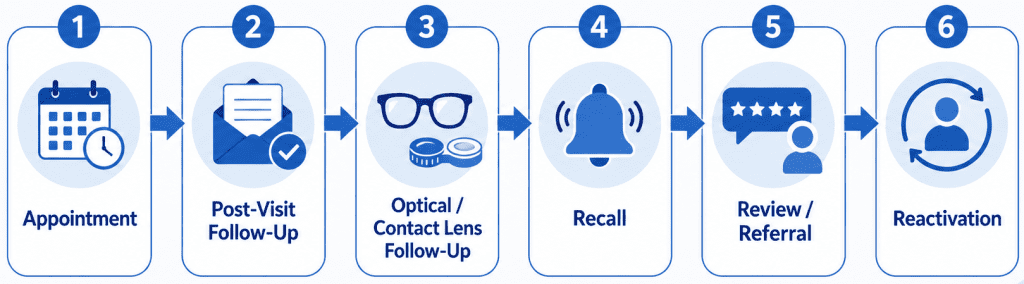
Many practices lose patients because the next step is not clearly defined. A patient completes an exam but does not schedule next year’s visit. A contact lens patient forgets to reorder. A frame buyer never receives a second-pair or sunglasses offer. A no-show is marked in the system but not followed up with a rescheduling sequence. An inactive patient stays in the database for years without a win-back campaign.
Segmentation makes this lifecycle more useful. Instead of sending the same generic message to everyone, optometrists can group patients by care need, purchase history, appointment status, and risk level. Useful segments include annual exam patients, contact lens wearers, optical buyers, pediatric patients, senior patients, medical eye care patients, inactive patients, and high-value eyewear customers.
How can automated recall campaigns bring optometry patients back on schedule?
Automated recall campaigns bring optometry patients back on schedule by sending reminders at the right time, through the right channel, with a clear scheduling action. A single reminder is easy to miss. A recall sequence is more effective because it follows the patient before they are due, when they are due, and after they become overdue.
A practical recall workflow might begin 30 to 60 days before the patient is due. The first message can educate the patient and invite scheduling. A second reminder can create urgency closer to the due date. A third can make booking simple with a direct call or scheduling link. If the patient does not respond, the system can move them into an overdue reactivation sequence.
Automated recall should still feel human. The message should explain the reason for the reminder, not just say “book now.” For example, a contact lens patient may need an updated prescription before reordering, while a child may need an eye exam before school. A patient with a medical condition may need a different follow-up schedule based on provider guidance.
HHS states that appointment reminders are considered part of treatment and can be made without a separate HIPAA authorization. That does not mean practices should be careless. Messages should use reasonable safeguards, avoid unnecessary protected health information, and follow the practice’s privacy and communication policies.
What are the best optometry patient recall strategies?
The best optometry patient recall strategies combine automation, segmentation, multi-channel communication, and staff follow-up. Automation makes recall consistent. Segmentation makes messages relevant. Multi-channel outreach increases the chance that patients actually see the reminder. Staff follow-up helps recover patients who need a more personal touch.
A strong recall strategy includes email, SMS, phone, and sometimes direct mail. Email works well for education, benefits reminders, optical promotions, and longer explanations. SMS works well for quick reminders and confirmations. Phone calls are useful for high-value, high-risk, or repeatedly overdue patients.
Practices should also test recall timing. Some patients respond better when contacted before they are officially due, while others need reminders after the due date. Tracking response rates by timing and patient type helps the practice improve future campaigns.
How can personalized patient communication increase repeat visits?
Personalized patient communication increases repeat visits because patients are more likely to respond when a message reflects their real needs. A generic “time for your appointment” reminder may be ignored. A message that references the patient’s likely next step—annual exam, contact lens renewal, benefits deadline, eyewear pickup, or pediatric vision check—feels more relevant.
Personalization does not need to be complicated. It can start with basic segments. Contact lens patients can receive reorder and prescription renewal reminders. Families can receive back-to-school vision messages. Optical customers can receive second-pair, sunglasses, or lens upgrade campaigns. Patients who missed appointments can receive a rescheduling sequence.
The best personalization also respects privacy. For sensitive health-related communication, practices should avoid unnecessary detail in unsecured messages and should follow HIPAA, TCPA, CAN-SPAM, and platform-specific rules. HHS distinguishes certain treatment and healthcare operations communications from marketing, while generally requiring authorization for uses or disclosures of protected health information for marketing unless an exception applies.
How can email marketing improve patient retention for optometrists?
Email marketing improves patient retention for optometrists by keeping the practice visible between visits. It gives the practice space to explain why routine exams matter, remind patients about benefits, promote optical services, educate patients about eye health, and invite overdue patients to schedule.
Email is especially useful for messages that need more detail than SMS. For example, an email can explain what happens during a comprehensive eye exam, why contact lens prescriptions need renewal, how blue light or sun protection options work, or why diabetic patients should stay consistent with eye exams.
For commercial email campaigns, practices should follow CAN-SPAM requirements. The FTC explains that commercial email must avoid deceptive headers and subject lines, include a valid physical postal address, and provide a clear opt-out method.
What retention campaigns should optometrists send throughout the year?
Optometrists should send retention campaigns that match patient needs, seasonal demand, and care timelines. The best calendar is not random. It should be designed around when patients are likely to need exams, eyewear, contacts, benefits reminders, or follow-up care.
Useful campaigns include:
- Annual eye exam recall campaigns
- Overdue patient reactivation campaigns
- Contact lens refill and prescription renewal campaigns
- Back-to-school pediatric vision campaigns
- Year-end benefits reminders
- Eyewear upgrade and second-pair campaigns
- Prescription sunglasses campaigns
- Dry eye follow-up campaigns
- Review request campaigns
- Referral campaigns
- Birthday or patient appreciation campaigns
- No-show rescheduling campaigns
Each campaign should have one clear goal. A year-end benefits campaign should encourage patients to use available benefits before they expire. A contact lens campaign should make reordering or scheduling an evaluation easy. A reactivation campaign should explain why returning matters and remove friction from scheduling.
PPC can support retention, but it needs privacy-aware strategy. Google Ads Customer Match allows advertisers to use online and offline first-party data to reach and re-engage customers across Google properties, but Google also restricts sensitive categories and prohibits ad content that implies knowledge of personally identifiable or sensitive information. For healthcare-related campaigns, optometry practices should use conservative audience strategies, general messaging, and proper compliance review.
How often should patients get their eyes checked?
Patients should get their eyes checked based on their optometrist’s recommendation, age, symptoms, vision needs, medical history, and risk factors. The article should avoid implying that one schedule fits every patient. Some patients may need routine comprehensive exams, while others need more frequent monitoring because of diabetes, eye disease risk, contact lens use, medication history, or provider findings.
The AOA describes periodic comprehensive eye exams as an important part of preventive healthcare and notes that many eye and vision problems do not have obvious signs or symptoms. For patients with diabetes, CDC guidance is more specific: yearly comprehensive vision exams, including dilated eye exams, are recommended.
For retention marketing, the practical takeaway is segmentation. A routine vision patient, contact lens wearer, child, senior, and diabetic patient should not all receive the same recall schedule or message.
How do appointment reminders reduce no-shows and protect revenue?
Appointment reminders reduce no-shows by helping patients remember, confirm, reschedule, or ask questions before the appointment time is lost. Missed appointments hurt revenue because the chair time is reserved but unused. They also create access problems because another patient could have taken that slot.
The most effective appointment reminder systems make it easy to act. A reminder should include the appointment date, time, location, arrival instructions, and a simple way to confirm or reschedule. If a patient cannot attend, the practice should know early enough to fill the slot.
Research supports the use of reminders. A Cochrane review found low- to moderate-quality evidence that mobile phone text message reminders increased attendance compared with no reminders or postal reminders, and that text reminders had a similar impact to phone reminders while costing less in the studies that reported cost data.
Do SMS reminders work for optometry patient recall?
SMS reminders can work well for optometry patient recall because they are immediate, brief, and easy to act on. They are especially useful for appointment confirmations, same-week reminders, overdue nudges, contact lens reorder prompts, and missed appointment follow-ups.
The best SMS reminders are short and privacy-conscious. They should not include unnecessary clinical detail. A simple message such as “You’re due for your next eye care visit. Reply or call us to schedule” is often safer and clearer than a message with detailed health information.
SMS should not replace every other channel. Some patients prefer email, phone, or portal messages. The strongest approach is to collect communication preferences and use SMS as part of a broader recall workflow.
How can reviews and reputation marketing support patient retention?
Reviews and reputation marketing support patient retention by reinforcing trust after the visit. Most practices think of reviews as an acquisition tool, and they are. But reviews also affect existing patients. When patients see that others consistently have positive experiences, it validates their decision to return.
A strong review workflow starts with patient satisfaction. After the visit, the practice can send a feedback request. Happy patients can be invited to leave a public review. Unhappy patients can be routed to a service recovery process before frustration becomes a public complaint or a lost relationship.
Google says local results are mainly based on relevance, distance, and prominence. It also says complete, accurate business information helps local visibility, and that responding to reviews shows the business values feedback. Reviews and positive ratings can help local ranking, according to Google’s own Business Profile guidance.
Retention-focused reputation marketing is not about pressuring patients. It is about making feedback easy, responding professionally, and using recurring comments to improve the patient experience.
How can eyewear, optical, and contact lens follow-ups bring patients back more often?
Eyewear, optical, and contact lens follow-ups bring patients back by extending the relationship beyond the exam. Many practices lose revenue after the prescription is written because patients shop online, delay purchasing, forget to reorder contacts, or do not understand the value of buying through the practice.
Optical follow-up campaigns can remind patients about frame styling, lens upgrades, prescription sunglasses, second-pair options, children’s eyewear, workplace eyewear, and benefits deadlines. These messages should focus on convenience, fit, quality, and continuity of care—not just discounts.
Contact lens patients also need structured follow-up. They may need reorder reminders, annual contact lens evaluations, prescription renewal messages, and education about safe lens wear. A simple contact lens sequence can help patients avoid running out of lenses and encourage them to return before their prescription expires.
This is where retention becomes both clinical and commercial. The practice is not merely trying to sell more products. It is helping patients maintain clear, comfortable vision while keeping optical revenue inside the practice.
Can membership, loyalty, or referral programs improve patient retention?
Membership, loyalty, and referral programs can improve patient retention when they create a practical reason to return. The program must feel valuable, simple, and relevant to the patient’s actual needs. A confusing discount program will not build loyalty. A clear care-based benefit can.
For optometry practices, loyalty programs may include family care reminders, optical savings, VIP frame events, annual eyewear benefits, referral incentives, or contact lens convenience programs. Membership models may also help practices create recurring value, especially for patients who do not have strong vision benefits.
Referral programs are especially useful because retained patients often know people like themselves. A parent can refer another parent. A contact lens wearer can refer a friend. A patient who had a great eyewear experience can refer a coworker. The key is to ask at the right time—usually after a positive visit, purchase, or review.
Practices should keep referral and loyalty programs compliant with applicable healthcare, insurance, and state rules. The safest programs are transparent, modest, and designed around patient value rather than aggressive inducements.
How can patient experience improvements make retention marketing more effective?
Patient experience improvements make retention marketing more effective because patients return to practices that are easy to work with. A reminder may bring someone back once, but the experience determines whether they keep returning.
The most important improvements are often operational. Patients want easy scheduling, clear communication, accurate insurance information, reasonable wait times, friendly staff, simple rescheduling, smooth eyewear pickup, and helpful follow-up. If those basics are missing, marketing may only expose the weakness faster.
Experience also affects reviews, referrals, and recall response. A patient who felt rushed may ignore the next reminder. A patient who felt cared for may schedule quickly, bring family members, and leave a review. That means retention is not only a marketing department responsibility. It involves the front desk, optical team, providers, billing team, and leadership.
A good retention strategy should include feedback loops. Review themes, satisfaction surveys, cancellation reasons, and staff notes can show where patients are getting stuck. Fixing those issues can improve every future campaign.
How should optometrists measure patient retention marketing performance?
Optometrists should measure patient retention marketing performance by tracking whether campaigns actually bring patients back, not just whether messages were sent. A practice can send thousands of emails and texts, but the real question is whether those messages produce appointments, purchases, reviews, referrals, and revenue.
Start with a clear retention rate. In general business terms, retention rate measures the percentage of customers who continue using or purchasing from a business over a defined time period. HubSpot’s formula subtracts new customers from customers at the end of the period, divides by customers at the start, and multiplies by 100. For optometry, the same logic can be adapted to active patients or recall cohorts.
The most useful reporting separates patients into cohorts. For example, track patients acquired through PPC separately from organic search, referrals, insurance directories, or walk-ins. Then measure how many return within 12, 18, or 24 months. This helps the practice understand not only which channels bring patients in, but which channels bring patients who stay.
What patient retention metrics should optometrists track?
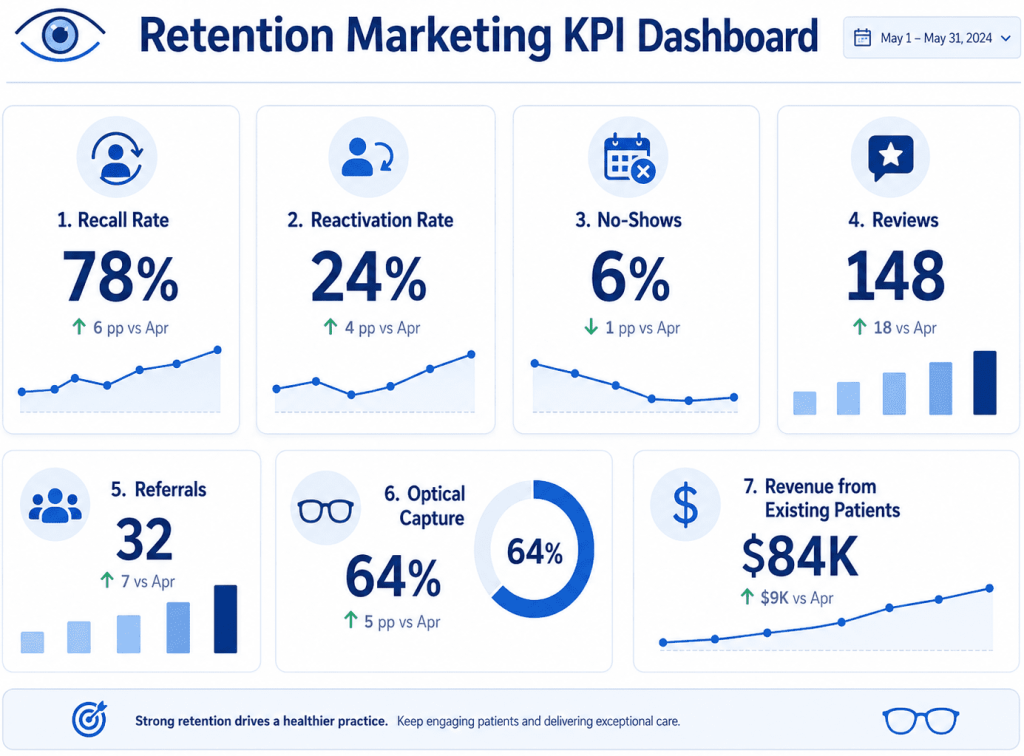
Optometrists should track metrics that connect communication to outcomes. The most useful retention metrics include:
- Patient retention rate
- Recall response rate
- Overdue patient reactivation rate
- Appointment confirmation rate
- No-show rate
- Cancellation rate
- Repeat appointment rate
- Optical capture rate
- Contact lens reorder rate
- Review request conversion rate
- Referral volume
- Patient lifetime value
- Revenue from existing patients
- PPC-acquired patient return rate
Each metric answers a different question. Recall response rate shows whether reminders are working. No-show rate shows whether appointment communication is protecting the schedule. Optical capture rate shows whether patients are buying eyewear from the practice. Reactivation rate shows whether overdue patients can be won back.
What patient retention marketing mistakes should optometrists avoid?
Optometrists should avoid treating retention as a one-time reminder. The biggest mistake is assuming that a single annual message is enough to bring patients back. Patients are busy, distracted, and often unaware of when they are due. Retention requires a sequence.
Another mistake is sending the same message to every patient. A family with children, a contact lens patient, a senior patient, and a diabetic patient may all need different care timelines and different reasons to return. Generic messaging weakens relevance and response.
Practices should also avoid ignoring no-shows, overdue patients, and unhappy feedback. A missed appointment is not just a scheduling issue. It may be the beginning of patient loss. A negative review is not just a reputation issue. It may reveal a retention problem. A patient who has not returned in two years is not just inactive. They may be recoverable with the right reactivation campaign.
Finally, optometrists should avoid using PPC only for new patient acquisition. Paid media can support brand recall, local visibility, and patient re-engagement, but healthcare advertising must be handled carefully. Google’s Customer Match and personalized advertising policies include restrictions around sensitive categories and ad content that implies knowledge of sensitive information, so retention-focused PPC should use privacy-conscious audience strategy and compliant messaging.
How do optometrists bring overdue patients back?
Optometrists bring overdue patients back by using a structured reactivation campaign instead of relying on one reminder. The first step is identifying overdue groups, such as patients who are 6, 12, 18, or 24 months past due. The second step is segmenting those patients by likely need: annual exam, contact lens renewal, medical follow-up, optical purchase, pediatric care, or inactive family account.
The campaign should explain why returning matters, make scheduling easy, and give the patient a low-friction next step. A simple reactivation sequence might include an educational email, an SMS scheduling reminder, a second email with benefit or availability messaging, and a final phone call for high-value or higher-risk patients.
The tone should be helpful, not guilt-driven. Patients should feel that the practice is looking out for them, not scolding them. A message like “It looks like you may be due for your next eye care visit” is usually better than “You are overdue.”
FAQ
What is patient retention marketing for optometrists?
Patient retention marketing for optometrists is the use of recall reminders, email, SMS, reviews, referrals, optical follow-ups, and reactivation campaigns to encourage existing patients to return for future visits and purchases.
How can optometrists improve patient retention?
Optometrists can improve patient retention by scheduling the next visit before patients leave, using automated recall, personalizing communication, following up after no-shows, improving the patient experience, and tracking retention metrics.
What is patient recall in optometry?
Patient recall in optometry is the process of reminding patients when they are due for an exam, prescription update, contact lens evaluation, medical follow-up, or other recommended appointment.
What are the best optometry patient recall strategies?
The best recall strategies use automation, segmentation, email, SMS, phone follow-up, and clear scheduling options. Patients should receive reminders before they are due, when they are due, and after they become overdue.
How do optometrists bring overdue patients back?
Optometrists bring overdue patients back with reactivation campaigns that identify overdue patients, segment them by need, send a sequence of reminders, explain why returning matters, and make scheduling simple.
How often should patients get their eyes checked?
Patients should follow the schedule recommended by their optometrist based on age, symptoms, medical history, risk factors, and vision needs. Patients with diabetes are advised by the CDC to get yearly comprehensive vision exams, including dilated exams.
How can email marketing improve patient retention for optometrists?
Email marketing improves retention by keeping patients engaged between visits. It can be used for exam recall, education, benefits reminders, contact lens prompts, eyewear promotions, and overdue-patient reactivation.
Do SMS reminders work for optometry patient recall?
SMS reminders can work well because they are fast, simple, and action-oriented. Research on healthcare appointment reminders shows that mobile text reminders can increase appointment attendance compared with no reminders or postal reminders.
What patient retention metrics should optometrists track?
Optometrists should track patient retention rate, recall response rate, reactivation rate, no-show rate, repeat appointment rate, optical capture rate, contact lens reorder rate, review conversion rate, referrals, patient lifetime value, and revenue from existing patients.
Should optometrists use PPC for patient retention?
Yes, PPC can support retention when handled carefully. Practices can use privacy-conscious messaging, brand campaigns, local search visibility, and compliant audience strategies, while following healthcare advertising and data-use policies.
Conclusion
Patient retention marketing for optometrists helps practices bring existing patients back more often by turning one-time visits into long-term relationships. The strongest retention systems combine recall reminders, email marketing, SMS, overdue-patient reactivation, optical follow-ups, reviews, referrals, patient experience improvements, and clear KPI tracking.
The most important takeaway is that retention should not be treated as a single campaign. It should be built into the full patient lifecycle. Every patient should have a next step, every missed visit should trigger follow-up, every optical opportunity should be supported, and every campaign should be measured.
For optometry practices that already invest in PPC, retention marketing is especially important. It helps increase the lifetime value of every patient acquired through paid search, local campaigns, referrals, and organic visibility. Instead of constantly starting from zero, practices can grow by bringing existing patients back more consistently.
Why Visiclix is Your Ideal Choice for Patient Retention Marketing for Optometrists?
Visiclix helps optometry practices think beyond one-time patient acquisition. A new appointment is valuable, but the real growth opportunity comes from building a system that keeps patients engaged after that first visit. With the right retention strategy, your existing patient database can become a stronger source of repeat appointments, optical revenue, referrals, and long-term loyalty.
Visiclix understands how retention connects with PPC performance, local visibility, patient reactivation, and conversion-focused messaging. Instead of treating paid ads, recall campaigns, reviews, and patient communication as separate efforts, Visiclix helps align them around one goal: bringing the right patients back more often. That gives your practice a more efficient path to growth without depending only on new patient lead generation.
Visiclix also brings a performance mindset to patient retention marketing. That means campaigns should not only look good or sound professional. They should be structured around measurable outcomes such as scheduled appointments, reactivated patients, lower no-show rates, stronger review generation, and more revenue from existing patients. For optometrists who want smarter growth, that combination of strategy, messaging, and measurement matters.
Bring More Patients Back with Visiclix
Ready to turn your existing patient base into a stronger source of repeat appointments and predictable growth? Visiclix can help your optometry practice build a retention marketing strategy that supports recall, reactivation, PPC performance, patient communication, and long-term loyalty.
Start bringing more patients back with Visiclix.