
Patient recall campaigns bring patients back by reminding them when they are due or overdue for care, but the tone, timing, and workflow behind those reminders determine whether patients experience them as helpful or pushy. A strong patient recall campaign strategy does not feel like a marketing blast. It feels like a timely nudge from a practice that is paying attention.
For healthcare practices, recall is important because patients often miss preventive visits, delay follow-up care, forget recommended treatment, or lose track of when they should return. A recall campaign gives the practice a structured way to identify those patients, contact them through the right channel, and make scheduling simple. AHRQ notes that reminder and recall systems can improve immunization rates, reduce missed appointments, increase preventive care visits, and help practices use clinician and staff time more efficiently.
The goal is not to chase patients. The goal is to help them reconnect with care at the right time, with a message that is specific, respectful, and easy to act on. This guide explains what patient recall means in healthcare, how to create a patient recall campaign, how to automate recall workflows, which strategies work best, and how to write SMS templates that encourage action without sounding aggressive.
What is patient recall in healthcare?
Patient recall in healthcare is the process of identifying patients who are due or overdue for care and contacting them so they can schedule the next appropriate visit. That care may include preventive exams, screenings, immunizations, chronic care follow-ups, annual checkups, dental cleanings, vision exams, wellness visits, treatment plan appointments, or missed appointment rescheduling.
The key word is appropriate. Patient recall should be based on a real care need, not just a desire to fill the calendar. A recall list should come from clinical, scheduling, or practice management data that shows who needs attention and why. For example, the American Academy of Pediatrics explains that immunization reminder and recall systems help practices identify and notify families whose children are due soon or behind on immunizations, often using EHR or Immunization Information System reports.
Patient recall also supports continuity of care. When a patient forgets a follow-up, skips a recommended exam, or never reschedules after a missed appointment, the practice has an opportunity to step in before the patient becomes fully inactive. Done well, recall feels less like “please book with us” and more like “we noticed you may need care, and we’re making it easy to come back.”
What is a patient recall campaign?
A patient recall campaign is a planned outreach effort that helps a practice bring patients back for needed care. It usually includes a defined patient group, a reason for recall, a message sequence, communication channels, scheduling instructions, staff follow-up rules, and performance tracking.
That structure is what separates a campaign from a one-off reminder. A front-desk team calling a few overdue patients when there is free time is helpful, but it is not a campaign. A campaign has a repeatable workflow. It answers: Who should we contact? Why are we contacting them? What should the message say? Which channel should we use? When should we follow up? When should outreach stop? How will we measure results?
The best patient recall campaigns are both operational and patient-centered. They help the practice manage lists, scheduling capacity, and reporting, while also giving patients a clear reason to return. The Community Preventive Services Task Force describes client reminder and recall interventions as notices that remind people when care is due or late, delivered through channels such as phone, letter, postcard, or text message.
What is the difference between patient recall and appointment reminders?
Patient recall messages are sent to patients who need to schedule care. Appointment reminders are sent to patients who already have an appointment booked.
An appointment reminder usually says something like, “You have an appointment with us on Thursday at 10:00 AM.” Its purpose is to reduce no-shows, confirm attendance, or give the patient a chance to cancel or reschedule. Patient recall is different because it starts before an appointment exists. It says, in effect, “You are due or overdue for care, and we can help you schedule.”
There is also a third category: patient reactivation. Reactivation usually focuses on patients who have been inactive for a longer period, such as 12, 18, or 24 months. These patients may need a warmer message because the relationship has cooled. A recall message can be direct and care-specific; a reactivation message often needs to rebuild trust first.
AHRQ makes a similar distinction by describing reminder systems as notices sent before scheduled appointments and recall systems as outreach to patients who missed appointments and need encouragement to reschedule. In practice, many healthcare teams use “reminder,” “recall,” and “reactivation” loosely, but separating them helps you write better messages and track better results.
Why do patient recall campaigns sometimes feel pushy?
Patient recall campaigns feel pushy when the message sounds generic, overly urgent, too frequent, or disconnected from the patient’s actual care need. Patients can tell the difference between a helpful reminder and a pressure tactic.
A pushy recall message usually focuses on the practice’s goal: “Book now,” “limited openings,” or “you are overdue.” A helpful recall message focuses on the patient’s next step: “It looks like you may be due for your next visit, and we can help you schedule a convenient time.” That small change matters because healthcare outreach carries more trust responsibility than ordinary marketing.
Recall also feels pushy when the patient receives too many messages too quickly. A sequence of three identical texts can feel automated in the worst way. A better approach is to vary the purpose of each touch: the first message identifies the care need, the second makes scheduling easier, and the third offers human help.
Clear language also matters. AHRQ’s health literacy guidance notes that even when patients know difficult words, plain language takes less effort to understand. In recall campaigns, that means replacing clinical or administrative phrasing with simple, patient-friendly language.
How does a helpful patient recall campaign strategy improve care and revenue?
A helpful patient recall campaign strategy improves care by closing gaps before they become bigger problems. Patients may intend to return but forget, delay, or assume the visit is not urgent. A well-timed recall message gives them a reason to act and makes the next step easy.
The care impact is especially clear in preventive services. AHRQ reports that reminder and recall systems can improve immunization rates, reduce no-shows, and increase preventive care visits. The Community Preventive Services Task Force recommends client reminder and recall interventions to increase vaccination rates across children, adolescents, and adults, with a review showing a median vaccination-rate increase of 11 percentage points across 29 studies.
The revenue impact comes from the same mechanism. More patients returning for appropriate care means fewer empty appointment slots, better follow-through on treatment plans, and stronger patient retention. This is not about pressuring patients into unnecessary visits. It is about reducing leakage from patients who already need care but have not scheduled.
For PPC-focused practices, recall campaigns can also improve marketing efficiency. Instead of spending only on new patient acquisition, a practice can recover value from patients already in its database. That makes recall a high-intent conversion opportunity because the audience already knows the practice and often has a clear reason to book.
Who should be included in a patient recall campaign first?
The first patients included in a recall campaign should be those with a clear care need and a high likelihood of benefiting from follow-up. Starting with the right segment helps the campaign produce results without overwhelming the front desk.
Good first segments include patients overdue for preventive visits, patients with unfinished treatment plans, patients who missed appointments and never rescheduled, patients due for annual exams or screenings, and patients with chronic care follow-up needs. Recently inactive patients are also a strong segment because they may still remember the practice and respond to a simple, helpful nudge.
Practices should avoid launching to the entire inactive database at once. A large blast may create a short-term spike in calls, but it can also create scheduling bottlenecks, slow response times, and frustrated patients. AAP recommends defining a target group first when broad outreach is not feasible, then running due or overdue reports and creating a clean outreach list.
A practical starting point is to choose one campaign goal, one patient group, and one booking outcome. For example: “Bring back patients overdue for annual eye exams,” “reschedule missed hygiene appointments,” or “complete unfinished treatment consultations.” Specific campaigns are easier to write, easier to automate, and easier to measure.
What are the best patient recall strategies?
The best patient recall strategies combine accurate data, smart segmentation, patient-friendly messaging, channel preference, easy scheduling, automation, human follow-up, and performance tracking. Each strategy supports the same goal: make it easier for the right patient to return for the right care at the right time.
Start with clean data. A recall campaign is only as strong as the list behind it. If the phone numbers are outdated, patients have moved, or the system includes people who already scheduled, the campaign will waste staff time and weaken trust. AAP recommends reconciling data, removing patients who have moved or transferred care, deduplicating records, and verifying phone, email, address, and portal access before outreach.
Next, segment the list. A patient overdue for a routine wellness visit should not receive the same message as a patient with an unfinished treatment plan. The reason for recall should shape the message, the channel, the cadence, and whether a staff member should follow up personally.
The strongest campaigns also make scheduling effortless. A message that says “Call us when you can” is weaker than one that gives a direct phone number, a booking link, or a reply option. Every extra step reduces conversion.
Finally, measure appointments booked, not just messages sent. Delivery rates and open rates are useful, but they do not prove that recall is working. The real performance indicators are responses, bookings, completed visits, no-show rates, opt-outs, and revenue recovered.
How do you create a patient recall campaign?
You create a patient recall campaign by choosing a care goal, identifying the right patient list, writing relevant messages, selecting communication channels, setting a follow-up cadence, and tracking results.
The first step is to define the campaign goal. A vague goal like “bring back inactive patients” is hard to execute. A stronger goal is “schedule overdue preventive exams from patients who have not visited in 13–18 months” or “recover missed follow-up visits from the last 60 days.” Specific goals create better targeting and better messaging.
The second step is to pull the patient list from the system of record, such as an EHR, PMS, CRM, scheduling platform, or registry. Then clean the list. Remove duplicates, exclude patients who already scheduled, update contact details, and confirm whether the patient should still be considered active.
The third step is to build the message sequence. Each message should answer three questions for the patient: Why are you contacting me? Why does this matter? What should I do next? Keep the language calm and direct. Avoid guilt, fear, or overly promotional language.
The fourth step is to launch in a controlled batch. Start small enough that the team can handle responses quickly. If patients reply but no one follows up for two days, the campaign creates friction instead of convenience.
How do you set up a patient recall system step by step?
A patient recall system turns campaign work into a repeatable workflow. Instead of manually remembering who to contact, the practice creates rules for identifying, messaging, following up, and measuring recall patients.
Step 1: Define recall categories
Start by deciding which care situations qualify for recall. Common categories include annual exams, missed appointments, overdue screenings, unfinished treatment, chronic care follow-ups, pediatric immunizations, dental hygiene visits, optical exams, and inactive patients.
Each category should have its own timing rule. For example, a missed appointment may trigger recall after 24–48 hours, while an annual visit may trigger recall after 12 months.
Step 2: Build patient lists
Use your EHR, PMS, CRM, scheduling software, or registry to identify patients who match the recall category. In immunization workflows, CDC notes that IIS tools can generate lists of patients due for vaccines, forecast future due dates, and support reminder functions.
For non-immunization campaigns, the same principle applies. Your system should help answer: Who is due? Who is overdue? Who missed care? Who never completed the next step?
Step 3: Confirm contact preferences
Ask patients how they prefer to be contacted: text, email, phone, portal, or mail. Then document that preference clearly. AAP recommends considering whether families use the patient portal, respond to mail, prefer calls, or find text messages more convenient.
Step 4: Create message rules
Decide what message each patient segment receives, when it is sent, and when outreach stops. For example, a patient who books after the first text should be automatically removed from the rest of the sequence.
Step 5: Connect scheduling
Recall works best when scheduling is easy. Use booking links, reply-to-schedule options, dedicated phone numbers, or clear front-desk workflows. The message should never leave the patient wondering what to do next.
Step 6: Assign staff follow-up
Not every patient should receive endless automation. High-priority patients, patients with complex treatment needs, and patients who express concern should be routed to a person.
Step 7: Review performance regularly
Review campaign results weekly during launch and monthly once the system is stable. Look at bookings, no-shows, opt-outs, patient feedback, staff workload, and revenue recovered.
How do you automate patient recall campaigns?
You automate patient recall campaigns by connecting patient data, recall rules, message templates, scheduling workflows, and reporting into one repeatable system. Automation should reduce manual work, not remove human judgment.
Automation can identify due or overdue patients, segment lists, send SMS and email sequences, trigger follow-ups, stop outreach when a patient books, route replies to staff, and report performance by campaign or channel. This is especially useful for busy practices because recall often fails when staff must manually pull lists, write messages, and track follow-ups one patient at a time.
Automation also helps recall happen at the right time. A patient who missed an appointment last week needs a different message than a patient who has been inactive for two years. Automated workflows can apply different timing rules so the outreach feels relevant.
Still, not everything should be automated. Sensitive situations, complex treatment plans, financial concerns, frustrated patients, and high-risk follow-ups often need human support. A good recall system should know when to send a message and when to hand the conversation to staff.
What channels work best for patient recall campaigns?
The best recall channel is the one the patient is most likely to notice, trust, and use. For most practices, that means using a coordinated mix of SMS, email, phone, portal messages, and sometimes mail.
SMS is strong for short, direct reminders because it is fast and convenient. Email is better when the patient needs more context, such as preparation instructions, educational information, or financing options. Phone calls work well for high-priority patients, older patients, sensitive cases, or people who do not respond digitally. Patient portal messages are useful when patients actively use the portal. Mail can still be helpful for formal notices or patients who are less responsive to digital channels.
The best campaigns often use channels in sequence rather than relying on one channel. For example, a practice may send an SMS first, follow up with email if there is no response, and then assign a phone call for high-value or high-risk patients.
Patient preference should guide the strategy. HHS says healthcare providers can communicate electronically with patients when reasonable safeguards are used, and patients have the right to request reasonable alternative communication methods or locations. That means recall campaigns should not just ask, “What channel converts best?” They should also ask, “What channel has this patient agreed to and expects us to use?”
What are the best patient recall SMS templates or scripts?
The best patient recall SMS templates are short, specific, calm, and easy to act on. They should tell the patient who is contacting them, why they are being contacted, and what to do next.
A helpful recall SMS should not include unnecessary sensitive details. Instead of naming a diagnosis or detailed treatment issue, use general language and invite the patient to call or reply. HHS advises limiting the amount of information disclosed in patient messages and using reasonable safeguards, especially when leaving messages or communicating through less secure channels.
Preventive care recall SMS
Hi [First Name], this is [Practice Name]. It looks like you’re due for your next [visit type]. Reply SCHEDULE or call [phone number] and we’ll help you find a convenient time.
Missed appointment follow-up SMS
Hi [First Name], we missed you at your recent appointment. We’d be happy to help you reschedule when you’re ready. Reply RESCHEDULE or call [phone number].
Annual exam recall SMS
Hi [First Name], this is [Practice Name]. It may be time to schedule your annual [exam/visit]. Reply BOOK or call [phone number] to choose a time that works for you.
Unfinished care plan SMS
Hi [First Name], this is [Practice Name]. We’re following up about your recommended next step. Please call [phone number] or reply CALL and our team can help.
Friendly inactive patient recall SMS
Hi [First Name], we haven’t seen you in a while and wanted to check in. When you’re ready, our team can help schedule your next visit. Reply BOOK or call [phone number].
Pushy vs. helpful recall message example
| Pushy Message | Helpful Message |
| You are overdue. Book now before it gets worse. | Hi [First Name], it looks like you may be due for your next visit. We can help you schedule a convenient time. |
| We have openings this week. Call immediately. | We have a few appointment times available this week if you’d like to come in. Reply BOOK or call us. |
| You never completed your treatment. | We’re following up about your recommended next step and can answer any questions when you’re ready. |
How often should you follow up without annoying patients?
Follow up often enough to be useful, but not so often that the patient feels pressured. A strong recall cadence gives patients multiple chances to respond while respecting silence, opt-outs, and scheduling decisions.
A practical sequence may look like this: send the first recall message when the patient becomes due or overdue, send a second message several days later, send a third message one to two weeks after that, and then use staff follow-up for high-priority patients. Stop the sequence when the patient books, declines, opts out, or is no longer eligible for the campaign.
The most important rule is that each follow-up should add value. Repeating the same message three times feels automated and irritating. A better sequence might start with a care reminder, follow with a scheduling convenience message, and end with an offer to speak with the team.
The cadence should also match the seriousness of the care need. A missed post-treatment follow-up may require faster staff attention than a routine annual visit. Recall strategy should always balance operational goals with clinical judgment.
What compliance and privacy rules should patient recall campaigns consider?
Patient recall campaigns should consider HIPAA, patient communication preferences, reasonable privacy safeguards, SMS consent and opt-out handling, vendor agreements, and internal access controls. The exact requirements can vary by jurisdiction, specialty, message content, technology, and whether a communication is treatment-related or marketing-related, so practices should involve compliance or legal counsel when building automated campaigns.
Under HIPAA, HHS states that appointment reminders are considered part of treatment and can be made without a patient authorization. HHS also says providers may leave messages or mail reminders, but should limit the amount of information disclosed and accommodate reasonable confidential communication requests, such as using email instead of a postcard when reasonable.
For SMS and automated calls, practices should also pay attention to TCPA rules and opt-out handling. The FCC announced that compliance with updated TCPA consent-revocation rules for robocalls and robotexts was required as of April 11, 2025. In practical terms, recall systems should make it easy for patients to opt out and should suppress future messages when they do.
Compliance-friendly recall messages are usually simple. They avoid unnecessary health details, identify the practice, give a clear next step, and respect communication preferences. Internally, patient recall lists should be accessible only to staff who need them, and vendors handling patient data should be reviewed for appropriate privacy and security obligations.
How do you measure whether your patient recall campaign strategy is working?
Measure both campaign performance and patient experience. A recall campaign that produces bookings but also creates high opt-outs, complaints, or staff overload may not be healthy long term.
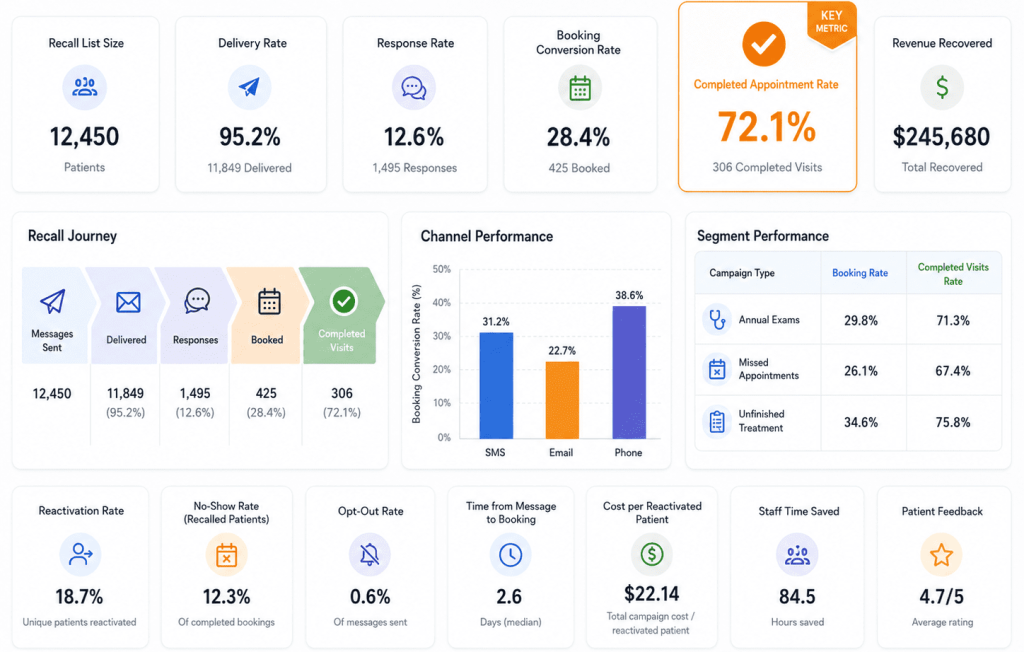
Important KPIs include recall list size, delivery rate, response rate, booking conversion rate, reactivation rate, no-show rate among recalled patients, completed appointment rate, revenue recovered, cost per reactivated patient, time from message to booking, channel performance, opt-out rate, patient feedback, and staff time saved.
The most important metric is usually appointments completed, not just appointments scheduled. A patient who books but no-shows still represents leakage. Track the full path from message sent to visit completed.
Segment-level reporting is also important. One campaign may perform well for annual exams but poorly for unfinished treatment plans. SMS may outperform email for routine recall, while phone calls may work better for complex care. The goal is not just to know whether recall works; it is to learn which recall strategy works best for each patient group.
What mistakes weaken patient recall campaign performance?
The biggest mistake is sending the same message to every patient. Generic outreach feels impersonal and usually performs worse because it does not reflect the patient’s actual reason for returning.
Another common mistake is using outdated data. If the patient has already scheduled, transferred care, changed phone numbers, or opted out, the recall campaign creates confusion. Data quality directly affects trust.
Practices also weaken recall performance by relying on only one channel. SMS may be effective for many patients, but not everyone wants text messages. Phone, email, portal, and mail can all play a role when matched to patient preference and campaign priority.
Over-automation is another risk. Automation is excellent for scale, but patients still need access to a human when they have questions, concerns, or barriers. A recall campaign that cannot handle replies is not truly patient-centered.
Finally, many practices measure the wrong thing. Opens and clicks are useful, but they are not the outcome. A recall campaign should be judged by patient action: responses, bookings, completed visits, lower no-shows, reduced care gaps, and healthier retention.
FAQ
What is patient recall in healthcare?
Patient recall in healthcare is the process of identifying patients who are due or overdue for care and contacting them so they can schedule the next appropriate appointment. It may apply to preventive visits, screenings, immunizations, exams, follow-ups, missed appointments, or unfinished care plans.
What is a patient recall campaign?
A patient recall campaign is a structured outreach effort designed to bring patients back for needed care. It includes a patient list, recall reason, segmentation, message templates, channels, follow-up timing, scheduling instructions, and performance tracking.
How do you create a patient recall campaign?
Create a patient recall campaign by defining the goal, identifying the patient segment, pulling and cleaning the list, writing helpful messages, choosing channels, adding scheduling options, setting follow-up rules, and measuring completed appointments.
What are the best patient recall strategies?
The best patient recall strategies include clean data, focused segmentation, patient-friendly messaging, multi-channel outreach, easy scheduling, automation, human follow-up, opt-out management, and regular reporting.
How do you set up a patient recall system step by step?
Set up a patient recall system by defining recall categories, building patient lists, confirming communication preferences, creating message rules, connecting scheduling workflows, assigning staff follow-up, and reviewing performance regularly.
How do you automate patient recall campaigns?
Automate patient recall campaigns by using technology to identify due or overdue patients, segment them, send scheduled messages, trigger follow-ups, stop outreach after booking, route replies to staff, and report performance.
What are the best patient recall SMS templates or scripts?
The best patient recall SMS templates are brief, specific, and calm. They identify the practice, explain the reason for outreach in general terms, and give one clear next step, such as replying BOOK or calling the office.
What is the difference between patient recall and appointment reminders?
Appointment reminders are sent to patients who already have appointments scheduled. Patient recall messages are sent to patients who need to schedule care because they are due, overdue, missed an appointment, or have not completed a recommended next step.
Conclusion
A strong patient recall campaign does more than ask patients to schedule. It helps them understand when care is needed, gives them a simple next step, and respects how they prefer to communicate.
The most effective patient recall campaign strategy combines accurate data, smart segmentation, helpful messaging, automation, human follow-up, privacy safeguards, and consistent measurement. When those pieces work together, recall campaigns can bring patients back while strengthening trust instead of making outreach feel pushy.
For practices focused on growth, this matters. Recall is one of the most practical ways to improve retention, recover missed opportunities, and make better use of existing patient relationships. The practices that win are not the ones that send the most messages. They are the ones that send the most relevant messages at the right time.
Why Visiclix is Your Ideal Choice for Patient Recall Campaign Strategy?
Visiclix helps healthcare practices turn patient recall from a scattered manual task into a structured growth and engagement system. Instead of relying on generic blasts or inconsistent front-desk follow-up, Visiclix supports a smarter approach built around timing, relevance, patient intent, and measurable results. That means practices can bring more patients back while keeping outreach clear, respectful, and easy to act on.
What makes Visiclix valuable is its balance of strategy and execution. A recall campaign should not only fill open slots; it should protect patient trust, support continuity of care, and help teams work more efficiently. With the right patient recall campaign strategy, Visiclix helps practices identify the right patients, deliver the right message, and guide each person toward the next best step.
Visiclix is especially useful for practices that care about ROI but do not want patient communication to feel overly promotional. By combining segmentation, automation, conversion-focused messaging, and performance tracking, Visiclix helps turn existing patient data into meaningful appointment opportunities. The result is a recall system that feels helpful to patients and valuable to the practice.
Bring Patients Back the Helpful Way With Visiclix
Ready to create recall campaigns that patients actually appreciate? Visiclix can help your practice build a patient recall system that improves bookings, supports retention, and keeps every message focused on trust, timing, and care.