
Front desk and marketing alignment matters because the front desk is often where marketing performance is either converted into revenue or lost through missed calls, inconsistent messaging, poor lead capture, slow follow-up, or unclear handoffs.
A marketing campaign can generate clicks, calls, form fills, appointments, walk-ins, and brand awareness. But once a prospect reaches out, the experience shifts from the ad, landing page, or search result to the people responsible for answering questions, booking appointments, confirming details, and creating confidence. That is why front desk and marketing alignment is not just an internal operations issue. It is a revenue issue.
For PPC campaigns especially, this alignment protects ad spend. Google Ads phone call conversion tracking is designed to help businesses understand which ads, keywords, ad groups, and campaigns drive valuable phone calls and ROI, but that data is only useful when the real customer interaction is handled and tracked properly.
When the front desk and marketing team work from the same playbook, customers hear consistent information, staff understand current campaigns, and every inquiry has a better chance of becoming a booked appointment, consultation, sale, review, or repeat visit.
What Is Front Desk and Marketing Alignment?
Front desk and marketing alignment means the people handling calls, appointments, check-ins, inquiries, and customer questions understand what the marketing team is promoting, who the campaign is targeting, what the customer expects, and what information needs to be captured.
In practical terms, it means the front desk knows which campaigns are live, what offers are being advertised, what landing pages say, what questions prospects are likely to ask, and how each lead should be tracked. It also means marketing understands what happens after someone calls, submits a form, or walks in. Without that visibility, marketing may keep optimizing ads while missing the operational issues that prevent leads from converting.
This is especially important for appointment-based businesses, healthcare practices, hospitality brands, local service providers, clinics, agencies, and multi-location businesses. In these environments, the front desk is not separate from the marketing funnel. It is part of the funnel.
Strong alignment creates one connected customer journey. The ad creates interest, the landing page builds intent, the front desk confirms trust, and the follow-up process moves the customer toward action.
Why Does Misalignment Between the Front Desk and Marketing Hurt Campaign Performance?
Misalignment hurts campaign performance because marketing can bring in the right people, but the customer experience can break down before those people convert.
For example, a PPC ad may promote a consultation, new patient offer, seasonal package, limited-time service, or same-day appointment. If the front desk has not been briefed, staff may not recognize the offer, explain it correctly, ask the right intake questions, or record the source. To the customer, that feels confusing. To the marketing team, it looks like the campaign is underperforming.
This is where many businesses misread their data. A campaign may appear to have a weak conversion rate when the real issue is missed calls, unclear scripts, slow response times, poor booking flow, or incomplete tracking. Google Ads call reporting can show details like call duration, call start time, whether the call was connected, and whether calls of a specified duration count as conversions, but it cannot fix what happens inside the conversation.
The customer experience impact is also significant. Microsoft’s Global State of Customer Service report found that 90% of respondents said customer service is important to their choice of and loyalty to a brand. That means the first human interaction after a campaign can influence not just one conversion, but long-term trust.
When the front desk is disconnected from marketing, common problems appear: staff give inconsistent answers, leads are not tagged correctly, appointments are booked under the wrong service, promotions are misunderstood, and marketing loses the feedback needed to improve campaigns.
How Does the Front Desk Influence the Marketing Funnel?
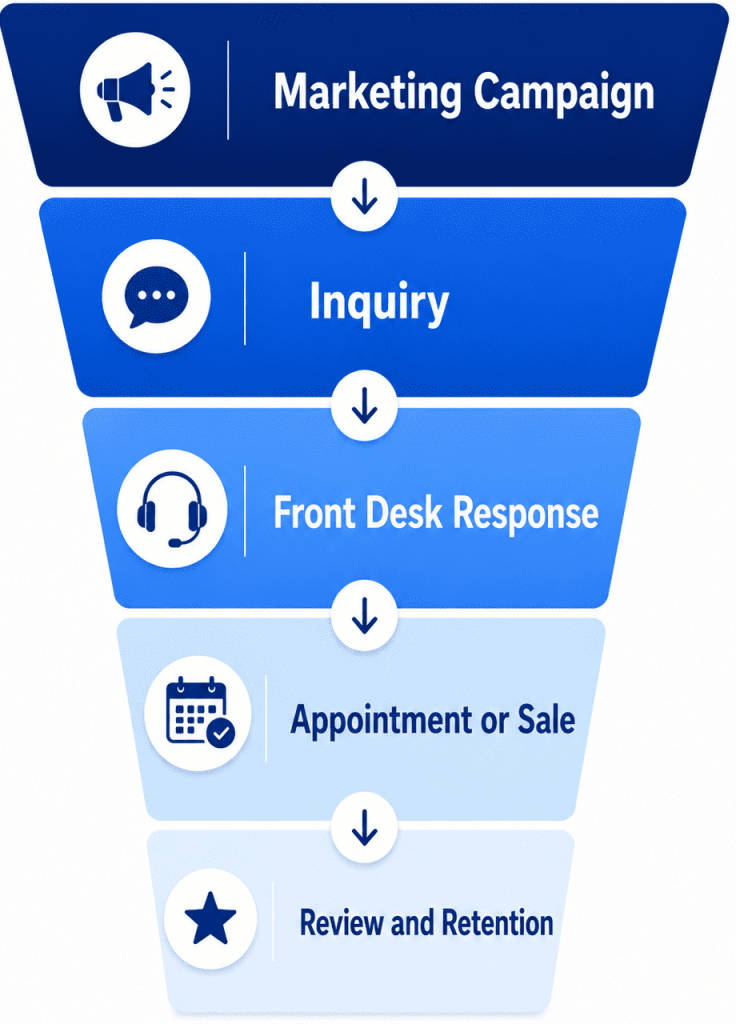
The front desk influences the marketing funnel by handling the critical conversion moments that happen after someone clicks, calls, submits a form, books online, or visits in person.
At the awareness stage, marketing creates demand through PPC, SEO, social media, email, referrals, review platforms, or local search. At the inquiry stage, the front desk becomes responsible for turning that interest into a clear next step. A friendly, informed, and confident response can reinforce the campaign promise. A slow or uncertain response can weaken it.
At the conversion stage, the front desk affects whether the prospect books, buys, visits, registers, schedules, or continues researching. This is where small operational details matter: how quickly the call is answered, whether the caller is asked how they found the business, whether the offer is explained clearly, and whether the next step is easy.
At the retention stage, the front desk continues to influence marketing outcomes through confirmations, reminders, rescheduling, follow-up, review requests, and repeat appointments. Salesforce notes that modern customers expect more than quality service and fair pricing; they increasingly expect proactive service, personalized interactions, and connected experiences across digital channels.
What Should Marketing Teams Share With the Front Desk Before a Campaign Launches?
Marketing teams should share a simple campaign brief before launch so the front desk knows what prospects saw, what they expect, and how to respond.
A campaign brief does not need to be complicated. It should explain the campaign name, launch dates, target audience, offer, promoted service, landing page message, phone number or form being used, and the main action the business wants the prospect to take. The goal is to give the front desk enough context to answer confidently.
The brief should also include common questions and approved answers. For example, if a campaign promotes a limited-time consultation, the front desk should know who qualifies, when the offer expires, how to book it, and what to say if someone asks for pricing, availability, or next steps.
For PPC campaigns, the brief should identify what needs to be tracked. If calls, forms, and appointment bookings are being measured as conversions, staff need to know which lead source fields to complete and what notes matter. Google Ads phone call conversion tracking can help connect ad clicks to calls and ROI, but front desk notes can add the human context behind the data.
A useful campaign brief should include:
- Campaign name and launch dates
- Target audience
- Main offer or service
- Landing page or ad message
- Expected customer questions
- Call script or talking points
- Booking instructions
- Lead source tracking requirements
- Follow-up process
- Escalation rules
- FAQs and approved answers
How Can Front Desk Teams Give Marketing Better Customer Insights?
Front desk teams can improve marketing by sharing what real prospects ask, what objections they raise, where they seem confused, and which messages lead to action.
Marketing platforms show clicks, impressions, conversions, cost per lead, and campaign performance. But the front desk hears the language customers actually use. Staff may notice that callers ask the same pricing question, misunderstand an offer, mention a competitor, request a service that is not highlighted on the website, or use different words than the marketing team uses.
This feedback can improve ad copy, landing pages, FAQs, call scripts, service pages, and follow-up campaigns. For example, if many callers ask whether a service is available on weekends, marketing may need to add that information to the landing page. If prospects keep asking whether an offer applies to existing customers, the ad or form may need clearer qualification language.
Front desk feedback also helps marketing understand lead quality. A campaign may generate many calls, but staff may report that callers are outside the service area, looking for the wrong service, not ready to book, or confused by the offer. That feedback is essential for improving targeting and messaging.
The best process is simple: create a shared feedback loop. Ask the front desk to report recurring questions, objections, missed expectations, campaign confusion, and lead quality notes weekly during active campaigns.
How Can Businesses Create a Better Lead Handoff Between Marketing and the Front Desk?
A better lead handoff comes from defining what counts as a lead, what information must be captured, who owns follow-up, and how quickly each inquiry should be handled.
Many businesses lose opportunities because the lead handoff is assumed rather than documented. Marketing may believe the front desk is following up. The front desk may believe marketing automation is handling it. Managers may assume every call was answered or every form was returned. Without clear ownership, leads slip through the cracks.
Speed matters. InsideSales reported from its 2021 lead response research that conversion rates were 8x greater in the first five minutes, based on more than 55 million sales activities and 5.7 million inbound leads across 400+ companies.
A strong handoff process should define required fields such as name, phone number, email, service interest, lead source, urgency, preferred appointment time, and outcome. It should also define lead statuses such as new, contacted, booked, no answer, rescheduled, not qualified, and closed.
The front desk should know exactly what to do with missed calls, voicemails, web forms, chat inquiries, and after-hours leads. Marketing should know which of those leads booked, which did not, and why. That closed-loop reporting is what turns marketing from a traffic source into a measurable acquisition system.
What Front Desk Scripts Help Keep Marketing Messaging Consistent?
Front desk scripts help staff communicate the same value proposition customers saw in ads, search results, landing pages, emails, or social posts.
Scripts should not make staff sound robotic. Their purpose is to create consistency, reduce uncertainty, and make sure every prospect receives accurate information. A good script gives the front desk a confident starting point while still allowing natural conversation.
A basic greeting script should confirm the business name, create a warm first impression, and invite the caller to explain what they need. A new lead intake script should capture contact information, service interest, how they found the business, and urgency. A promotion script should explain the offer clearly and avoid overpromising.
Objection-handling scripts are especially useful for PPC campaigns because paid traffic often includes prospects comparing options quickly. Staff should be prepared to answer questions about pricing, availability, insurance, consultation requirements, service fit, location, and next steps.
Useful script categories include:
- Greeting script
- New lead intake script
- Campaign offer script
- Appointment booking script
- Objection-handling script
- Missed call voicemail script
- Follow-up script
- Review request script
The goal is not to control every word. The goal is to make sure the front desk and marketing team are reinforcing the same promise.
Which Metrics Show Whether Front Desk and Marketing Alignment Is Working?
Front desk and marketing alignment is working when campaign-generated inquiries are being answered, tracked, booked, followed up, and converted at a measurable rate.
The most important metrics connect marketing activity to front desk outcomes. For example, PPC clicks alone do not tell the full story. A business also needs to know how many calls were answered, how many callers booked, how many appointments showed up, and how much revenue came from those booked opportunities.
Google Ads call reporting can help measure call assets, location assets, and call ads, including details such as whether calls were connected and how long calls lasted. Google also allows calls of a specified duration to be counted as conversions.
However, businesses should not rely only on platform data. They should compare advertising metrics with internal operations metrics. A high call volume with a low booking rate may suggest a script, availability, pricing, or lead quality issue. A strong form volume with slow follow-up may suggest a staffing or workflow issue.
Key metrics to track include:
| Metric | Primary Owner | Why It Matters |
| Call answer rate | Front desk | Shows whether campaign demand is being captured |
| Missed call rate | Front desk | Reveals lost opportunities from paid and organic traffic |
| Average response time | Front desk / operations | Measures speed-to-lead |
| Lead-to-appointment rate | Front desk / marketing | Shows whether inquiries are converting |
| Appointment show rate | Front desk / operations | Reveals quality of booking and confirmation process |
| Source-to-booking rate | Marketing | Shows which campaigns drive real outcomes |
| Cost per booked appointment | Marketing | Connects ad spend to operational conversion |
| Review volume and sentiment | Front desk / marketing | Shows customer experience quality |
| Revenue per campaign lead | Marketing / leadership | Measures true campaign ROI |
How Often Should Front Desk and Marketing Teams Meet?
Front desk and marketing teams should meet before every major campaign launch and then review performance weekly or monthly depending on campaign volume.
A pre-launch meeting should focus on campaign context. Marketing should explain what is being promoted, who the campaign targets, which channels are being used, what the customer will see, and what action the front desk should encourage. The front desk should confirm that it understands the offer, booking process, FAQs, and lead tracking requirements.
During active PPC campaigns, a short weekly check-in is often useful. This meeting does not need to be long. It should cover call quality, booking outcomes, common questions, objections, lead quality, missed calls, and anything confusing customers.
Monthly reviews should look at performance trends. This is where teams can compare ad spend, call volume, form submissions, booked appointments, show rates, and revenue. If campaigns are producing leads that do not book, the team can decide whether the issue is targeting, messaging, availability, front desk training, follow-up, or offer fit.
Quarterly process reviews are useful for improving scripts, CRM fields, reporting dashboards, campaign briefs, training materials, and team responsibilities.
What Tools Can Improve Front Desk and Marketing Alignment?
The best tools are the ones that make campaign details, lead activity, customer notes, and follow-up responsibilities visible to both teams.
A CRM is often the center of this process because it gives teams a shared place to record customer information, lead source, notes, status, and follow-up activity. Appointment scheduling tools can help reduce booking friction. Call tracking tools can help connect calls to campaigns. Shared dashboards can help marketing and operations review performance together.
For paid campaigns, call tracking and conversion tracking are especially important. Google Ads explains that phone call conversion tracking can show how ad clicks lead to calls and can help businesses understand ROI and make better ad spend decisions.
Useful tools may include:
- CRM systems
- Call tracking platforms
- Shared campaign calendars
- Shared FAQs or knowledge bases
- Appointment scheduling tools
- Project management tools
- Review management tools
- Shared KPI dashboards
- Internal chat channels
- Marketing automation platforms
Tools only help when the process is clear. A CRM will not fix alignment if staff do not know what to enter. Call tracking will not improve ROI if no one reviews missed calls. A dashboard will not drive better decisions if marketing and front desk teams do not discuss what the data means.
How Can Leaders Build a Culture Where Front Desk and Marketing Teams Work Together?
Leaders build alignment by treating front desk and marketing teams as contributors to the same revenue and customer experience goals.
This starts by removing blame. If a campaign underperforms, the answer should not automatically be “marketing brought bad leads” or “the front desk failed to convert them.” The better question is: where did the customer journey break down?
Leaders should make campaign context part of front desk training. Staff should understand why certain services are being promoted, what kind of customers the business wants to attract, and how their role affects revenue. This gives the front desk a stronger sense of ownership.
Marketing teams should also understand front desk realities. It is easy to design a campaign around an offer, but the front desk knows whether the offer creates confusion, whether appointment slots are available, whether the phone volume is manageable, and whether prospects are asking unexpected questions.
A healthy alignment culture celebrates shared wins: booked appointments, high-quality calls, better reviews, improved close rates, and stronger campaign ROI. It also documents processes so performance does not depend on one experienced staff member remembering every detail.
What Is a Simple Front Desk and Marketing Alignment Checklist?
A front desk and marketing alignment checklist helps teams confirm that campaigns, scripts, tracking, follow-up, and reporting are ready before money is spent on marketing.
Use this checklist before launching a campaign:
- Campaign brief completed
- Front desk trained on offer and FAQs
- Call scripts reviewed
- Landing page message reviewed by front desk manager
- Lead source tracking confirmed
- CRM fields updated
- Appointment booking process tested
- Missed call recovery process active
- Follow-up process assigned
- After-hours inquiry process confirmed
- Review request process ready
- Reporting dashboard reviewed
- Feedback meeting scheduled
This checklist is especially useful for PPC because paid traffic creates immediate demand. If the front desk is not prepared when the campaign goes live, the business may waste budget before the marketing team has enough data to diagnose the problem.
A good rule is simple: no major campaign should launch until the front desk knows what is being promoted, how to respond, what to track, and who to notify when something is unclear.
FAQ
What does front desk and marketing alignment mean?
Front desk and marketing alignment means the front desk team and marketing team share the same information, goals, messaging, and lead handling process. The front desk understands current campaigns, and marketing understands what happens after a prospect calls, submits a form, books, or visits.
Why is the front desk important to marketing ROI?
The front desk is important to marketing ROI because it handles many of the conversion moments that happen after marketing generates interest. If calls are missed, leads are not tracked, or staff cannot explain the offer, the campaign may lose revenue even if the ads are working.
How can the front desk help improve PPC campaigns?
The front desk can improve PPC campaigns by tracking lead sources, recording common questions, reporting objections, identifying confusing offers, and sharing which inquiries turn into booked appointments. This feedback helps marketing improve targeting, ad copy, landing pages, and follow-up.
What should be included in a front desk campaign brief?
A front desk campaign brief should include the campaign name, dates, target audience, offer, landing page message, expected questions, approved talking points, booking instructions, tracking requirements, and escalation rules.
How do you track whether front desk calls are converting?
You can track front desk call conversions by combining call reporting, call tracking, CRM notes, appointment records, and campaign source data. Google Ads call reporting can help measure calls from ads, while internal tracking shows whether those calls became appointments, sales, or revenue.
How often should marketing train the front desk team?
Marketing should train the front desk before every major campaign launch and provide refreshers whenever messaging, offers, pricing, services, or booking processes change. Active PPC campaigns may also require short weekly check-ins.
What causes front desk and marketing misalignment?
Common causes include lack of campaign briefs, unclear lead ownership, inconsistent scripts, poor CRM usage, missed calls, incomplete tracking, outdated FAQs, and no regular feedback loop between teams.
Can small businesses align marketing and front desk teams without expensive software?
Yes. Small businesses can start with a shared campaign brief, simple call scripts, a lead tracking spreadsheet, weekly check-ins, and a missed call follow-up process. Software helps, but clear communication and accountability matter first.
Conclusion
Front desk and marketing alignment turns marketing from a lead-generation activity into a complete customer acquisition system. Campaigns perform better when the people answering calls, booking appointments, and greeting customers understand what marketing is promising and what customers expect.
The key is not complexity. The key is clarity. Marketing should give the front desk campaign context, scripts, FAQs, tracking requirements, and performance goals. The front desk should give marketing real-world feedback about questions, objections, lead quality, and conversion barriers.
For PPC-driven businesses, this alignment is especially important because every missed call, unclear answer, or untracked lead can affect ROI. When both teams work from the same playbook, the business can reduce wasted ad spend, improve customer experience, and turn more inquiries into measurable revenue.
Why Visiclix Is Your Ideal Choice for Front Desk and Marketing Alignment?
Visiclix is an ideal choice for businesses that want marketing performance to connect with real customer outcomes. A strong campaign is not only about generating traffic; it is about making sure calls, forms, appointments, and follow-ups are handled with the same strategy that brought the customer in. Visiclix helps businesses think beyond clicks and focus on the full path from first impression to booked opportunity.
Visiclix can help businesses identify the gaps between campaign strategy and front desk execution. That includes improving lead handling, clarifying messaging, strengthening PPC tracking, reviewing conversion data, and helping teams understand what happens after a prospect reaches out. With the right alignment, businesses can make better decisions, improve campaign ROI, and create a smoother customer experience.
Align Your Front Desk and Marketing Strategy With Visiclix
Ready to stop losing valuable leads between the campaign and the conversation? Partner with Visiclix to improve your marketing operations, strengthen front desk and marketing alignment, and turn more campaign-generated inquiries into real business growth.