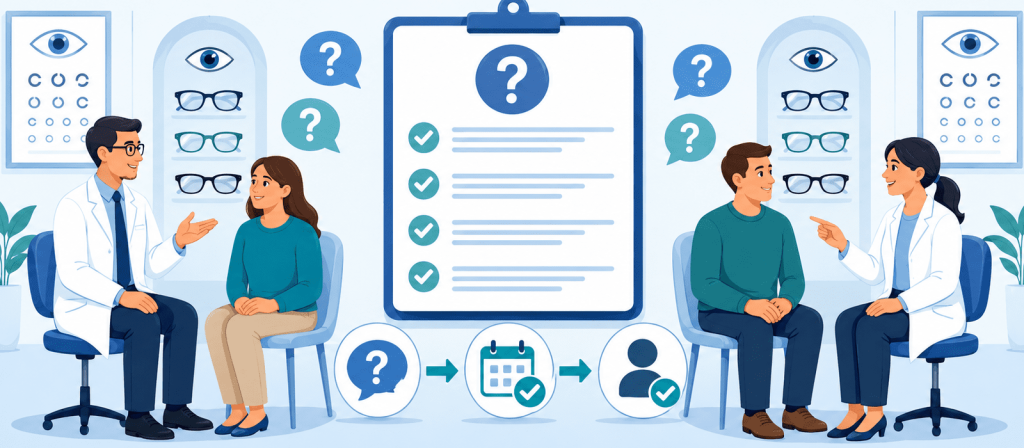
Yes. FAQ pages for optometrists can help clinics get better leads when they answer real patient questions, reduce uncertainty, and guide visitors toward the right appointment action. A strong FAQ page does more than fill space on a website. It helps potential patients understand whether your clinic is the right fit before they call, submit a form, or book online.
For eye clinics, that matters because many patients arrive with a mix of practical and emotional questions. They may wonder whether their insurance is accepted, whether a symptom is urgent, how much an exam might cost, whether their child needs care, or what actually happens during an appointment. When those answers are missing, patients often hesitate, leave the site, or call the front desk with basic questions that could have been answered earlier.
Well-built FAQ content supports both SEO and conversion. Google’s guidance emphasizes helpful, reliable, people-first content rather than pages created mainly to manipulate rankings, which makes real patient questions especially valuable for healthcare websites. For PPC campaigns, FAQ content can also improve the post-click experience by making landing pages more useful, relevant, and easy to navigate. Google describes landing page experience around the usefulness and relevance of the page, ease of navigation, and whether the page matches expectations from the ad.
What Are FAQ Pages for Optometrists?
FAQ pages for optometrists are website pages or sections that answer common patient questions about eye exams, insurance, appointment scheduling, eyewear, contact lenses, symptoms, specialty services, and clinic policies. They are designed to help patients quickly understand what your clinic offers, what to expect, and what step to take next.
A general FAQ page usually covers broad clinic questions, such as accepted insurance, appointment availability, payment options, first-visit instructions, cancellation policies, and how to contact the office. This type of page is useful for patients who are still deciding whether to book or who need quick logistical information before calling.
Service-specific FAQs are more focused. These appear on pages for services such as comprehensive eye exams, pediatric eye care, dry eye treatment, myopia management, contact lens fittings, diabetic eye exams, emergency eye care, or specialty contact lenses. A patient reading a dry eye page may not need general office policies first. They may need to know what symptoms count as dry eye, whether treatment is covered by insurance, how long care takes, and what happens at the first visit.
The best FAQ content uses the patient’s language. Instead of leading with clinical terms, it answers questions the way patients actually ask them: “Why are my eyes always dry?” “Do I need a separate exam for contacts?” “Is sudden blurry vision an emergency?” This makes the content easier to understand, more useful for search, and more effective at moving visitors toward a confident decision.
Why Do Eye Clinic Visitors Need FAQs Before They Book?
Eye clinic visitors need FAQs because unanswered questions create friction. A patient may be interested in booking, but uncertainty about cost, insurance, symptoms, appointment length, or next steps can stop them from taking action. An FAQ page gives them quick reassurance before they decide whether to call or schedule.
Patients often come to an optometry website with practical concerns. They want to know if the clinic accepts their vision insurance, whether medical insurance is different from vision coverage, how long an eye exam takes, what they should bring, whether dilation is required, or whether same-day appointments are available. These questions may seem basic to a clinic team, but they can be decision-making questions for patients.
They also come with health concerns. Someone experiencing flashes, floaters, eye pain, redness, sudden blurry vision, or headaches may not know whether they need a routine eye exam, urgent care, or a medical eye visit. FAQ answers should not try to diagnose the patient online, but they can explain when symptoms deserve prompt evaluation and encourage patients to contact the clinic or seek urgent medical attention when appropriate.
This is especially important because eye exams are connected to broader health. The American Optometric Association notes that comprehensive eye exams can evaluate eye and vision health across age groups, while the CDC states that people with diabetes have a higher risk of eye diseases such as retinopathy, glaucoma, and cataracts and benefit from yearly dilated eye exams and treatment when needed. An FAQ page can help patients understand why care matters without overwhelming them with medical detail.
How Do FAQ Pages Reduce Friction for Optometry Patients?
FAQ pages reduce friction by giving patients fast, clear answers at the moment they are deciding whether to book, call, or leave. In optometry, friction usually appears in five areas: information, trust, booking, cost, and urgency.
Information friction happens when patients cannot find basic answers. For example, they may not know whether your clinic offers pediatric exams, contact lens fittings, dry eye treatment, or diabetic eye exams. If your website makes those answers hard to find, the patient may assume you do not offer the service or may return to search results.
Trust friction happens when patients are unsure whether the clinic is credible or right for their needs. FAQs can support trust by explaining the clinic’s process, what types of patients it helps, how appointments work, and what patients can expect from the care experience. This is not a replacement for doctor bios, reviews, testimonials, or credentials, but it adds another layer of reassurance.
Booking friction happens when patients are unsure what to do next. A patient may wonder whether to request a comprehensive exam, contact lens fitting, urgent eye visit, or optical appointment. A good FAQ can clarify appointment types and direct users to the correct scheduling path. That saves the patient time and helps the clinic receive cleaner, more accurate inquiries.
Financial friction is one of the most common barriers. Patients want to know whether insurance is accepted, whether vision and medical insurance are different, whether HSA or FSA payments are allowed, and what costs may be out of pocket. Even when pricing cannot be exact, explaining the factors that affect cost can reduce anxiety and improve trust.
Urgency friction happens when patients do not know whether a symptom can wait. FAQ answers should be careful and safety-focused. For example, instead of saying, “Floaters are usually harmless,” a stronger answer would explain that new flashes, a sudden increase in floaters, a curtain-like shadow, eye pain, or sudden vision loss should be evaluated promptly. This approach helps patients make safer decisions while avoiding online diagnosis.
How Can FAQ Pages Improve Lead Quality for Optometrists?
FAQ pages improve lead quality by helping visitors self-qualify before they contact the clinic. A better lead is not just someone who fills out a form. It is someone who understands the service, knows what to expect, has fewer unresolved objections, and is more likely to schedule the right appointment.
For example, a contact lens FAQ can explain that a contact lens prescription usually requires a separate fitting from a glasses prescription. That answer can prevent confusion, reduce pricing surprises, and help patients book the correct visit. A dry eye FAQ can explain that treatment may involve evaluation of symptoms, tear quality, eyelid health, screen habits, medications, and environmental factors. That prepares the patient for a more realistic care journey.
FAQ content also helps reduce poor-fit leads. If a clinic does not offer walk-in optical repairs, certain medical procedures, or specific insurance plans, clear FAQ answers can prevent mismatched inquiries. That protects staff time and helps the front desk focus on patients who are more likely to schedule appropriate care.
For PPC campaigns, this becomes even more important. Paid traffic costs money with every click. If someone clicks an ad for “dry eye treatment,” lands on a page, and still cannot tell what the clinic offers, what the first appointment involves, or how to book, the campaign may lose a high-intent visitor. Google’s ads guidance connects landing page quality with usefulness, relevance, navigation, and alignment with ad expectations, which means FAQ content can directly support a stronger post-click experience.
A strong FAQ section near the booking CTA can answer the final objections that often stop conversion: “Is this covered by insurance?” “How soon can I be seen?” “What should I bring?” “Do I need a referral?” “Can I book online?” When these answers are available, visitors can move from interest to action with less hesitation.
What Questions Should Optometrists Include on an FAQ Page?
Optometrists should include questions that real patients ask before booking, during scheduling, at check-in, and after common appointments. The best FAQ pages are built from actual patient behavior, not guesses. Front desk call logs, form submissions, live chat transcripts, Google Business Profile questions, PPC search terms, and staff feedback are all useful sources.
Appointment and scheduling questions should appear near the top because they affect conversion directly. Examples include: “Do I need an appointment for an eye exam?” “How long does a comprehensive eye exam take?” “What should I bring to my first appointment?” “Can I book online?” “Do you offer same-day appointments?” and “What type of appointment should I schedule?”
Insurance and payment questions are also essential. Patients often need to know whether the clinic accepts vision insurance, medical insurance, HSA or FSA payments, and out-of-pocket payment options. A helpful FAQ can also explain that vision insurance and medical insurance may apply to different types of visits, depending on the reason for the appointment.
Eye exam questions should answer common concerns about the experience itself. Examples include: “How often should I get an eye exam?” “What happens during a comprehensive eye exam?” “Is dilation always necessary?” “Can an eye exam detect other health issues?” and “Do children need eye exams before school?” The AOA provides age-based guidance for pediatric and adult eye exams, which clinics can reference when developing patient education content.
Contact lens questions should clarify the difference between a regular eye exam and a contact lens fitting. Patients may ask: “Do I need a separate contact lens exam?” “Can I renew my contact lens prescription online?” “What if my contacts feel uncomfortable?” “Can I switch from glasses to contacts?” and “Do you fit specialty contact lenses?”
Urgent symptom questions should be handled with extra care. Good examples include: “When should I see an eye doctor for floaters?” “Is sudden blurry vision an emergency?” “What should I do if my eye is red and painful?” and “Can I wait if I see flashes of light?” These answers should encourage timely professional evaluation when symptoms could be serious.
Specialty service questions should support the clinic’s growth priorities. If the clinic wants more dry eye, myopia management, diabetic eye exam, pediatric, or specialty lens patients, the FAQ page should address those topics clearly. For example: “Do you treat dry eye?” “Can my child’s nearsightedness get worse?” “Do people with diabetes need yearly eye exams?” and “Who is a good candidate for specialty contact lenses?” The CDC states that yearly dilated eye exams and treatment can help avoid or delay diabetes-related eye disease complications.
How Should Optometrists Structure an FAQ Page for Better User Experience?
Optometrists should structure an FAQ page by category, make questions easy to scan, and link answers to the most relevant next step. A long, unorganized list of questions can overwhelm visitors. A clear structure helps patients find answers quickly and helps search engines understand the page.
Start with the questions most closely tied to booking. These usually include appointment availability, insurance, cost, what to bring, online scheduling, and first-visit expectations. Visitors who are ready to act should not have to scroll through a long medical FAQ before finding practical information.
Then organize the rest of the page into categories. Common categories include appointments, insurance and payment, eye exams, contact lenses, eyewear, children’s eye care, urgent symptoms, specialty services, and clinic policies. Each category should use plain-language headings so patients know where to look.
Answers should be direct first, then helpful. A good FAQ answer starts with a clear response in the first sentence. After that, it can add context, explain exceptions, and suggest the next step. For example, “Yes, most patients need a separate contact lens fitting because contact lenses require measurements and a fit evaluation beyond a glasses prescription.”
Internal links should be used strategically. If a question mentions dry eye treatment, link to the dry eye service page. If a question explains pediatric exams, link to the children’s eye care page. If a question answers booking logistics, link to the appointment page. This helps users continue their journey and helps search engines understand topic relationships.
Mobile usability matters because many patients search from a phone. Google has highlighted the importance of relevant content and easy-to-navigate landing pages for ads quality systems. FAQ pages should use collapsible sections carefully, readable text, clear buttons, and fast-loading layouts so mobile visitors can find answers without friction.
Where Should FAQs Appear on an Eye Clinic Website?
FAQs should appear on the main FAQ page, service pages, PPC landing pages, booking pages, and other high-friction conversion points. A single FAQ hub is useful, but it should not carry the full burden of answering every patient question.
The main FAQ page is best for broad clinic questions. It should answer questions about appointments, insurance, payment options, location, parking, accessibility, forms, cancellation policies, first visits, and how to contact the clinic. This page works well for branded searches and visitors who are evaluating the clinic overall.
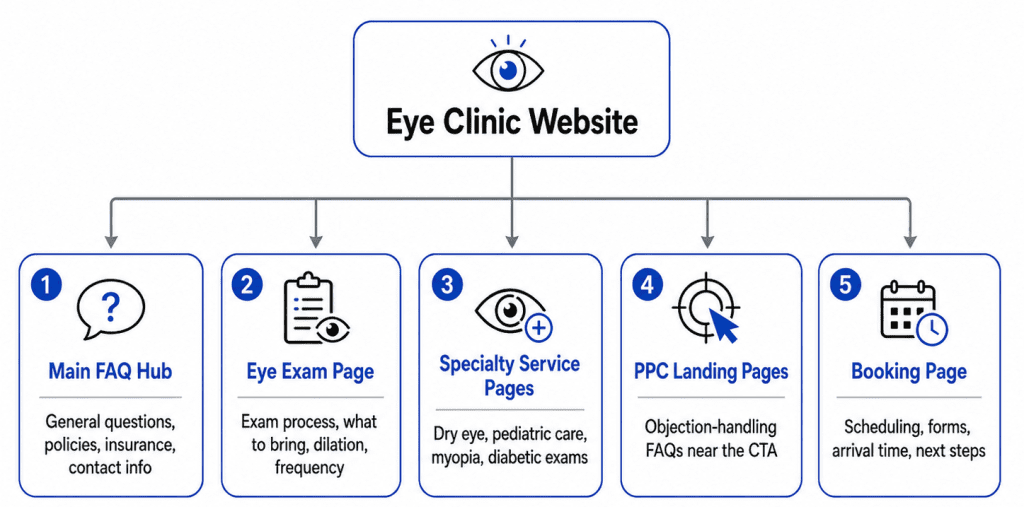
Service page FAQs should answer questions tied to specific care needs. A dry eye page should answer dry eye questions. A contact lens page should answer contact lens questions. A myopia management page should answer parent concerns about children’s nearsightedness. These FAQs help visitors who are already interested in a specific service move closer to booking.
PPC landing page FAQs should be short, focused, and objection-driven. They should answer the questions most likely to stop a paid visitor from converting. For example, a landing page for an eye exam campaign might include FAQs about appointment length, insurance, same-day availability, what to bring, and online booking. A landing page for dry eye treatment might answer whether symptoms can be treated, what the first visit includes, and how soon the patient can schedule.
Booking and contact pages should include practical FAQs only. These may include “What should I bring?” “How early should I arrive?” “Can I reschedule?” “Do I need insurance information?” and “What happens after I submit this form?” These answers reduce last-minute hesitation and help patients complete the booking process.
How Do FAQ Pages Support SEO for Optometrists?
FAQ pages support SEO by targeting long-tail, question-based searches that patients use when they are looking for eye care answers. Patients often search in natural language because they do not know the clinical term for their issue. They may type “why are my eyes blurry after reading,” “do I need an eye exam for contacts,” or “does vision insurance cover eye exams.”
Google’s people-first content guidance is especially relevant here. It encourages content that is useful, reliable, and created for people rather than search engines. FAQ pages naturally fit this model when they are based on real patient questions and answered with accuracy, clarity, and helpful next steps.
FAQ content can also strengthen topical relevance. A clinic with strong pages about eye exams, contact lenses, dry eye, pediatric care, and diabetic eye exams can use FAQ sections to answer related questions and link between relevant services. This creates a more complete content ecosystem around the clinic’s core offerings.
Structured data can help search engines understand question-and-answer content, but clinics should use it carefully and stay current. Google’s FAQPage structured data guidance states that FAQ rich results are available only for well-known, authoritative government-focused or health-focused websites. That means FAQ schema should not be treated as a shortcut to guaranteed enhanced search results. The content itself still needs to be useful.
For optometrists, the SEO goal is not only visibility. It is qualified visibility. A good FAQ page should attract people with real patient intent, help them understand their care options, and move them toward the right service page or appointment action.
How Can FAQ Pages Help Optometrists Get More Value From PPC Traffic?
FAQ pages help optometrists get more value from PPC traffic by reducing uncertainty after the click. Paid search visitors often arrive with a specific need. They may be looking for an eye exam, contact lens fitting, dry eye treatment, pediatric optometrist, or emergency eye care. If the landing page does not answer their immediate questions, the clinic may lose a visitor it already paid to attract.
A good PPC landing page should match the ad’s promise. If the ad promotes same-week eye exams, the landing page should quickly explain availability, booking options, what the exam includes, accepted insurance, and what patients should bring. Google’s landing page experience guidance focuses on usefulness, relevance, navigation, and user expectations after clicking an ad. FAQ content can support all four.
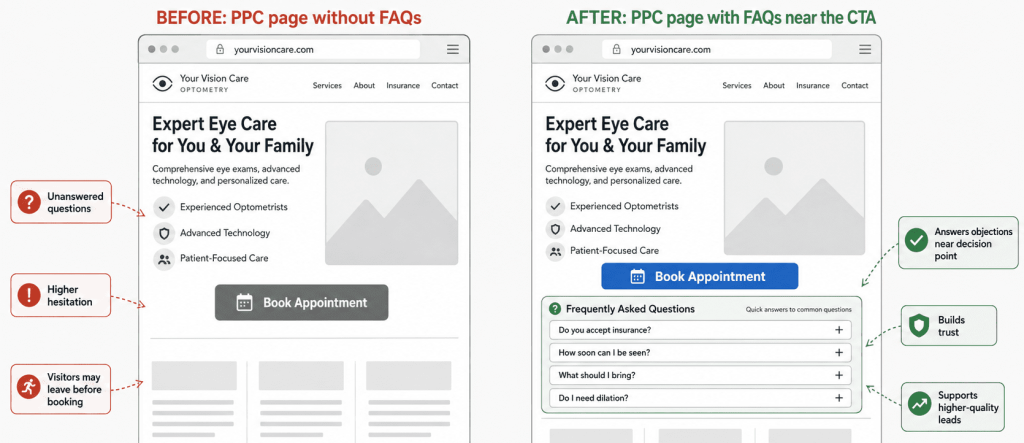
FAQs also help filter traffic. If someone clicks a contact lens ad but needs a service the clinic does not provide, a clear FAQ can prevent an unqualified form submission. If someone is a strong fit, the FAQ can answer enough questions to make booking feel easier.
For campaigns with high cost per click, small improvements in conversion quality matter. A page that generates many vague inquiries may look successful at the form-fill level but create extra staff work and fewer booked appointments. A page that answers objections can produce fewer but stronger leads: patients who understand the service, know what to expect, and are ready for the next step.
FAQ content is especially useful near CTAs. A visitor may be interested but still hesitant. Questions like “Do you accept insurance?” “How soon can I schedule?” “Will I need dilation?” or “Can I book for my child?” can be placed close to the booking button. This lets the page answer objections at the exact point of decision.
How Should Optometrists Write FAQ Answers That Convert?
Optometrists should write FAQ answers that are clear, reassuring, specific, and action-oriented. The best answers do not dodge the question. They answer it directly, explain what matters, and guide the patient toward the next step.
A strong FAQ answer usually follows a simple structure. First, answer the question in the opening sentence. Then add context in plain language. Next, explain what the patient should do if they are unsure. Finally, include a relevant link or CTA when the question shows booking intent.
For example:
Question: Do I need a separate exam for contact lenses?
Yes, contact lens prescriptions usually require a separate fitting because the doctor needs to evaluate lens fit, comfort, and eye health. This helps ensure your lenses are safe, comfortable, and matched to your vision needs. Schedule a contact lens exam if you are new to contacts or need an updated prescription.
This answer works because it is direct, educational, and action-oriented. It explains the reason behind the policy instead of making it feel like an extra charge or administrative hurdle.
Avoid using “Call us for more information” as the main answer to every question. That increases friction. There are times when patients should call, especially for urgent symptoms, insurance verification, or individualized medical concerns. But the FAQ should still provide enough context to be useful.
Medical questions require extra care. FAQ answers should educate, not diagnose. For symptom-related questions, use safe language such as “This can have several causes,” “It is best to schedule an exam,” or “Seek urgent care if you experience sudden vision loss, severe pain, flashes, or a curtain-like shadow.” This keeps the content helpful without replacing professional evaluation.
What Mistakes Should Eye Clinics Avoid With FAQ Pages?
Eye clinics should avoid generic, outdated, poorly organized, or overly promotional FAQ pages. An FAQ page should feel like a useful patient resource, not a thin SEO checklist.
One common mistake is copying generic questions from another clinic. This often produces vague answers that do not reflect the clinic’s services, policies, insurance realities, or patient population. A better approach is to collect actual patient questions from phone calls, front desk conversations, emails, forms, reviews, and paid search terms.
Another mistake is avoiding cost and insurance questions completely. Clinics may not be able to give exact pricing online because coverage and services vary, but they can explain what affects cost, what types of insurance may apply, and how patients can verify benefits. Avoiding the topic entirely can make patients more anxious.
Some FAQ pages use too much medical jargon. Terms like refraction, ocular surface disease, diabetic retinopathy, binocular vision, or keratoconus may be accurate, but many patients need plain-language explanations. Technical terms can still appear, but they should be explained clearly.
Outdated information is another risk. Insurance lists, office hours, appointment policies, payment options, and service availability can change. If an FAQ page gives old information, it can create frustration and damage trust. FAQ pages should be reviewed regularly by both marketing and clinic operations.
Finally, clinics should avoid writing symptom answers that sound too definitive. Eye symptoms can have many causes, and some require urgent attention. FAQ content should help patients understand when to seek care, not convince them that an online answer is enough.
How Can Optometrists Measure Whether Their FAQ Page Is Working?
Optometrists can measure FAQ performance by tracking engagement, search visibility, calls, bookings, and front desk question volume. The goal is not only more page traffic. The goal is better patient decisions and better lead quality.
In Google Search Console, clinics can monitor impressions and clicks for question-based searches. These may include queries about eye exam frequency, contact lens exams, insurance, dry eye symptoms, floaters, dilation, pediatric exams, or diabetic eye exams. Rising impressions can show that the FAQ content is helping the site appear for more long-tail searches.
In Google Analytics, clinics can track FAQ page visits, scroll depth, clicks to service pages, booking button clicks, and form starts. If users visit the FAQ page and then move to appointment scheduling or a service page, that suggests the content is supporting the patient journey.
Call tracking can reveal whether FAQ-driven visitors turn into appointments. Clinics can also compare call quality from pages with FAQs versus pages without FAQs. For PPC campaigns, this is especially useful because form fills alone may not show whether leads are actually valuable.
Front desk feedback is just as important. If staff receive fewer repetitive questions about insurance, appointment length, forms, directions, or what to bring, the FAQ page is doing operational work. If staff keep answering the same questions, those questions should be added or improved.
Heatmaps and session recordings can also show where patients hesitate. If visitors repeatedly expand certain FAQ questions, those topics may deserve more visibility on service pages or landing pages. If visitors ignore a long FAQ section, the page may need better organization, clearer headings, or stronger placement near the CTA.
FAQ
Are FAQ pages for optometrists good for SEO?
Yes. FAQ pages for optometrists can support SEO by answering long-tail, question-based searches that patients use before booking eye care. They also help build topical depth around services such as eye exams, contact lenses, dry eye, pediatric care, and diabetic eye exams.
The SEO value depends on quality. A thin FAQ page with generic answers is unlikely to perform well. A helpful FAQ page based on real patient questions, clear explanations, and relevant internal links is much more useful for both patients and search engines.
Should every optometry service page have FAQs?
Most important service pages should include a short FAQ section. This is especially useful for pages connected to high-intent searches, such as comprehensive eye exams, contact lens exams, dry eye treatment, pediatric eye care, emergency eye care, and myopia management.
The FAQ section does not need to be long. Three to six strong questions near the bottom of a service page can answer objections, support SEO, and help visitors take the next step.
How many questions should an optometrist FAQ page include?
A main FAQ page can include 20 to 40 questions if they are organized by category. A service page FAQ should usually be shorter, often three to eight questions, depending on the complexity of the service.
Quality matters more than volume. Each question should answer something patients actually ask or something that affects booking decisions.
Can FAQ pages help reduce phone calls to the front desk?
Yes. FAQ pages can reduce repetitive calls by answering common questions about insurance, appointment length, forms, what to bring, payment options, and scheduling policies.
They will not eliminate calls, and they should not. Some patients need personalized help. The goal is to reduce avoidable calls so the front desk can spend more time helping patients who need direct support.
Should optometrists include pricing questions in FAQs?
Yes, pricing questions should usually be included, but the answers should be carefully written. Many clinics cannot provide exact prices for every patient because insurance, exam type, testing, and materials can vary.
A helpful answer can explain what affects cost, whether insurance may apply, whether HSA or FSA payments are accepted, and how patients can verify benefits before their visit.
Can FAQ pages help PPC landing pages convert better?
Yes. FAQ sections can improve PPC landing pages by answering the questions that stop paid visitors from booking. These often include cost, insurance, availability, appointment type, treatment expectations, and what happens next.
For paid traffic, FAQ content should be concise and placed close to the CTA. The goal is to reduce hesitation without distracting from the appointment action.
How often should an eye clinic update its FAQ page?
Eye clinics should review FAQ pages at least every few months, and any time policies, insurance participation, services, hours, providers, or booking processes change.
Clinics should also update FAQs when staff notice repeated patient questions. If patients keep asking the same thing, the website should answer it more clearly.
Should optometry FAQ answers include medical advice?
FAQ answers can include general educational information, but they should not diagnose or replace an exam. Symptom-related answers should explain when to schedule an appointment or seek urgent care.
For example, an FAQ can explain that sudden vision loss, severe eye pain, flashes, or a sudden increase in floaters should be evaluated promptly. It should not tell a patient that their symptom is harmless without an exam.
What is the best format for an optometrist FAQ page?
The best format is a categorized, easy-to-scan page with clear questions, direct answers, internal links, and appointment CTAs where appropriate. Categories may include appointments, insurance, eye exams, contact lenses, eyewear, urgent symptoms, and specialty care.
On mobile, the page should be simple to navigate. Collapsible accordions can work well when they are accessible, fast, and easy to open.
Do FAQ pages help patients choose the right appointment type?
Yes. FAQ pages can explain the difference between a comprehensive eye exam, contact lens fitting, medical eye visit, emergency appointment, optical visit, or specialty consultation.
This helps patients book the correct appointment and helps the clinic reduce scheduling confusion. Better appointment selection can improve both patient experience and staff efficiency.
Conclusion
FAQ pages are not just support content. For optometrists, they can reduce hesitation, improve trust, support SEO, and help patients make better decisions before they contact the clinic. They are especially valuable when they answer real patient questions about appointments, insurance, symptoms, services, costs, and next steps.
The best FAQ pages are clear, organized, patient-friendly, and connected to the rest of the website. They do not replace service pages, doctor expertise, or direct patient communication. Instead, they make each of those assets easier to access.
For clinics investing in SEO or PPC, FAQs can also improve lead quality. They help visitors self-qualify, understand what the clinic offers, and move toward the right appointment with fewer unresolved concerns. When every click and call matters, that kind of clarity can make a measurable difference.
Why Visiclix is Your Ideal Choice for FAQ Pages for Optometrists?
Visiclix understands that effective FAQ content for eye clinics has to do more than answer basic questions. It needs to reduce patient hesitation, support search visibility, and guide the right visitors toward booking an appointment. By combining healthcare marketing strategy with conversion-focused content, Visiclix helps optometrists turn common patient questions into stronger website performance.
For clinics investing in SEO or PPC, Visiclix can help build FAQ pages that support both organic discovery and paid traffic conversion. The result is content that works harder across the full patient journey, from first search to scheduled appointment. With the right structure, messaging, and placement, FAQ pages can become one of the most practical lead-quality tools on an optometry website.
Visiclix also understands the difference between more leads and better leads. A strong FAQ strategy can help patients understand appointment types, insurance considerations, service fit, and next steps before they contact the clinic. That means your team can spend less time answering repetitive questions and more time helping patients who are ready for care.
Turn More Patient Questions Into Better Appointments With Visiclix
Your patients already have questions before they book. Visiclix helps you turn those questions into clear, strategic content that reduces friction, improves lead quality, and supports stronger SEO and PPC performance.
Build an FAQ page that works like a conversion tool, not an afterthought. Partner with Visiclix to create patient-focused FAQ content that helps the right visitors take the next step with confidence.