
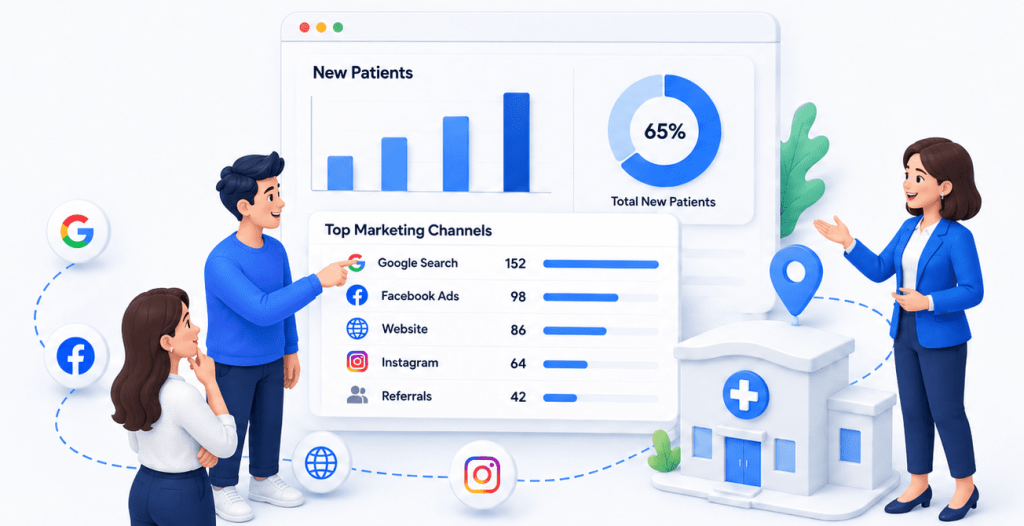
Clinics spend money across Google Ads, SEO, social media, local listings, referrals, email, direct mail, and community outreach. But when a new patient books an appointment, many practices still struggle to answer one simple question: which marketing channel actually drove that patient?
That is where patient attribution marketing becomes valuable. Instead of judging campaigns only by clicks, impressions, calls, or form fills, attribution helps clinics connect marketing activity to real patient outcomes. The goal is not to create a perfect tracking system overnight. The goal is to build a practical model that helps your clinic see which channels create awareness, which ones drive appointment requests, and which ones produce patients who actually show up.
For clinics, this matters because the most visible channel is not always the most valuable one. A patient may first discover your clinic through an educational blog post, return later through a Google search, click a paid ad, call the front desk, and then book after checking reviews. If your reporting only credits the last click, you may overvalue the final touchpoint and undervalue the marketing that built trust earlier in the journey.
A simple attribution model gives clinic owners, practice managers, and healthcare marketers a clearer way to decide where to increase spend, where to reduce waste, and how to measure PPC performance by patient quality instead of lead volume alone.
What Is Patient Attribution Marketing?
Patient attribution marketing is the process of connecting a new patient’s journey back to the marketing channels and touchpoints that influenced them. In plain terms, it helps a clinic answer, “Where did this patient come from, and what marketing activity helped them choose us?”
Marketing attribution usually focuses on assigning credit to clicks, form submissions, purchases, or other conversions. Patient attribution goes further because healthcare conversions often happen through phone calls, appointment requests, insurance checks, referrals, and front-desk conversations. A clinic does not just need to know that someone clicked an ad. It needs to know whether that person became a booked appointment, showed up, and became a real patient.
This makes attribution more complex in healthcare than in ecommerce. An online store can often track a user from ad click to checkout. A clinic’s journey may include online and offline steps: a Google search, a website visit, a phone call, a conversation with staff, a referral from a friend, a review check, and finally an appointment. Google Analytics can show campaign and traffic data when links are tagged properly with UTM parameters, but that digital data still needs to be connected to calls, forms, scheduling, and patient outcomes.
That is why the best clinic attribution model tracks both source and outcome. Source tells you where the patient first came from. Outcome tells you whether the inquiry became a booked and attended appointment. Without both, a clinic may optimize for the campaigns that generate the most activity instead of the campaigns that generate the best patients.
Why Is Patient Attribution Hard for Clinics?
Patient attribution is hard because patient journeys are not linear, many conversions happen offline, and healthcare data must be handled carefully. A person looking for care may not behave like a typical buyer. They may search symptoms, compare clinics, check insurance acceptance, read reviews, ask a family member, and come back days or weeks later before contacting your practice.
This creates a common reporting problem: the channel that closes the conversion often gets too much credit. For example, a patient may first discover your clinic through a non-branded Google Ad for “physical therapy near me,” then return later by searching your clinic name directly. If your system only uses last-click reporting, branded search or direct traffic may receive the credit even though the original paid search campaign introduced the patient to your clinic.
Healthcare also relies heavily on phone calls. Google Ads phone call conversion tracking can help advertisers understand which ads, keywords, ad groups, and campaigns lead to calls, but that still does not automatically confirm whether the caller booked, showed up, or became a valuable patient. A campaign that produces many calls may look successful until the clinic learns that most calls were existing patients, wrong-fit inquiries, insurance mismatches, or unbooked leads.
Privacy adds another layer of complexity. HHS explains that HIPAA rules apply when information collected through tracking technologies or disclosed to vendors includes protected health information. That means healthcare organizations must be careful about how analytics, pixels, call tracking, CRM tools, and advertising platforms collect and share user data. Attribution is still possible, but it should be designed with privacy, data minimization, access controls, and appropriate vendor review in mind.
Another challenge is internal data fragmentation. Marketing reports may show clicks and conversions. Call tracking may show call volume. The front desk may know who booked. The practice management system may show who attended. Finance may know revenue or insurance collections. If these systems are not connected by a simple shared process, the clinic ends up with partial truths instead of a reliable view of patient acquisition.
How Does a Simple Attribution Model Work for Clinics?
A simple clinic attribution model assigns credit based on the patient’s first known source, last known conversion action, and confirmed appointment outcome. This gives the clinic a more balanced view than last-click attribution alone while staying practical enough for small and mid-sized practices.
The model can be summarized like this:
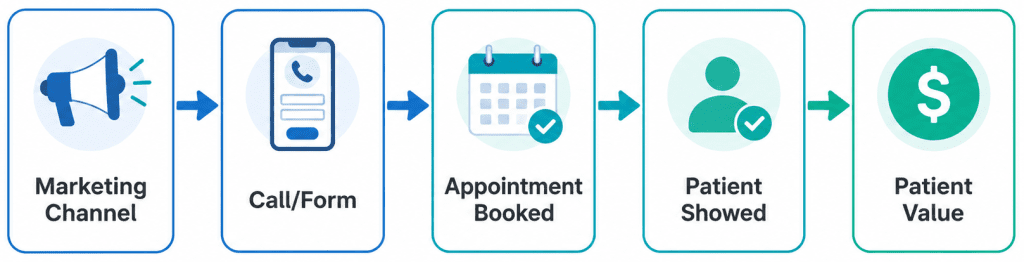
The first step is identifying the first known source. This is the earliest reliable channel that introduced the patient to the clinic. Examples include Google Ads, organic search, Google Business Profile, paid social, organic social, a referral partner, an insurance directory, a local event, or direct mail. This matters because the first source often reflects demand creation. It shows which channel got the patient into your world.
The second step is identifying the last conversion action. This is the action that finally caused the patient to contact or book. Examples include a phone call, appointment form, online booking, chat, returning branded search, or walk-in. Google Analytics attribution path reporting is designed to help marketers understand the different paths users take before completing key events and how credit is assigned across those touchpoints. For clinics, that concept becomes even more useful when digital paths are paired with scheduling outcomes.
The third step is confirming the patient outcome. This is where many clinics improve their marketing decisions quickly. Instead of stopping at “lead generated,” the clinic tracks whether the person booked, whether they showed up, and whether they became a new patient for the intended service line. Missed appointments and cancellations can affect care delivery, patient experience, and operational efficiency, so attribution should not treat every inquiry as equal.
A simple attribution record might look like this:
| Patient Journey Field | Example |
| First known source | Google Ads: non-branded search |
| Last conversion action | Phone call from landing page |
| Supporting influence | Google reviews |
| Appointment status | Booked |
| Visit status | Showed |
| Service line | Urgent care visit |
| Estimated value | $X based on clinic average |
Which Marketing Channels Should Clinics Track First?
Clinics should start by tracking the channels most likely to influence patient acquisition: paid search, organic search, local listings, social media, referrals, calls, and offline campaigns. Trying to track every possible touchpoint at once can make attribution overwhelming. It is usually better to track fewer channels consistently than to build an overly complex system nobody trusts.
Paid search should be one of the first channels tracked because PPC often carries high commercial intent. Patients searching for terms like “urgent care near me,” “pediatric dentist appointment,” or “physical therapy for back pain” are often closer to taking action. For PPC campaigns, clinics should track not just clicks and form fills but phone calls, booked appointments, show rates, and cost per acquired patient.
Organic search is also important because many patients research conditions, symptoms, providers, insurance questions, and treatment options before booking. A blog post may not drive an immediate appointment, but it can create trust and influence a later conversion. This is one reason last-click attribution can mislead clinics: it may undervalue educational SEO content that supports decision-making earlier in the journey.
Google Business Profile and local search deserve special attention. Many clinic decisions happen locally and quickly, especially for urgent care, dental, dermatology, physical therapy, chiropractic, vision care, and primary care. Patients may compare proximity, hours, reviews, photos, and appointment availability before calling. If the clinic does not separately track local listing calls or direction requests where possible, local visibility may be underreported.
Referrals, social media, email, offline advertising, signage, and events should also be tracked when they are active. The practical question is not, “Can we track everything perfectly?” It is, “Can we consistently capture enough information to see which channels produce real patient growth?”
How Can Clinics Track Phone Calls and Form Submissions More Accurately?
Clinics can improve attribution by using source-specific phone numbers, UTM tracking, call tracking, form tracking, and consistent front-desk intake questions. This combination gives the clinic a clearer view of both digital and offline patient behavior.
For phone calls, clinics can use call tracking numbers for major campaigns or channels. For example, a Google Ads landing page may use one tracking number, the website’s organic pages may use another, and a direct mail campaign may use a separate number. Google Ads supports phone call conversion tracking to help advertisers understand how ad clicks lead to different types of calls. It can also track calls from ads or website phone numbers when configured properly.
For forms, clinics should capture source data automatically where possible. UTM parameters can identify the campaign source, medium, and campaign name when users arrive from tagged links. Google’s own Analytics documentation explains that adding campaign parameters to destination URLs lets Analytics show which campaigns referred traffic. For a clinic, that means paid social ads, email campaigns, referral partner links, and PPC landing pages should use consistent UTM naming.
Dedicated landing pages are especially useful for PPC. Instead of sending all ad traffic to a homepage, a clinic can send patients to a service-specific landing page with a trackable phone number, form, and campaign source. This improves both conversion rate and attribution quality because the clinic can see which campaign, keyword group, or service line produced the inquiry.
The front desk also plays a major role. A simple intake question such as “What made you choose us today?” can capture information that digital platforms miss. This question is better than “How did you hear about us?” because it focuses on influence, not just awareness. A patient may say, “I saw your ad, but your reviews convinced me,” which gives the clinic a more complete picture.
For smaller clinics, a spreadsheet can be enough at the beginning. The key is consistency. Every new patient inquiry should include source, channel, campaign if known, appointment status, show status, and service line. Once that process is stable, the clinic can move toward CRM, call tracking, or practice management integrations.
What Attribution Model Should a Small or Mid-Sized Clinic Use?
Most clinics should start with a hybrid model that combines first-touch, last-touch, and appointment outcome tracking. This is practical because it recognizes that patient decisions usually involve more than one interaction while still keeping reporting easy to understand.
Pure last-click attribution is simple, but it can be misleading. It gives all credit to the final touchpoint before conversion, even when earlier channels created the demand. The Association for Computing Machinery’s practical attribution overview describes last-touch attribution as assigning 100% credit to the last engagement in the journey, which is easy to apply but limited when multiple touchpoints influence a decision.
Multi-touch attribution gives a fuller picture, but it can be too complex for clinics that do not yet have clean data. If calls, forms, scheduling outcomes, and patient source fields are inconsistent, a sophisticated model will only make messy data look more advanced. For most practices, the better starting point is a simple weighted model.
A clinic-friendly model could assign credit this way:
| Attribution Component | Suggested Credit |
| First known source | 40% |
| Last conversion source | 40% |
| Supporting touchpoints or patient-reported influence | 20% |
For example, suppose a patient first clicks a non-branded Google Ad, returns later through organic search, reads reviews, and finally calls from the website. The clinic might give 40% credit to paid search for first discovery, 40% to the website call source for conversion, and 20% to organic search or reviews as supporting influence.
The percentages do not need to be perfect. The important point is that the clinic uses the model consistently. Consistency allows month-over-month and quarter-over-quarter comparison. Over time, patterns become more useful than any single patient journey.
This model is especially helpful for PPC because it prevents overreaction. Without balanced attribution, a clinic might pause a campaign that appears expensive on a last-click basis even though it is creating high-quality new patient demand. With outcome tracking, the clinic can see whether that campaign contributes to booked and showed appointments.
How Do You Connect Attribution to Actual Patient ROI?
To connect attribution to ROI, clinics need to measure beyond leads and track booked appointments, attended visits, and estimated or actual patient value. A marketing campaign is not successful simply because it generated clicks or calls. It is successful when it helps the clinic acquire the right patients at a sustainable cost.
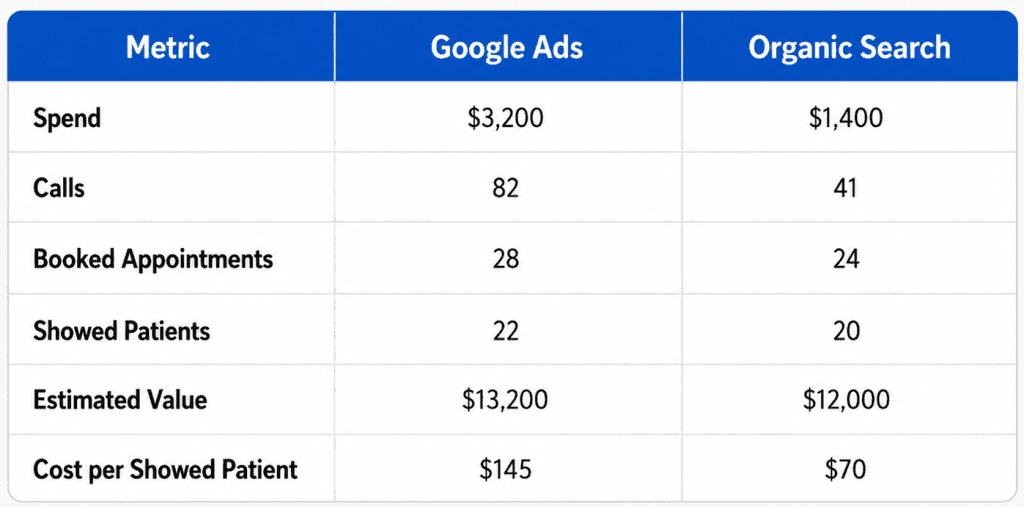
The first step is separating lead metrics from patient metrics. Cost per lead tells you how much you paid for an inquiry. Cost per booked appointment tells you how many inquiries turned into scheduled visits. Cost per showed patient tells you how much you paid for someone who actually arrived. Cost per acquired patient tells you the cost of gaining a new patient, ideally separated from existing patient calls.
This distinction matters because lead volume can be deceptive. Imagine Campaign A generates 80 calls at a low cost, while Campaign B generates only 30 calls at a higher cost. Campaign A may look better in the ad platform. But if only 10 of those 80 callers book and show up, while 18 of Campaign B’s 30 callers become attended appointments, Campaign B may be the stronger investment.
Clinics should also evaluate patient value by service line. A dermatology consultation, urgent care visit, dental implant inquiry, fertility consultation, LASIK evaluation, or physical therapy plan may have very different economic value. A campaign with fewer leads may still deserve more budget if it drives higher-value appointments or better-fit patients.
Google Ads data-driven attribution is designed to use account performance data to help advertisers understand which keywords, ads, ad groups, and campaigns play the biggest role in reaching business goals. For clinics, that “business goal” should not stop at the web conversion. The more meaningful goal is usually a booked appointment, showed patient, completed consultation, or revenue-linked patient acquisition event.
What Metrics Should Clinics Use for Patient Attribution Marketing?
Clinics should use attribution metrics that connect marketing activity to patient growth, not just website traffic or ad clicks. Traffic metrics can help diagnose visibility, but they rarely tell the full patient acquisition story.
The most useful starting metrics include cost per lead, cost per booked appointment, cost per showed patient, new patient volume by channel, appointment show rate by channel, and conversion rate from inquiry to appointment. These metrics help the clinic see not only which channels generate interest but also which channels produce patients who are likely to attend.
For PPC, clinics should pay close attention to branded and non-branded search. Branded campaigns often look efficient because people searching the clinic’s name already know the practice. Non-branded campaigns may look more expensive, but they often introduce the clinic to new patients. Without separating branded and non-branded performance, a clinic may overestimate demand capture and underestimate demand creation.
Call quality is another essential metric. A call should not automatically count as a successful patient acquisition event. Clinics should separate new patient calls from existing patient calls, wrong-number calls, sales calls, insurance mismatch calls, and calls that do not result in booking. Google Ads allows advertisers to set call conversion criteria such as minimum call duration, which can help filter for more meaningful phone interactions.
The strongest attribution dashboards usually include both marketing and operational metrics. A clinic should be able to look at a channel and see spend, inquiries, booked appointments, show rate, cost per showed patient, and estimated value. That is the difference between reporting activity and measuring growth.
How Often Should Clinics Review Attribution Data?
Clinics should review attribution data monthly for campaign optimization and quarterly for budget planning. Weekly checks are useful for catching tracking problems, but bigger marketing decisions usually need more data.
A weekly review should focus on obvious issues. Are calls tracking correctly? Are forms working? Did a campaign stop spending? Did a landing page break? Did the front desk forget to capture source information? Weekly reviews are about data health and quick fixes, not major strategic changes.
A monthly review should evaluate PPC performance, appointment quality, and channel trends. This is where the clinic can compare cost per lead, cost per booked appointment, cost per showed patient, and new patient volume by channel. Monthly reporting is also useful for identifying service lines that need landing page improvements, ad copy changes, or budget shifts.
A quarterly review should focus on budget allocation and strategy. Some healthcare categories have seasonal patterns, insurance-related demand shifts, or local competitive changes. A single week can be misleading, especially for smaller clinics with limited data. Quarterly review gives leadership a better view of which channels consistently contribute to patient acquisition.
The clinic should also review attribution whenever a major change happens. Examples include opening a new location, launching a new service line, changing call handling, replacing the website, adding online booking, starting a new PPC campaign, or changing insurance participation. Attribution is most useful when it reflects the clinic’s actual operating environment.
What Are the Most Common Attribution Mistakes Clinics Make?
The biggest mistake is giving all credit to the final click while ignoring the channels that created patient awareness and trust. This often leads clinics to overinvest in bottom-funnel channels and underinvest in the content, reviews, social proof, and education that influence patient decisions earlier.
Another common mistake is relying only on Google Ads dashboard conversions. Ad platform data is useful, but it is not the same as patient acquisition data. A Google Ads conversion may represent a form submission, call click, or tracked call. The clinic still needs to know whether that conversion became a booked and attended appointment.
Clinics also make the mistake of treating all calls as equal. A 15-second call from an existing patient should not be valued the same as a new patient call that turns into a completed consultation. Call tracking is helpful, but call outcome tracking is what makes it actionable.
Another issue is failing to separate new patients from existing patients. Existing patient calls may be valuable operationally, but they should not be counted as new patient acquisition unless the campaign’s goal is retention or reactivation. Without this distinction, campaigns can appear more successful than they really are.
Inconsistent intake questions can also damage attribution quality. If one front-desk employee asks “How did you hear about us?” and another does not ask at all, the clinic’s source data becomes unreliable. Attribution depends on repeatable behavior from both marketing and operations.
Finally, many clinics optimize for the cheapest lead instead of the best patient. A low-cost lead source may produce poor-fit inquiries, low show rates, or low-value appointments. A higher-cost channel may be more profitable if it attracts patients who book, attend, and continue care.
How Can Clinics Start Patient Attribution Without Complex Software?
Clinics can start with a simple spreadsheet, clean campaign naming, UTM links, call tracking, and a consistent intake process. Advanced software can help later, but the first goal is building a reliable habit around source and outcome tracking.
Start by defining what counts as a conversion. For many clinics, the best primary conversion is not a click or page view. It is a qualified phone call, appointment request, online booking, or new patient form submission. The clinic should also define secondary outcomes, such as booked appointment, showed appointment, completed visit, and estimated patient value.
Next, list all active marketing channels. Include Google Ads, SEO, Google Business Profile, paid social, organic social, email, referrals, insurance directories, events, print materials, signage, and offline ads. Each channel should have a clear naming convention so reports do not split the same source into multiple inconsistent labels.
Then add tracking where it matters most. Use UTM parameters for campaign links, source-specific phone numbers for key campaigns, hidden form fields for source capture, and dedicated landing pages for important PPC campaigns. Google’s campaign URL guidance supports using UTM parameters to identify referral campaigns inside Analytics reports.
After that, train staff to capture source information consistently. The question should be simple and repeatable. For example: “What made you choose our clinic today?” or “Was there anything specific that helped you decide to book with us?” This can reveal influences that tracking pixels and analytics platforms miss.
Finally, review cost per showed patient monthly. This metric forces the clinic to look beyond surface-level lead generation. If a channel drives cheap leads but few showed appointments, it may need better targeting, better landing pages, improved call handling, or reduced budget. If a channel drives fewer but better patients, it may deserve more investment.
When Should a Clinic Move From Simple Attribution to Advanced Attribution?
A clinic should move to advanced attribution when it has multiple locations, higher ad spend, longer patient journeys, or leadership needs clearer ROI reporting. Simple attribution is enough for many clinics at the beginning, but growth creates complexity.
Multi-location clinics often need more advanced tracking because each location may have different demand, competition, service lines, staff capacity, and patient value. Without location-level attribution, strong performance in one market can hide weak performance in another.
Clinics with multiple service lines also benefit from advanced attribution. A campaign for urgent care, primary care, dental implants, dermatology, fertility, or physical therapy may have very different conversion rates and patient values. Service-line attribution helps leadership avoid making budget decisions based on blended averages.
Higher PPC spend is another signal. As budgets grow, small tracking errors become expensive. A clinic spending a few hundred dollars per month may be able to make decisions manually. A clinic spending thousands or tens of thousands per month needs cleaner conversion tracking, call outcome reporting, offline conversion imports, and more disciplined ROI analysis.
Advanced attribution may also be necessary when the clinic wants to connect marketing data to CRM, call tracking, practice management, or revenue systems. Google Ads supports importing call conversion information so advertisers can track when calls lead to more valuable customer actions. For clinics, that type of offline feedback loop can help PPC platforms optimize toward better patient outcomes rather than raw inquiry volume.
FAQ
What is patient attribution marketing?
Patient attribution marketing is the process of identifying which marketing channels and touchpoints influenced a patient to contact, book, and attend an appointment. It helps clinics connect campaigns to real patient growth instead of stopping at clicks, calls, or form submissions.
Why is last-click attribution a problem for clinics?
Last-click attribution is a problem because it gives all credit to the final touchpoint before conversion. A patient may discover the clinic through SEO, social media, reviews, or a non-branded ad before later converting through branded search or direct traffic. If the clinic only credits the final click, it may undervalue the channels that created trust and awareness.
What is the easiest way to track where patients come from?
The easiest way is to combine UTM tracking, call tracking, form source capture, and a consistent front-desk question. Even a spreadsheet can work if the clinic records source, channel, appointment status, show status, and service line for each new patient inquiry.
Should clinics use first-touch or last-touch attribution?
Most clinics should not rely on only one of them. A hybrid model is usually better because first-touch shows what introduced the patient to the clinic, while last-touch shows what caused the patient to contact or book. Adding appointment outcome tracking makes the model more useful for ROI decisions.
How do clinics track phone call attribution?
Clinics can track phone call attribution with call tracking numbers, Google Ads call conversions, website call tracking, and front-desk call outcome notes. The clinic should also record whether the call came from a new or existing patient and whether it resulted in a booked and attended appointment.
What is the difference between a lead and an acquired patient?
A lead is someone who contacts the clinic or submits an inquiry. An acquired patient is someone who books, shows up, and receives care. This distinction matters because a campaign with many leads may not be profitable if few of those leads become real patients.
How can attribution improve PPC performance for clinics?
Attribution improves PPC performance by showing which campaigns, keywords, and landing pages drive booked and showed patients. Instead of optimizing only for low-cost clicks or calls, the clinic can optimize for patient quality, appointment volume, show rate, and return on ad spend.
Conclusion
Patient attribution does not need to be perfect to be useful. Clinics simply need a consistent way to connect marketing channels to inquiries, booked appointments, showed patients, and patient value. Once that connection exists, marketing reports become more than activity summaries. They become decision-making tools.
A simple attribution model helps clinics avoid the biggest reporting trap: assuming the final click did all the work. Patients often interact with several channels before choosing a provider. By tracking first known source, last conversion action, and appointment outcome, clinics get a clearer view of which channels create demand, which ones convert demand, and which ones drive real growth.
For PPC-focused clinics, this clarity is especially important. Ad platforms can show clicks, calls, and conversions, but the clinic needs to know whether those conversions became patients. When attribution is tied to show rates and patient value, budget decisions become smarter, waste becomes easier to find, and growth becomes easier to scale.
Why Visiclix is Your Ideal Choice for Patient Attribution Marketing?
Visiclix helps clinics move beyond surface-level marketing reports and understand which campaigns are actually driving patient growth. Instead of focusing only on clicks or call volume, Visiclix looks at the full path from ad interaction to inquiry, booked appointment, and real patient outcome. This gives clinics a more practical way to evaluate PPC performance and make confident budget decisions.
With a performance-focused approach, Visiclix can help clinics structure campaigns, landing pages, tracking, and reporting around the metrics that matter most. That includes call attribution, form tracking, source analysis, campaign optimization, and patient-quality insights. For clinics that want clearer ROI from paid search and digital marketing, Visiclix brings the strategy and tracking discipline needed to turn marketing data into growth decisions.
Ready to See Which Campaigns Are Actually Driving Patients? Partner With Visiclix
Your clinic should not have to guess which marketing channels are producing real patients. Visiclix can help you build a clearer attribution process, improve PPC tracking, and identify where your budget is creating the strongest patient acquisition opportunities.
Request a PPC and attribution review with Visiclix and start making marketing decisions based on patient outcomes, not guesswork.