Many eye care websites publish content one article at a time: a post about dry eye, another about contact lenses, another about children’s vision, and maybe a short service page for eye exams. Each piece may be useful on its own, but without a connected structure, the website can feel scattered to both patients and search engines.
Topic clusters solve that problem by organizing content around the way patients actually search. Instead of relying on disconnected blog posts, an eye care practice builds a central pillar page around a major service, condition, or patient need, then supports it with related articles that answer specific questions. Each page has a clear purpose, and every page helps strengthen the larger topic.
For eye care practices, this is more than an SEO tactic. It is a better patient education system. Google’s own guidance emphasizes creating helpful, reliable, people-first content, especially content that clearly serves users rather than existing only to manipulate rankings. That matters in eye care because patients are often searching for guidance about symptoms, risks, treatments, and when to schedule an exam.
What Are Topic Clusters for Eye Care Websites?
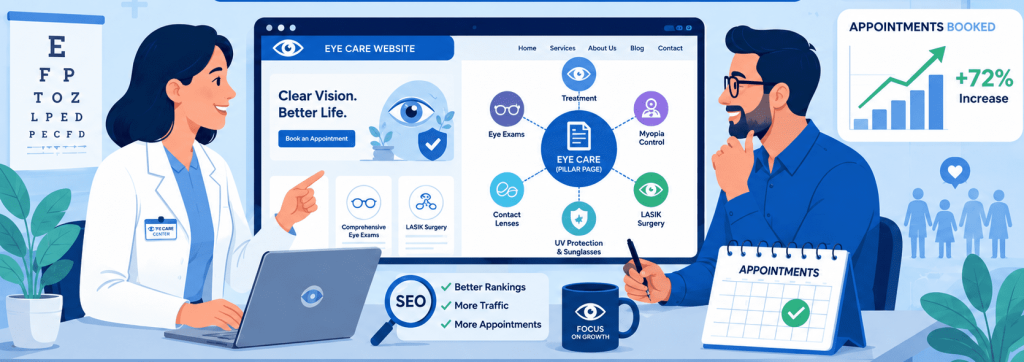
Topic clusters for eye care websites are organized groups of content built around one central eye care topic. A main pillar page covers the broad subject, while supporting cluster pages answer more specific questions related to that topic.
A topic cluster usually has three parts: a pillar page, cluster pages, and internal links connecting them. Ahrefs describes topic clusters as topically grouped pages designed to cover a subject, with one main topic page, supporting subtopic pages, and internal links between them. HubSpot similarly explains the model as a single pillar page supported by multiple related pages that link back to the pillar.
For an eye care practice, a topic cluster might look like this:
Pillar page: Dry Eye Treatment
Cluster pages:
- What causes dry eyes?
- How is dry eye diagnosed?
- Are eye drops enough for dry eye?
- Can screen time make dry eye worse?
- When should you see an eye doctor for dry eyes?
This structure is stronger than posting random blogs because each article contributes to a larger SEO and patient education goal. The dry eye pillar page explains the condition and available care options. The cluster pages answer detailed questions patients may search before they feel ready to schedule an appointment.
The same model works for optometry practices, ophthalmology groups, optical retailers, LASIK co-management providers, pediatric eye care clinics, and multi-location eye care brands. The key is to organize content by patient need instead of publishing isolated posts with no clear connection.
Why Do Eye Care Websites Need a Topic Cluster Strategy?
Eye care websites need a topic cluster strategy because patients rarely make care decisions from one search. They often move through a journey: noticing a symptom, researching possible causes, comparing treatment options, checking whether an exam is necessary, and then choosing a provider.
For example, someone with irritated eyes may start by searching “why do my eyes burn at night.” Later, they may search “dry eye treatment,” “are artificial tears enough,” or “eye doctor for dry eyes near me.” A topic cluster gives your website the opportunity to appear at multiple points in that journey.
This matters because eye care is both educational and action-oriented. Patients need information they can trust, but practices also need content that leads toward appointments. A well-built cluster can serve both purposes. It educates the patient first, then guides them naturally toward the relevant service page, appointment form, phone number, or online booking option.
Eye care content also falls into a sensitive health-related category. The American Optometric Association notes that many eye and vision problems have no obvious symptoms, and early diagnosis and treatment can help prevent vision loss. That means eye care websites should not publish shallow or misleading content. They need organized, accurate, helpful resources that encourage appropriate professional care.
A topic cluster strategy also helps practices avoid a common SEO problem: writing many articles that compete with each other. Without a plan, a site might publish several similar posts about dry eye, eye exams, or contact lenses. With a cluster, each page has a distinct role and links back to a broader authority page.
How Do Topic Clusters Improve SEO for Eye Care Practices?
Topic clusters improve SEO by helping search engines understand which services, conditions, and patient questions your website covers in depth. They also help patients navigate your website more easily, which supports both visibility and conversion.
Google’s SEO Starter Guide explains that websites should be built with users in mind and organized so people can find and explore content easily. Topic clusters support that goal because they create a clear hierarchy: broad topic first, detailed answers second, logical links throughout.
A single page about “eye exams” may not be able to rank for every related search. Patients search for many variations, including comprehensive eye exams, children’s eye exams, diabetic eye exams, contact lens exams, eye exam frequency, and what to expect during an appointment. A topic cluster allows each page to target a specific intent while supporting the larger service topic.
Clusters also strengthen internal linking. When each cluster page links back to the pillar page, and the pillar page links to the most important cluster pages, the website creates a clearer topical relationship. This helps search engines understand which page is the central authority and which pages provide supporting detail.
Another benefit is long-tail keyword coverage. Eye care patients often search in detailed, question-based phrases. They may not search “pediatric optometry” first. They may search “how do I know if my child needs glasses” or “what age should kids get an eye exam.” Cluster content gives your site more chances to appear for these specific, high-intent searches.
What Eye Care Topics Make the Best Pillar Pages?
The best pillar pages are broad, commercially valuable topics that match core services, patient needs, or high-value conditions. A strong pillar topic should be important enough to your practice that you want to rank for it, and broad enough to support several related cluster pages.
For many eye care websites, strong service-based pillar pages include comprehensive eye exams, contact lens exams, pediatric eye care, dry eye treatment, myopia management, diabetic eye exams, glaucoma testing, emergency eye care, cataract evaluations, LASIK consultations, and vision therapy.
Condition-based pillar pages can also perform well when they match patient search behavior. Examples include blurry vision, red eyes, eye pain, digital eye strain, headaches and vision, children’s vision problems, and senior eye health.
Optical-related pillar pages may include prescription glasses, contact lenses, specialty lenses, multifocal lenses, computer glasses, sunglasses, and UV protection. These pages are especially useful for practices that want to connect clinical care with optical product revenue.
Not every topic deserves a pillar page. A blog post about “how to clean your glasses” may be useful, but it probably does not need a full content cluster unless eyewear care is a major part of your business strategy. On the other hand, “contact lenses” could support many related pages, including fitting exams, lens types, comfort issues, replacement schedules, dry eye concerns, and multifocal options.
A good test is simple: can this topic support at least five meaningful patient questions, and does it connect to a service or business goal? If yes, it may be a good pillar candidate.
How Should Eye Care Practices Choose Cluster Topics?
Eye care practices should choose cluster topics by combining patient questions, keyword research, service priorities, and appointment intent. The best cluster topics sound like real questions patients ask before booking care.
Start with your major services. If dry eye treatment is a priority, list the questions patients ask during consultations. They may ask what causes dry eye, whether screen time is involved, whether drops are enough, how diagnosis works, and what treatment options exist. These questions become cluster page candidates.
Then evaluate search intent. Some searches are informational, such as “what causes dry eyes.” Others are commercial or appointment-focused, such as “dry eye treatment near me.” Both can matter, but they need different page types. Informational searches may work best as blog articles, while appointment-focused searches should usually lead to service pages or optimized location pages.
Next, prioritize topics based on business value. If a practice wants to grow pediatric care, myopia management, or specialty contact lenses, those topics should receive more content support than lower-priority services. SEO should not exist separately from business strategy.
For example, a pediatric eye care cluster could include:
What Age Should a Child Have Their First Eye Exam?
This page would answer a common parent question and explain why pediatric eye exams are different from school vision screenings.
How Do I Know If My Child Needs Glasses?
This page could cover signs such as squinting, headaches, sitting close to screens, reading difficulty, or complaints about blurry vision.
Can Vision Problems Affect School Performance?
This page would connect visual skills with reading, attention, and classroom performance while avoiding exaggerated medical claims.
What Is Myopia Control for Children?
This page would explain progressive nearsightedness and introduce treatment conversations in a patient-friendly way.
Are Contact Lenses Safe for Kids?
This page could address maturity, hygiene, sports, self-esteem, and provider guidance.
The strongest cluster topics do not feel like SEO formulas. They feel like helpful answers to questions patients are already asking.
How Do You Build a Topic Cluster for an Eye Care Website Step by Step?
Build a topic cluster by selecting a pillar topic, mapping supporting pages, creating the pillar page, publishing cluster content, and linking everything together clearly.
Step 1: Pick One Primary Service or Condition
Choose a topic that has both search demand and business value. Dry eye treatment, pediatric eye care, contact lens exams, myopia management, and diabetic eye exams are strong examples because they match real patient concerns and can lead to appointments.
Step 2: Define the Search Intent
Before writing, identify what the patient wants to accomplish. Are they trying to understand symptoms? Compare treatment options? Decide whether they need urgent care? Find a local provider? Each intent requires a different content angle.
A patient searching “why are my eyes red” may need education and triage guidance. A patient searching “emergency eye doctor” likely needs fast scheduling information. A patient searching “what happens during a contact lens exam” may need reassurance before booking.
Step 3: Create the Pillar Page
The pillar page should give a complete overview of the topic without trying to answer every subtopic in exhaustive detail. For a dry eye pillar, it may explain symptoms, causes, diagnosis, treatment options, when to see an eye doctor, and how to schedule a visit.
The American Academy of Ophthalmology explains dry eye as a condition involving insufficient or poor-quality tears, with symptoms such as stinging, burning, blurry vision, and irritation. The American Optometric Association also notes that dry eye can occur when tear production and drainage are not in balance. A strong pillar page can use this kind of medically credible information while still staying readable for patients.
Step 4: Create Supporting Cluster Pages
Each cluster page should answer one specific question in depth. Avoid writing several pages that all say the same thing. A page about “dry eye symptoms” should not duplicate the same content as “dry eye treatment options.” Each page should have a distinct purpose.
Step 5: Add Internal Links
Every cluster page should link back to the pillar page. The pillar page should link out to the most important supporting pages. Related cluster pages can also link to each other when it helps the user.
For example, an article about screen-related dry eye can link to a page about dry eye diagnosis, and both can link back to the dry eye treatment pillar page.
Step 6: Add Conversion Points
Topic clusters should educate first, but they should still make the next step easy. Include clear calls to action such as appointment buttons, phone links, online scheduling, insurance information, and location details where appropriate.
A patient who reads three pages about worsening dry eye should not have to search your website to book care.
Step 7: Update the Cluster Over Time
A topic cluster is not a one-time project. Add new questions, update treatment information, refresh internal links, and improve underperforming pages based on search data and patient behavior.
What Does a Strong Eye Care Topic Cluster Look Like?
A strong eye care topic cluster has one central pillar page, several patient-focused support pages, and clear internal links that guide users toward the next helpful step.
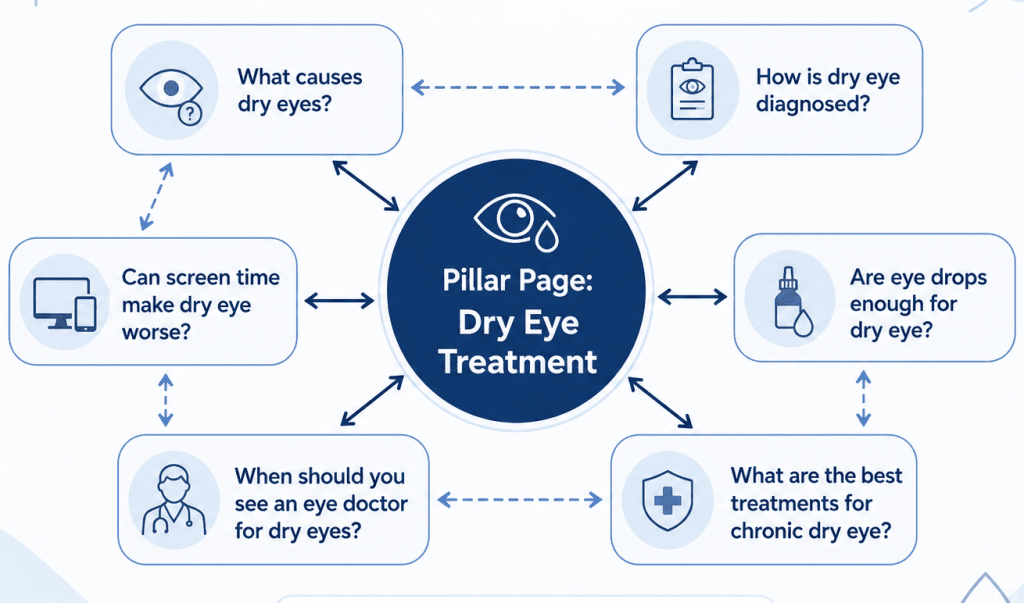
Example 1: Dry Eye Treatment Cluster
Pillar page: Dry Eye Treatment
Cluster pages:
- What causes dry eyes?
- How do eye doctors diagnose dry eye?
- What are the best treatments for chronic dry eye?
- Can screen time cause dry eye?
- Are artificial tears enough for dry eye?
- When should I see an eye doctor for dry eyes?
This cluster works because dry eye patients often search symptoms before searching treatment. It also gives the practice multiple opportunities to explain care options, build trust, and encourage an exam.
Example 2: Myopia Management Cluster
Pillar page: Myopia Management for Children
Cluster pages:
What is myopia control?
Can myopia get worse as children grow?
Are atropine drops used for myopia management?
What are orthokeratology lenses?
How often should children with myopia see an eye doctor?
Is myopia management worth it?
This cluster works well for practices that offer pediatric or specialty care. Parents often need education before they understand why myopia management is different from simply updating a glasses prescription.
Example 3: Contact Lens Cluster
Pillar page: Contact Lens Exams
Cluster pages:
- What happens during a contact lens exam?
- Are daily or monthly contacts better?
- Why do my contacts feel uncomfortable?
- Can I wear contacts with dry eyes?
- Are multifocal contact lenses right for me?
- How often should I replace contact lenses?
This cluster can support both clinical services and optical revenue. It also captures patients who are frustrated with their current lenses and may be looking for a better fitting experience.
How Should Internal Linking Work in an Eye Care Topic Cluster?
Internal linking should clearly connect each supporting article to the main pillar page and guide patients to the next most helpful page. It should feel natural, not forced.
Use descriptive anchor text. Instead of writing “click here,” use phrases like “dry eye treatment options,” “schedule a comprehensive eye exam,” or “learn what happens during a contact lens exam.” Descriptive links help users understand what they will find next.
The pillar page should link to the most important cluster pages, especially when it introduces a subtopic that deserves a deeper explanation. Cluster pages should link back to the pillar page so patients can return to the broader service overview. Closely related cluster pages should link to each other when the connection helps the reader.
For example, a blog post about “why contacts feel uncomfortable” could link to “can I wear contacts with dry eyes” and the main “contact lens exams” page. That helps a patient move from symptom research to service consideration.
Internal linking should also support conversion. Educational blog posts can link to relevant service pages, appointment pages, or location pages. The goal is not to make every paragraph sales-heavy. The goal is to make the patient’s next step obvious when they are ready.
How Can Topic Clusters Support Local SEO for Eye Care Websites?
Topic clusters support local SEO by connecting service expertise with location relevance in a natural, patient-first way. The best local SEO content does not repeat city names awkwardly. It helps local patients understand services, access care, and choose the right provider.
For a single-location practice, local relevance can appear through appointment information, service area context, provider expertise, insurance details, and location-specific calls to action. For example, a dry eye treatment pillar page can mention the practice location naturally in the scheduling section instead of forcing the city name into every heading.
For multi-location practices, topic clusters can support local SEO without creating thin duplicate pages. A common mistake is publishing nearly identical pages such as “Dry Eye Treatment in City A,” “Dry Eye Treatment in City B,” and “Dry Eye Treatment in City C” with only the city swapped. A better structure is to create one strong dry eye pillar page, then connect it to location pages that provide unique details about providers, availability, equipment, parking, insurance, and appointment access.
Google Search Essentials explain the core requirements for making web-based content eligible to appear and perform in Google Search. For local eye care websites, that foundation should be paired with useful, unique content that reflects real services and real patient needs.
Local SEO works best when location signals support usefulness. A patient should leave the page knowing what the service is, whether it fits their situation, where they can receive care, and how to schedule.
Are Topic Clusters Better Than Regular Blogging for Eye Care Practices?
Topic clusters are usually better than regular blogging because they turn individual posts into a connected SEO system. Regular blogging can still work, but only when each article has a strategic role.
A random blog post may answer a useful question, but it may not build authority around a priority service. For example, a practice might publish one post about blue light glasses, one post about glaucoma, and one post about children’s vision. Each post may attract some traffic, but together they do not necessarily strengthen one core topic.
Topic cluster blogging is different. Every article supports a defined pillar page. The content library becomes organized around major services and patient needs. Search engines can better understand the site’s topical depth, and patients can move more easily from education to action.
Regular blogging often produces scattered content, inconsistent internal linking, and unclear conversion paths. Topic clusters create strategic topics, stronger service alignment, clearer internal links, and better long-term SEO value.
This does not mean every blog must be part of a large cluster from day one. A practice can start with one priority cluster, such as dry eye, eye exams, or pediatric eye care. Once that cluster is built, the next cluster becomes easier to plan.
What Mistakes Should Eye Care Websites Avoid With Topic Clusters?
The biggest mistakes are choosing topics that are too broad, publishing thin content, ignoring patient intent, and failing to link pages together.
One common mistake is creating a pillar page that is too short. A pillar page should be a useful central resource, not a 300-word summary with a booking button. It should answer the patient’s main questions and guide them to deeper resources.
Another mistake is writing cluster pages that overlap too much. If three articles all target nearly the same question, they may compete with each other. Each cluster page should have a unique angle, specific keyword intent, and clear connection to the pillar.
Medical accuracy is also essential. Eye care content should be reviewed carefully, especially when discussing symptoms, diseases, treatments, or urgency. Content should encourage professional evaluation when appropriate rather than implying that a website can diagnose a patient’s condition.
Practices should also avoid overusing location terms. Repeating the city name in every heading or paragraph can make content sound unnatural. Local relevance should be woven into service access, provider information, and patient context.
Finally, do not publish clusters without conversion points. An educational article can build trust, but it should still give readers a clear next step. A patient who learns that their symptoms may need an exam should be able to schedule without friction.
How Do You Measure the Success of Topic Clusters for Eye Care Websites?
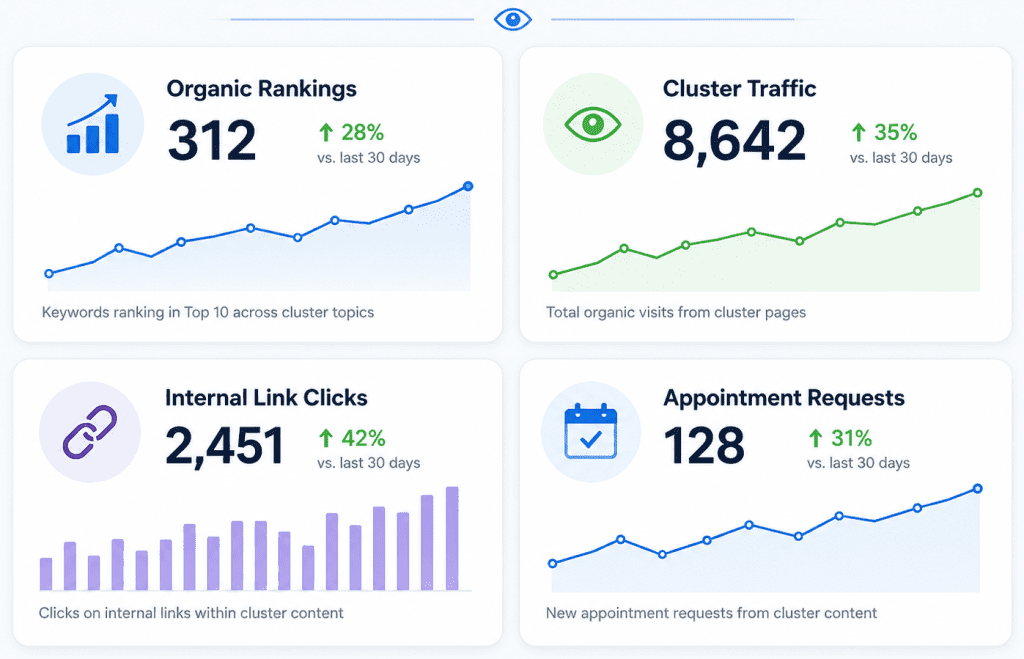
Measure topic cluster success by tracking rankings, organic traffic, engagement, internal link behavior, and appointment conversions. Traffic matters, but the real goal is qualified visibility that leads to patient action.
Start with organic traffic to the pillar page. If the cluster is working, the pillar page should gradually earn more impressions, clicks, and rankings for related terms. Then review traffic to supporting cluster pages. Some cluster articles may bring in early-stage visitors who later return or click into service pages.
Track keyword growth across the whole cluster, not just one primary keyword. A successful dry eye cluster may rank for dozens of related searches, including symptom questions, treatment questions, and appointment-intent terms.
Engagement metrics also matter. Look at time on page, scroll depth, internal link clicks, and whether users continue to related pages. If people land on a cluster article and immediately leave, the page may not be answering the question clearly enough.
Most importantly, track conversions. For eye care practices, useful conversion metrics include appointment form submissions, phone calls, online booking clicks, contact lens exam requests, dry eye consultation requests, and location page visits. Topic clusters should help the practice attract better patients, not just more pageviews.
FAQ
What is a topic cluster in SEO?
A topic cluster in SEO is a group of related pages organized around one main topic. The pillar page covers the broad topic, while cluster pages answer specific subtopics and link back to the pillar.
How many cluster pages should an eye care pillar page have?
Most eye care pillar pages should start with five to ten strong cluster pages. The exact number depends on the topic. A broad topic like eye exams or dry eye treatment can support more cluster pages than a narrow topic.
Can small optometry practices use topic clusters?
Yes. Small optometry practices can use topic clusters effectively by starting with one high-value service. For example, a practice could build a cluster around comprehensive eye exams, dry eye treatment, pediatric eye care, or contact lens exams.
Should every eye care service have its own topic cluster?
No. Every important service should have a strong page, but not every service needs a full topic cluster. Build clusters around services that have strong search demand, patient questions, and business value.
How long should an eye care pillar page be?
An eye care pillar page should be long enough to answer the patient’s main questions clearly. Many strong pillar pages are comprehensive, but length should come from usefulness, not filler. The page should explain the service or condition, who it helps, what to expect, related questions, and next steps.
Do topic clusters help with local SEO?
Yes. Topic clusters can support local SEO by strengthening service relevance and connecting educational content to local service pages, provider pages, and appointment options. The key is to use location naturally instead of forcing city names into every section.
How often should eye care websites update topic clusters?
Eye care websites should review important topic clusters at least a few times per year. Updates may include refreshing medical information, adding new patient questions, improving internal links, and strengthening calls to action.
Can topic clusters improve appointment bookings?
Yes. Topic clusters can improve appointment bookings when they attract qualified search traffic and guide patients toward relevant services. The structure works best when educational pages connect clearly to service pages, online scheduling, and location-specific appointment options.
Conclusion
Topic clusters give eye care websites a smarter way to organize content around patient needs, search intent, and core services. Instead of publishing disconnected blog posts, practices can build content systems that help patients understand symptoms, compare care options, and decide when to schedule an appointment.
The best clusters are built around real patient questions. They use strong pillar pages, specific supporting articles, and clear internal links to create a better experience for both users and search engines. They also connect SEO to business outcomes by guiding visitors toward relevant services, locations, and appointment options.
For eye care practices, the opportunity is clear: a well-planned topic cluster strategy can turn your website from a basic online brochure into a structured patient acquisition asset.
Why Visiclix is Your Ideal Choice for Topic Clusters for Eye Care Websites?
Visiclix helps eye care practices move beyond random blog publishing and build content systems that support real growth. Instead of creating isolated articles, Visiclix structures content around patient intent, service priorities, and the search journeys that lead people from symptoms to appointments. This makes your website easier for patients to use and easier for search engines to understand.
With Visiclix, topic clusters are planned around the services your practice actually wants to grow. Whether your priority is dry eye treatment, pediatric eye care, myopia management, contact lens exams, or comprehensive eye exams, Visiclix can help turn those services into organized content hubs. Each page is built to educate, build trust, and guide patients toward the next step.
Visiclix also understands that eye care content must be accurate, clear, and confidence-building. Patients are not just looking for generic SEO content; they are looking for answers that help them make better health decisions. By combining SEO strategy with patient-focused messaging, Visiclix helps eye care websites attract qualified traffic and convert more visitors into scheduled appointments.
Build a Smarter Eye Care SEO Strategy With Visiclix
Ready to turn your website content into a stronger patient acquisition system? Partner with Visiclix to plan, build, and optimize topic clusters that improve search visibility, answer patient questions, and support more appointment bookings.