
Many optometry practices know they should publish blog content, but the planning process often starts with guessing. A team brainstorms a few eye care topics, checks what competitors are writing about, adds a seasonal post, and hopes the content brings in patients. The problem is not blogging itself. The problem is choosing topics without a clear connection to what patients are already asking, searching, and worrying about.
A stronger optometry blog topic strategy starts with patient questions. Those questions reveal symptoms, concerns, objections, timing issues, service needs, and appointment intent. They also help your practice create content that feels genuinely useful instead of promotional.
Google’s own guidance emphasizes creating helpful, reliable, people-first content rather than content made mainly to manipulate rankings. That makes patient-question-led planning especially valuable for optometry practices because it aligns SEO with real patient needs.
What Is an Optometry Blog Topic Strategy?
An optometry blog topic strategy is a structured plan for choosing, organizing, publishing, and measuring blog topics that answer patient questions while supporting practice growth. It is not just a list of blog ideas. It is a system that connects patient concerns to relevant services, local search visibility, PPC insights, and appointment-focused calls to action.
For example, a random blog idea might be “5 Tips for Healthy Eyes.” A strategic topic would be “Why Do My Eyes Feel Dry After Wearing Contacts All Day?” The second topic is more specific, more patient-centered, and easier to connect to a contact lens exam, dry eye evaluation, or specialty lens consultation.
A good topic strategy also helps organize your website around themes. HubSpot describes topic and pillar structures as a way to organize content around topics that matter to customers, with supporting content linking back to a central pillar page. For an optometry practice, that might mean building a dry eye content cluster, pediatric eye care content cluster, contact lens content cluster, or comprehensive eye exam content cluster.
The goal is not to publish more content for the sake of activity. The goal is to create a useful content system that helps patients understand their symptoms, compare care options, trust your expertise, and take the next step toward booking.
Why Should Optometry Practices Plan Blog Topics Around Patient Questions?
Optometry practices should plan blog topics around patient questions because those questions show what people are actively trying to understand before they schedule care. Patients rarely begin with perfect clinical language. They search things like “why are my eyes burning,” “does my child need glasses,” “how often should I get an eye exam,” or “why do contacts feel scratchy.”
Those searches reveal intent. Some patients are looking for education. Some are trying to decide whether symptoms are serious. Some are comparing services. Others are close to booking but need reassurance first. Google’s SEO Starter Guide explains that SEO is about helping search engines understand content and helping users find a site and decide whether to visit it. Patient-question topics support both goals because they make the content clearer for search engines and more useful for people.
Patient questions also help practices avoid generic content. A post about “eye care tips” may be accurate, but it is broad. A post answering “Can an eye exam detect diabetes?” is more specific and more likely to match a real patient concern. The CDC notes that people with diabetes are at higher risk for vision loss and eye diseases, and yearly dilated eye exams can help avoid or delay these conditions.
This approach can also support the front desk and clinical team. If patients repeatedly ask what happens during a contact lens exam, whether children need annual eye exams, or when dry eye symptoms need professional care, those questions can become blog posts, FAQ sections, email content, and ad landing page support.
How Do You Find the Patient Questions That Should Become Blog Topics?
Start with the questions your patients already ask, then validate them with search data, PPC data, and service relevance. The best topic ideas usually come from the daily language of your patients, not from an isolated keyword spreadsheet.
Your front desk is one of the best sources. They hear questions about insurance, exam pricing, appointment timing, accepted plans, urgent symptoms, what to bring, and whether a concern requires an eye doctor. These questions may not sound like “SEO topics” at first, but they often reveal conversion barriers.
Doctors and technicians are another strong source. They hear questions during comprehensive exams, pediatric visits, dry eye consultations, contact lens fittings, diabetic eye exams, and eyewear discussions. When the same explanation is repeated multiple times each week, it is usually a sign that the topic deserves a blog post.
Google Business Profile reviews, appointment forms, chat transcripts, intake notes, and website search data can also reveal useful language. Reviews may show why patients choose the practice, what they appreciated, what confused them, or what services they did not know were available.
PPC data is especially useful for practices running Google Ads. Google Ads’ search terms report shows the actual searches that triggered ads and how those searches performed. Google also notes that this report can help advertisers discover ideas for creative and landing page content that aligns with what customers are looking for.
For Visiclix, this is where blog strategy becomes more than SEO. PPC search terms can reveal high-intent patient language quickly. If paid campaigns are showing that people search for “dry eye doctor near me,” “children’s eye exam cost,” or “contact lens exam for astigmatism,” those insights can shape organic blog topics, service page FAQs, ad copy, and remarketing content.
How Do You Turn Patient Questions Into Blog Topics?
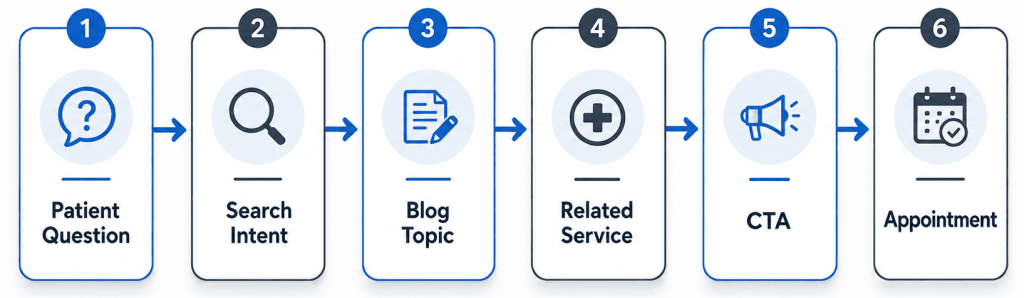
Turn each patient question into a blog topic by identifying the concern behind the question, the search intent, the related service, and the next step the reader should take. The question itself is only the starting point. The strategy comes from mapping that question to the patient journey.
A patient asking “Why do my contacts feel dry?” may be dealing with lens fit, dry eye, screen use, allergies, overwear, or the wrong lens material. A strong blog post would answer the question directly, explain common causes, describe when to schedule an exam, and link to contact lens or dry eye services.
A patient asking “How often should my child get an eye exam?” needs more than a short answer. The post can explain why children’s vision matters, how school vision screenings differ from comprehensive eye exams, what parents may notice at home, and how pediatric eye care supports learning and development. The AOA emphasizes that comprehensive eye and vision examinations are part of preventive healthcare because some eye and vision problems may have no obvious signs or symptoms.
| Patient Question | Blog Topic | Related Service | CTA |
| “How often should my child get an eye exam?” | How Often Should Children Have Eye Exams? | Pediatric eye care | Schedule a children’s eye exam |
| “Why are my contacts uncomfortable?” | Why Do My Contact Lenses Feel Dry or Scratchy? | Contact lens exam / dry eye care | Book a contact lens evaluation |
| “Can an eye exam detect diabetes?” | What Health Problems Can an Eye Exam Detect? | Comprehensive eye exams / diabetic eye exams | Schedule a comprehensive eye exam |
| “Why are my eyes dry when I wake up?” | Why Do My Eyes Feel Dry in the Morning? | Dry eye treatment | Request a dry eye consultation |
| “Are floaters normal?” | Are Eye Floaters Something to Worry About? | Medical eye care / urgent eye care | Call for an eye health evaluation |
The best blog topics are specific enough to answer a real concern, but broad enough to support a complete article. Avoid turning every question into a thin 300-word post. A good patient-question article should answer the question quickly, explain the context, clarify edge cases, and guide the reader toward care when appropriate.
How Should You Prioritize Optometry Blog Topics?
Prioritize optometry blog topics based on patient demand, service value, local relevance, and conversion potential. Not every question deserves the same urgency. Some questions may be common but not closely tied to growth. Others may have lower search volume but strong appointment intent.
A question like “Why do my eyes burn after using a computer?” may be valuable because it connects to dry eye, digital eye strain, workplace habits, and comprehensive exams. The National Eye Institute notes that dry eye can cause symptoms such as scratchiness, burning, redness, light sensitivity, and blurry vision, and that dry eye can happen when people spend a lot of time looking at computers, tablets, or smartphones.
High-priority topics usually meet several criteria. They are commonly asked by patients. They connect to services the practice wants to grow. They show some level of appointment intent. They can be answered with real clinical expertise. They can link naturally to a service page. They can also support PPC, email, social, or Google Business Profile content.
Do not choose topics only because they have high search volume. In healthcare and local service marketing, lower-volume questions can be highly valuable if they indicate a specific need. Ahrefs describes long-tail keywords as more specific and often less competitive than broad head terms, with stronger intent alignment and potential conversion value.
A practical prioritization score can include:
| Scoring Factor | Question to Ask |
| Patient frequency | Do patients ask this often? |
| Service value | Does it connect to a priority service? |
| Intent strength | Does the question suggest the patient may book soon? |
| Expertise | Can the practice answer this better than generic sites? |
| Internal linking | Can it link to a relevant service page? |
| Campaign value | Can it support PPC, email, social, or remarketing? |
The strongest topics are not always the flashiest. They are the topics that sit at the intersection of patient concern, clinical relevance, and business value.
What Types of Patient Questions Make the Best Optometry Blog Topics?
The best optometry blog topics usually come from symptom questions, service questions, timing questions, comparison questions, cost questions, and prevention questions. These categories work because they mirror how patients think before they book.
Symptom-based questions are often the strongest starting point. Patients may search for blurry vision, dry eyes, headaches, redness, floaters, light sensitivity, eye strain, burning, or trouble seeing at night. These topics should be handled carefully, with patient-friendly explanations and clear guidance about when to seek professional care.
Service-based questions help patients understand what your practice offers. Examples include “What happens during a comprehensive eye exam?”, “What is included in a contact lens exam?”, “How does dry eye treatment work?”, “What is myopia management?”, and “What is a diabetic eye exam?” These posts can reduce uncertainty and make service pages more persuasive.
Timing questions are also valuable. Patients often want to know how often to get an eye exam, when children should be seen, when to replace glasses, when contact lenses need an update, or when symptoms become urgent. These posts can create natural appointment opportunities without sounding pushy.
Comparison questions help patients make decisions. Examples include “Optometrist vs. ophthalmologist: who should I see?”, “Eye exam vs. vision screening: what is the difference?”, “Daily vs. monthly contacts: which is better?”, and “Glasses vs. contacts: which option fits my lifestyle?”
Cost and insurance questions can be sensitive, but they are often important conversion topics. A practice does not always need to list exact prices in a blog post, especially when fees vary by exam type or insurance plan. But it can explain what affects cost, what may be included, and why patients should contact the office for personalized details.
Prevention and lifestyle questions work well for building trust. Topics may include screen habits, UV protection, sports eyewear, allergy season, workplace eye strain, nutrition, and back-to-school eye care. These are useful for early-stage patients who may not be ready to book today but are building familiarity with the practice.
How Can Blog Topics Support Local SEO for Optometry Practices?
Blog topics support local SEO when they answer real local patient concerns and connect naturally to services available in the community. Local SEO does not mean stuffing the city name into every heading. It means making content useful for the people the practice actually serves.
Forced geo-targeting sounds unnatural. A title like “Best Dry Eye Doctor in Dallas” may feel written for search engines, not patients. A better title would be “Why Dry Eyes Can Flare Up During Dallas Allergy Season.” That version uses location context because it adds relevance, not because it is trying to repeat a keyword.
Local blog topics can reflect school schedules, seasonal allergies, climate, major employers, sports activities, senior communities, or local lifestyle patterns. A pediatric optometry post might connect to back-to-school timing. A dry eye post might connect to local weather or screen-heavy jobs. A sports eyewear post might connect to youth sports seasons.
Google Business Profile content can also support local visibility and patient engagement. Google says businesses can post updates, offers, announcements, event details, text, photos, and videos directly to their Business Profile on Search and Maps. Blog posts can be repurposed into shorter Business Profile updates that point patients toward helpful information.
The key is restraint. Mention the location when it makes the content more useful. Do not repeat the city name in every paragraph. Patients notice when content feels manufactured for SEO.
How Does a Patient-Question Blog Strategy Improve PPC Performance?
A patient-question blog strategy can improve PPC performance by revealing better keyword ideas, strengthening landing page content, supporting remarketing, and helping patients trust the practice after a paid click. This matters because PPC traffic is expensive. Every click should lead to a better user experience.
Google Ads search terms can show which patient questions are already creating impressions, clicks, and conversions. That data can help Visiclix and the practice identify blog topics with proven demand. For example, if search terms show repeated interest in “eye exam for headaches,” “dry eye treatment near me,” or “my child failed vision screening,” those phrases may deserve blog support.
Blog content can also improve the journey after a paid click. A patient who lands on a dry eye service page may also click into a blog post explaining symptoms, causes, or treatment options. That additional education can make the practice feel more credible and help the patient decide whether to schedule.
Remarketing is another connection point. Google Ads remarketing allows advertisers to show ads to people who previously visited a website or used an app, and dynamic remarketing can tailor ads based on products or services viewed. For optometry practices, educational blog readers can become remarketing audiences for relevant services when handled in a privacy-conscious, compliant way.
Blog strategy also improves ad copy. Patient questions often make excellent headlines and FAQ-style landing page sections. If people repeatedly search “why are my eyes dry with contacts,” ad copy can reflect that concern more directly than a generic “Schedule an Eye Exam Today” message.
This is where an optometry blog topic strategy becomes a performance tool. It does not replace PPC. It helps PPC become more informed, more relevant, and more connected to the patient journey.
How Do You Build a Monthly Blog Calendar From Patient Questions?
Build a monthly blog calendar by grouping patient questions into service themes, then assigning each post a search intent, related service, and conversion goal. A calendar should not be a random sequence of disconnected posts. It should help the practice build authority around the services it wants to grow.
Start with one monthly theme. A dry eye month might include a symptom post, a treatment explanation, a lifestyle prevention post, and a comparison or FAQ post. A pediatric eye care month might include first eye exam timing, signs a child may need glasses, vision screening vs. comprehensive exam, and back-to-school eye care.
A simple monthly structure might look like this:
| Week | Topic Type | Example |
| Week 1 | High-intent service question | What Happens During a Dry Eye Evaluation? |
| Week 2 | Symptom question | Why Do My Eyes Burn After Screen Time? |
| Week 3 | Prevention or lifestyle question | How Can Office Workers Reduce Digital Eye Strain? |
| Week 4 | FAQ or comparison question | Dry Eye Drops vs. In-Office Treatment: What Is the Difference? |
Each blog should have a purpose beyond publishing. One post may target organic search. Another may support a PPC landing page. Another may become an email topic. Another may be shortened into Google Business Profile updates and social posts.
What Should Every Optometry Blog Post Include to Convert Readers?
Every optometry blog post should answer the question clearly, explain the context, connect the topic to care, and include a next step. The first paragraph should directly answer the heading. Patients should not have to scroll through a long introduction before getting useful information.
The body should explain the “why” and “how” behind the answer. For medical or symptom-related topics, the post should avoid diagnosing the reader. It should educate, explain possibilities, and encourage professional care when symptoms are persistent, severe, sudden, or concerning.
Every post should also include internal links. A blog about morning dry eye should link to the dry eye service page. A blog about children’s eye exams should link to pediatric eye care. A blog about diabetic eye exams should link to comprehensive or medical eye care. Internal links help users continue their journey and help search engines understand the relationship between pages.
Trust signals matter too. Mention doctor expertise, diagnostic technology, patient experience, specialty services, and what patients can expect during a visit. This is especially important in eye care, where patients may be nervous about symptoms or unsure whether their concern is serious.
The CTA should match intent. A broad prevention post may use “Learn more about comprehensive eye exams.” A high-intent symptom post may use “Schedule an eye health evaluation.” A contact lens discomfort post may use “Book a contact lens exam.” The more specific the CTA, the more natural it feels.
How Do You Measure Whether Your Blog Topic Strategy Is Working?
Measure whether your blog topic strategy is working by tracking qualified traffic, rankings, service-page clicks, phone calls, form submissions, bookings, and PPC insights. Traffic alone is not enough. A blog post that brings thousands of unqualified visitors but no patient actions is less valuable than a lower-traffic post that sends readers to a high-value service page.
Google Search Console can help measure search visibility. Google says Search Console can show which queries bring users to a site and analyze impressions, clicks, and position in Google Search. These metrics can help identify which patient questions are gaining visibility and which posts may need updates.
Google Analytics can help measure business actions. Google defines a key event as an action that is important to business success, such as an appointment request, phone click, form submission, or other meaningful website action. Marking important events as key events makes it easier to evaluate marketing performance across channels.
Useful blog KPIs include organic impressions, organic clicks, rankings for question-based queries, click-through rate, internal clicks to service pages, phone calls, form submissions, appointment requests, and assisted conversions. For PPC-focused teams, blog performance can also be measured by whether topics inspire better keywords, ad copy, landing page FAQs, or remarketing audiences.
A strong strategy should also include content refreshes. If a blog post receives impressions but few clicks, the title and meta description may need improvement. If a post gets traffic but no service-page clicks, the CTA may be weak. If a post ranks for unexpected queries, that may reveal a new content opportunity.
What Mistakes Should Optometry Practices Avoid When Choosing Blog Topics?
The biggest mistake is choosing blog topics based on what sounds interesting internally instead of what patients actually ask and search for. Practice teams are close to the services, so it is easy to overestimate what patients already understand. Patients may not know the difference between a routine exam and a medical eye exam. They may not know that dry eye treatment exists. They may not know that a child can pass a school screening and still need a comprehensive eye exam.
Another mistake is copying competitor topic lists without adapting them to the practice. Competitor research can reveal content gaps, but it should not replace strategy. A practice specializing in dry eye, myopia management, or specialty contact lenses needs a different content plan than a general optical shop.
Thin content is another common issue. A patient question deserves a complete answer. A post should explain the direct answer, common causes or scenarios, when to seek care, what the appointment may involve, and what next step makes sense.
Practices should also avoid unnatural keyword use. Google’s helpful content guidance reinforces the importance of content created to benefit people, not content created mainly to manipulate rankings. Keyword stuffing and formulaic city-name repetition can make a post feel less trustworthy.
Finally, do not treat blog posts as isolated assets. A blog should link to service pages, support PPC, feed email and social content, answer front-desk questions, and help patients move toward care.
How Can an Optometry Practice Start Its Blog Topic Strategy This Month?
An optometry practice can start this month by collecting real patient questions, grouping them by service line, and publishing the highest-value topics first. The process does not need to be complicated. It needs to be consistent.
Begin by asking the front desk, doctors, technicians, opticians, and billing team for common questions. Aim for at least 25. Group them under services such as comprehensive eye exams, pediatric eye care, dry eye, contact lenses, diabetic eye exams, eyewear, emergency eye care, and myopia management.
Next, identify which questions show appointment intent. A question like “Why are my eyes suddenly blurry?” may be more urgent than “What foods are good for eye health?” Both can be useful, but they serve different purposes.
Choose four topics for the first month. Map each topic to one service page and one CTA. Then decide how each post will be repurposed. A single blog can become a Google Business Profile update, email section, social post, ad copy test, or landing page FAQ.
Use this simple framework:
Listen → Validate → Prioritize → Publish → Measure → Improve
Listen to patients. Validate with search and PPC data. Prioritize based on business value. Publish with depth and clarity. Measure actions that matter. Improve based on performance.
FAQ
What should an optometry practice blog about?
An optometry practice should blog about real patient questions related to symptoms, services, timing, costs, prevention, comparisons, and appointment preparation. Strong topics include dry eye symptoms, children’s eye exams, contact lens discomfort, diabetic eye exams, screen-related eye strain, eyewear choices, and when to seek urgent eye care.
How often should an optometry practice publish blog posts?
Most practices can start with two to four high-quality blog posts per month. Consistency matters more than volume. A monthly calendar built around patient questions and priority services is better than publishing random posts irregularly.
Are patient questions good for SEO?
Yes. Patient questions are often strong SEO topics because they reflect real search intent. They also tend to create specific, helpful content that aligns with how people search before choosing an eye care provider.
Can blog topics help an optometry practice get more appointments?
Yes, blog topics can help generate appointments when they answer high-intent questions, link to relevant service pages, and include clear CTAs. The blog should guide readers from education to action.
Should optometry blogs target local keywords?
Yes, but local keywords should be used naturally. A blog can include local context when it helps the reader, such as local allergy season, school schedules, workplace habits, or community needs. Avoid repetitive city-name stuffing.
How long should an optometry blog post be?
An optometry blog post should be long enough to answer the question thoroughly. Some FAQ-style posts may be concise, while symptom, service, or comparison topics may need more depth. Quality, clarity, and usefulness matter more than hitting a fixed word count.
Can PPC data help choose optometry blog topics?
Yes. PPC search terms can show what prospective patients are already searching before they click an ad. Those terms can reveal blog topics, landing page FAQ ideas, ad copy angles, and service-page improvements.
What is the difference between a blog topic and a content strategy?
A blog topic is one article idea. A content strategy is the larger plan that decides which topics to publish, why they matter, how they connect to services, how they support SEO and PPC, and how success will be measured.
Conclusion
Optometry blogging should not begin with guessing. The strongest content plans begin with real patient questions because those questions reveal what people need to understand before they trust a practice, schedule an exam, or choose a specific service.
A successful optometry blog topic strategy connects patient education with measurable marketing outcomes. It helps practices create helpful content, support local visibility, improve PPC insights, strengthen service pages, and guide more qualified readers toward appointments.
The best strategy is simple at its core: listen to patients, validate demand, prioritize business value, publish useful answers, and measure what happens next.
Why Visiclix is Your Ideal Choice for Optometry Blog Topic Strategy?
Visiclix helps optometry practices turn patient questions into content strategies that support visibility, trust, and appointment growth. Instead of building blog calendars around guesswork, Visiclix connects real search behavior, PPC insights, service priorities, and conversion goals. That means every topic has a reason to exist and a clear role in the patient journey.
Visiclix also understands that blog content should not sit apart from the rest of your marketing. A strong article can support SEO, strengthen paid search campaigns, improve landing page messaging, feed remarketing audiences, and give your team better answers to common patient concerns. With a strategy-first approach, Visiclix helps optometry practices create content that educates patients and supports measurable growth.
Build a Smarter Optometry Blog Strategy With Visiclix
Stop guessing what your patients want to read. Visiclix can help your practice build a patient-question-led blog strategy that supports search visibility, PPC performance, and new appointment opportunities.
Turn everyday patient questions into content that earns trust and drives action with Visiclix.