
Structure myopia content by assigning one search intent, topic, and conversion goal to every URL. Keep eye exam pages focused on vision evaluation and appointment booking, place treatment and consultation information on the main myopia management page, and reserve supporting articles for narrower educational questions.
A well-planned myopia content cluster expands your website’s topical coverage without forcing multiple pages to compete for the same search. Before publishing anything new, document which page owns each keyword group, what information belongs there, and where the reader should go next.
Why Do Myopia and Eye Exam Pages Start Competing With Each Other?
Myopia and eye exam pages start competing when they use similar headings, explanations, keywords, and calls to action for different patient needs.
Some vocabulary will naturally appear across several pages. An article about childhood myopia may mention eye examinations, while an eye exam page may explain that an examination can identify refractive errors. Shared terminology alone does not necessarily create keyword cannibalization.
The problem begins when two URLs provide essentially the same answer. For example, an educational article and a service page might both target “myopia exam,” explain the same evaluation process, and repeatedly ask visitors to schedule an appointment.
Clear page titles, distinct descriptions, and organized site architecture make it easier for users and search engines to understand each page’s purpose. Google also recommends giving pages clear, accurate, and unique titles rather than publishing multiple pages that appear interchangeable.
What Pages Belong in a Myopia Content Cluster?
The strongest myopia content cluster has one central commercial page supported by focused educational resources. It does not contain several lightly rewritten pages targeting “myopia management.”
| Page type | Primary intent | Topic owned by the page | Main action |
| Myopia management service page | Commercial | Services, candidacy, provider expertise, consultation details | Request a consultation |
| Treatment-specific page | Commercial and informational | One treatment the practice offers | Ask about treatment |
| Patient education article | Informational | Progression, terminology, parent questions, expectations | Explore related services |
| Comparison article | Decision support | Meaningful differences between appropriate options | Discuss options with the practice |
| Eye exam page | Local and transactional | Examination process, evaluation, scheduling | Book an eye exam |
| Vision screening page | Informational or community-focused | Screening purpose and limitations | Learn whether an exam is needed |
Treatment pages should only be created when the practice actually offers the service and can provide enough original information to justify a separate resource. Otherwise, the treatment can remain a section within a stronger parent page, such as a comprehensive guide to parent-focused myopia control education.
Terminology also deserves attention. The International Myopia Institute notes that “myopia management” and “myopia control” can have different meanings depending on the clinical, research, or communication context. Content teams should therefore select terms deliberately instead of treating every variation as an opportunity to create another page.
How Do You Separate Myopia Topics From Eye Exam Topics?
Separate them by defining what each page owns, what it may briefly mention, and what it must leave for another URL.
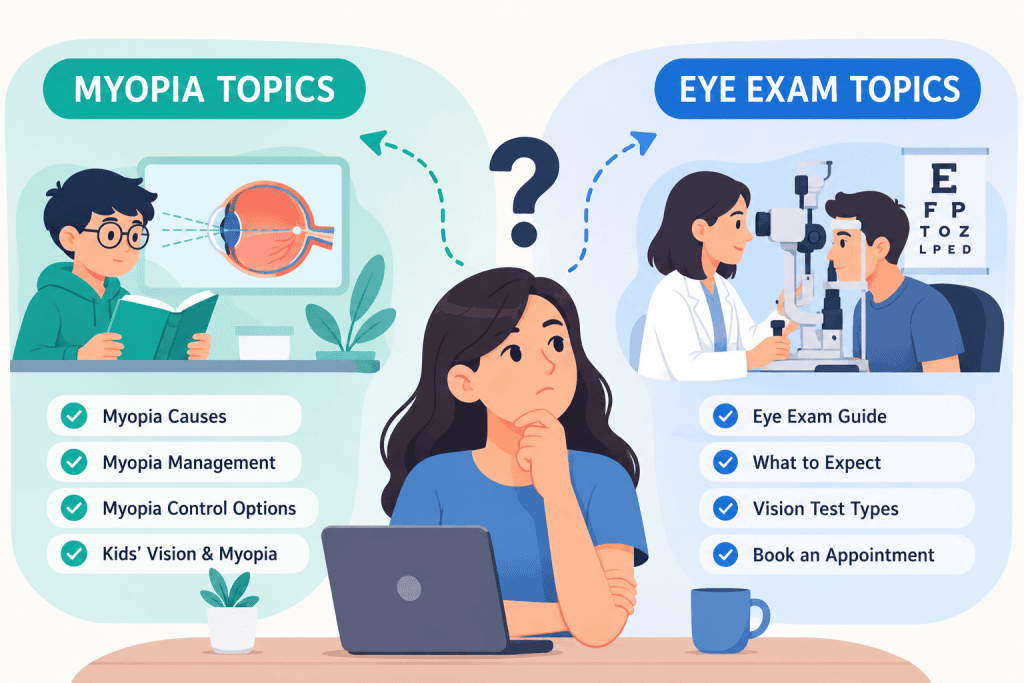
Step 1: Assign One Owner to Each Search Intent
Every important search intent should have a primary destination.
- “Pediatric eye exam” belongs to the comprehensive eye exam page.
- “Children’s vision screening” belongs to the screening page.
- “Myopia management” belongs to the main service page.
- “What is myopia control?” belongs to an educational resource.
- “Ortho-K for myopia” may belong to a treatment page when the practice offers it.
This does not mean other pages can never use those words. It means they should not try to rank for the same need.
Step 2: Define What Each Page Will Not Cover
A myopia article may explain that an examination is necessary before treatment recommendations can be made. It should not reproduce the entire exam process, target “eye exam near me,” or use appointment-booking language in every section.
Similarly, an eye exam page may mention that myopia can be identified or monitored during an examination. It should not duplicate detailed treatment comparisons from the myopia service page.
Visiclix applies a similar distinction in its guide to children’s vision screening marketing, which separates the limited role of screenings from the purpose of comprehensive examinations.
Step 3: Give Each Page a Different CTA
The next action should reflect the page’s intent.
An eye exam page can invite visitors to schedule an examination. A myopia management page can encourage parents to request a specialized consultation. An educational article can direct readers toward treatment information, while a seasonal resource about back-to-school eye exam campaigns can focus on timely appointment demand.
Different destination. Different promise. Different action.
Step 4: Compare Drafts Before Publishing
Place related drafts side by side. Compare their titles, H1s, opening answers, FAQs, target queries, internal links, and CTAs.
Two pages can use different wording while still performing the same job. When the value offered to the reader is nearly identical, the pages probably need clearer boundaries or consolidation.
How Should You Build a Keyword and Page-Ownership Map?
Build a working spreadsheet that assigns every keyword group to one primary page before writers begin drafting.
Include the URL, page type, primary query, supporting queries, search intent, patient-journey stage, CTA, internal links, reserved topics, and recommended action. Actions might include keep, update, merge, redirect, reposition, or create.
Start by inventorying every URL that mentions myopia, pediatric vision, screenings, comprehensive exams, Ortho-K, atropine, progression, or related treatments. Then identify pages that cover the same need.
A strong SEO strategy for optometrists should use this map as an editorial control document. Whenever a new topic is proposed, the team can see whether it deserves a separate URL or belongs within an existing page.
How Should Internal Links Reinforce the Correct Page?
Internal links should identify the most useful and authoritative destination for each topic.
Supporting articles should generally link toward the main myopia service page or another clearly defined parent resource. Eye exam pages should link to myopia content only when progression, management, or treatment is contextually relevant.
Internal links hold a myopia content cluster together, but more links are not automatically better. Use concise, descriptive anchor text, avoid sending the same phrase to several competing URLs, and link to the preferred version of a page.
Google explains that links help it discover pages and evaluate relevance. Its documentation also recommends using anchor text that is relevant to the destination and linking consistently to the preferred canonical URL.
How Can You Detect and Fix Overlap After Publication?
Detect overlap by checking which URLs receive impressions for the same searches and whether those pages serve genuinely different intentions.
In Google Search Console, filter the Performance report by an important query and review the Pages tab. Look for several URLs appearing for the same search, unstable performance, or an informational article attracting visitors who should reach a service page. Search Console allows performance data to be grouped and filtered by queries and pages, making it useful for this comparison.
When overlap appears:
- Choose the URL that best satisfies the intended search.
- Expand or refine that page.
- Narrow the secondary page around a distinct question.
- Merge substantially duplicated material.
- Redirect a page when it no longer provides independent value.
- Update internal links to point toward the preferred destination.
Do not delete a page merely because it shares a few keywords with another URL. Act when the pages are interchangeable, the wrong page is converting poorly, or authority is being divided between near-duplicates.
Can a Myopia Article Link to an Eye Exam Page?
Yes. Link to the eye exam page when an examination is the appropriate next step, provided the article remains primarily educational and does not begin targeting local exam-booking searches.
Should Every Myopia Treatment Have Its Own Page?
No. A separate page needs distinct search intent, substantial original information, and a real service offered by the practice. Thin treatment pages can create more overlap than value.
What Should You Do When Two Pages Rank for the Same Query?
Compare their intent, clicks, conversions, content depth, and usefulness. Differentiate them when they answer separate needs. Combine them when they provide nearly identical information.
How Often Should a Myopia Content Map Be Reviewed?
Review it before publishing any related page and during regular content-performance audits. Update it whenever the practice adds a service, changes treatment offerings, or restructures its website.
What Should Your Practice Do Next?
Begin with a list of every myopia, pediatric vision, screening, and eye exam URL on your website. Assign each page one clear job, choose an owner for every valuable search intent, and correct unclear boundaries before commissioning more content.
A useful myopia content cluster is not measured by how many pages it contains. It is measured by how easily patients can find the right answer and move toward the right service.
Start small. Compare one overlapping pair of pages, decide what each should own, and make the distinction unmistakable.
Why Visiclix Is Your Ideal Choice for Myopia Content Architecture?
Visiclix specializes in digital marketing for eye care professionals, making it easier to distinguish patient education from service, examination, screening, and appointment intent. Rather than treating each article as an isolated deliverable, the team can align content with website structure, local search visibility, conversion goals, and myopia management search strategy. That creates a clearer experience for both patients and practice teams.
Visiclix can audit existing URLs, establish keyword ownership, strengthen internal links, and identify where content should be expanded or consolidated. Its integrated approach can also coordinate organic pages with Google Ads for eye care practices, reducing the risk that paid and organic landing pages send conflicting messages. The result is a more focused content system built around the services your practice actually provides.
Build a Clearer Myopia Search Strategy With Visiclix
Your website should guide patients—not make its own pages compete for attention. Request a free marketing review from Visiclix to identify overlapping myopia, pediatric vision, and eye exam content and build a clearer path from search to appointment.