
Answer engine optimization for optometrists is the process of turning real patient questions into clear, structured, trustworthy answers that search engines, AI Overviews, voice assistants, and conversational tools can understand and surface. For an optometry practice, this means building content around the questions patients already ask before booking an appointment: “Do I need an eye exam every year?”, “What causes dry eyes?”, “Can children wear contact lenses?”, or “Which eye doctor accepts my insurance?”
The goal is not only to rank for keywords. It is to become the reliable answer when patients search, compare, and decide where to receive care. Google’s own guidance states that traditional SEO best practices still matter for generative AI search features, and that visibility depends on crawlable, useful, well-structured content rather than a separate “magic” AEO tactic.
What Changes When Patients Ask AI Instead of Searching Manually?
Patients no longer move through search in a purely linear way. Instead of typing a short keyword, clicking five websites, and comparing pages manually, many users now ask full questions and expect summarized answers. This changes the competitive environment for optometrists because the practice website must be understandable not only to patients, but also to systems that extract, summarize, and compare information.
Google’s AI features, including AI Overviews and AI Mode, are designed to help users explore information directly in search experiences. Google notes that sites still need to meet core technical and content requirements to be eligible for visibility in these AI-driven features.
The practical issue is simple: if your optometry website buries answers inside vague service copy, AI systems may struggle to identify the best response. If your site answers questions clearly, cites credible sources where needed, and connects educational information to local care options, it has a stronger chance of being useful in answer-driven search.
This matters because AI summaries can reduce traditional click behavior. Pew Research Center found that Google users who encountered an AI summary were less likely to click links than users who did not encounter one. For optometrists, this means visibility cannot be judged by clicks alone. Brand presence inside answers, local recommendations, and assisted appointment intent are increasingly important.
How Do Patient Questions Become Search Visibility Assets?
Patient questions become visibility assets when they are organized into answer-first content. An optometry practice should begin by collecting questions from phone calls, front desk conversations, consultations, Google Business Profile Q&A, reviews, and appointment forms. These questions reveal the language patients actually use before they trust a provider.
A strong AEO content system separates questions by intent. Some questions are informational, such as “What is astigmatism?” Others are clinical and decision-oriented, such as “When should I see an optometrist for blurry vision?” Some are commercial or local, such as “Where can I get a same-week eye exam?” Each category needs a different type of answer.
The best structure is direct and layered. Start with a one- or two-sentence answer. Then explain the context, symptoms, risks, process, or next step. For example, a page about dry eye should quickly explain what dry eye is, then discuss common causes, when to seek an exam, and what treatment options an optometrist may evaluate.
This is where Search Engine Optimization for eye doctors supports AEO. SEO helps the page become discoverable, while answer-first formatting helps the content become easier to interpret. The two should work together, not compete.
Why Does Answer-First Content Matter for Eye Care Practices?
Answer-first content matters because eye care decisions are trust-sensitive. Patients are not only shopping for convenience; they are evaluating whether a provider is credible, accessible, and clinically responsible. A vague answer may create uncertainty. A clear answer can move the patient closer to booking.
For optometrists, useful answers should avoid overdiagnosis. A page can explain that blurry vision may be caused by refractive error, dry eye, digital eye strain, or other conditions, but it should also encourage a professional exam for personal evaluation. This balance protects patient trust and supports responsible medical communication.

Answer-first content also helps capture long-tail search demand. Many optometry searches are phrased as questions: “How long does an eye exam take?”, “Are contact lenses safe for kids?”, “Why do my eyes burn after computer use?” These questions may not always carry huge search volume, but they often reveal real patient concern.
The commercial value comes from connecting education to action. After answering the question, the content should naturally guide readers toward scheduling, calling, checking insurance, or reading a related service page. For paid and organic campaigns, this improves continuity between search intent, landing page content, and conversion path.
How Can Optometry Websites Make Answers Easier for AI to Trust?
Optometry websites can make answers easier to trust by using clear structure, consistent facts, credible sourcing, and schema markup where appropriate. Google explains that structured data gives Search explicit clues about the meaning of a page and helps classify content.
For optometry practices, structured data should support the basics first. LocalBusiness markup can clarify business hours, address, phone number, and location details, which are especially important when patients search for nearby care. Google’s LocalBusiness documentation states that this structured data can help Google understand and display business details in Search and Maps contexts.
Content formatting also matters. Each important question should have a clear heading. Each answer should begin directly. Pages should use descriptive title tags, concise introductions, relevant internal links, and scannable sections. A page about pediatric eye exams, for example, should answer age, frequency, preparation, symptoms, insurance, and appointment expectations in separate sections.
The website experience must also support conversion. A technically strong article loses value if patients cannot book easily. Website design and hosting for optometrists should prioritize mobile performance, accessible navigation, clear appointment buttons, and pages that are easy for both users and crawlers to process.
What Local Signals Help Answer Engines Recommend an Optometrist?
Local signals help answer engines connect a patient’s question to a real practice. For optometrists, this means keeping name, address, phone number, services, hours, insurance information, and appointment links consistent across the website, Google Business Profile, and major directories.
Reviews also matter because answer engines may evaluate reputation signals from multiple online sources. Patients commonly search for trust indicators before booking, especially for family eye care, specialty contact lenses, dry eye treatment, or pediatric services. A strong reputation management strategy helps practices encourage feedback, respond professionally, and maintain a credible public profile.
Local content should be specific without sounding forced. Instead of repeating a city name unnaturally, optometrists can mention relevant service context: nearby schools for pediatric exams, commuter-friendly appointment times, local insurance patterns, or community eye health needs. This makes location relevance useful rather than formulaic.
Paid search can also support AEO indirectly. When high-intent search campaigns reveal which questions and services convert best, those insights can inform organic and answer-first content. A PPC Google Search Ads campaign can uncover patient intent patterns that later become FAQ sections, service page improvements, or new educational articles.
How Should Optometrists Measure AEO Performance?
Optometrists should measure AEO by looking beyond rankings. Traditional metrics such as organic sessions, impressions, and keyword positions still matter, but they do not show the full picture when AI-generated answers reduce clicks.
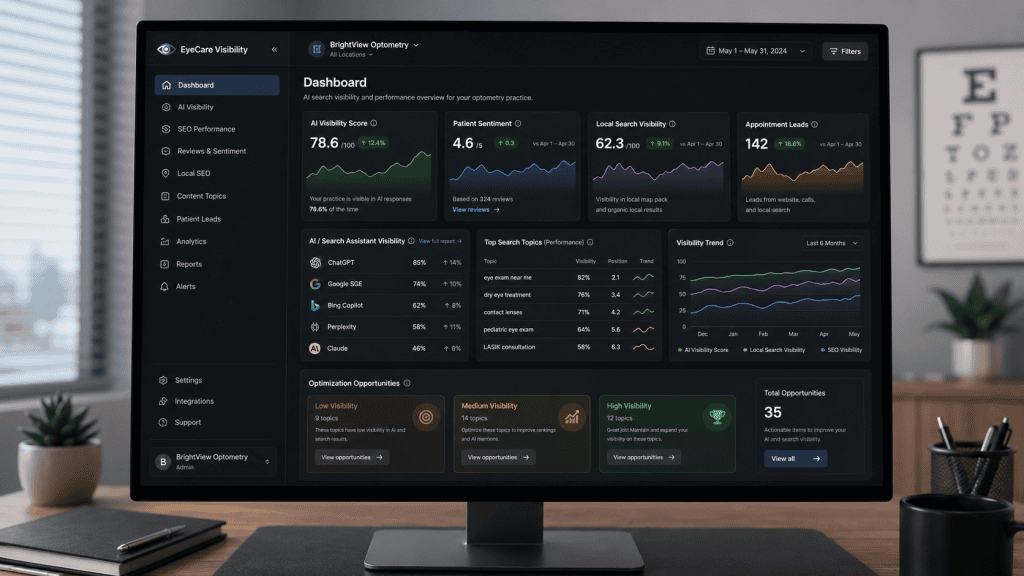
Useful AEO metrics include branded search growth, impressions for question-based queries, appointment conversions from educational pages, calls from local landing pages, Google Business Profile actions, and referral traffic from AI or answer platforms where visible. Search Console query data can also show whether the site is gaining visibility for question-based searches.
Conversion quality matters more than raw traffic. A smaller number of visitors who arrive after reading a strong answer may be more valuable than a larger audience with weak booking intent. This is especially relevant for optometry practices, where the desired outcome is usually a call, appointment, form submission, or consultation request.
AEO should also be reviewed alongside broader digital marketing services for eye care practices. Search visibility, local reputation, paid campaigns, website design, and conversion tracking all influence whether patient questions turn into measurable growth.
FAQ
What is the main difference between SEO and AEO for optometrists?
SEO helps optometrists rank and attract search traffic, while AEO helps their content become the direct, trusted answer to patient questions. The best strategy uses both: SEO for discoverability and AEO for clarity, structure, and answer visibility.
Does answer engine optimization replace local SEO?
No. AEO does not replace local SEO. Optometrists still need accurate local listings, Google Business Profile optimization, reviews, location pages, and strong technical SEO. AEO builds on those foundations by making content easier to extract and summarize.
What types of patient questions should optometrists answer first?
Start with questions tied to appointments, symptoms, insurance, services, and treatment decisions. Examples include “How often should I get an eye exam?”, “What causes dry eyes?”, “Can kids wear contacts?”, and “What should I bring to an eye appointment?”
Is schema markup necessary for AEO?
Schema markup is not the only factor, but it helps search engines understand key information. LocalBusiness, Organization, Article, and relevant medical or service-related structured data can make optometry pages easier to interpret when implemented correctly.
How often should optometry practices update AEO content?
Core service and FAQ content should be reviewed at least quarterly, especially when hours, insurance, services, staff, or technology change. Clinical content should also be reviewed for accuracy and updated when guidance or practice offerings change.
A Smarter Way to Be Found Before the Appointment Is Booked
Answer visibility begins with the questions patients already ask. When those questions are answered clearly, organized by intent, supported by credible information, and connected to local booking pathways, an optometry website becomes more than a brochure. It becomes a structured knowledge asset that can support search, AI discovery, and patient trust.
For optometrists, the opportunity is practical. Build content that answers real concerns. Make your services easy to understand. Keep your local signals consistent. Then connect every helpful answer to a next step that makes booking simple.
Why Visiclix is Your Ideal Choice for Answer Engine Optimization?
Visiclix understands that eye care marketing is different from general digital marketing. Optometrists need visibility strategies that respect patient trust, clinical accuracy, local search behavior, and appointment-driven growth. With experience in SEO, Google Ads, web design, and reputation management for eye care professionals, Visiclix helps practices turn digital visibility into measurable patient opportunities.
The advantage of working with Visiclix is focus. Rather than applying generic marketing templates, the team builds strategies around the way patients actually search for optometry and ophthalmology services. From answer-first content and local SEO to conversion-focused websites and campaign tracking, Visiclix helps eye care practices compete with clarity and confidence.
Start Building Answer Visibility With Visiclix
Patients are already asking questions. The practices that answer them clearly are more likely to earn attention, trust, and appointments.
Connect with Visiclix to review your current search visibility, identify patient-question content opportunities, and build a smarter path from online discovery to booked appointments.