
Transparent eye care pricing can improve patient confidence before booking because it reduces uncertainty, answers cost-related concerns early, and helps patients feel more in control of their care decisions. When patients can understand what an eye exam, contact lens fitting, diagnostic test, eyewear option, or specialty service may cost before they schedule, they are less likely to feel anxious about hidden fees or surprise bills.
This matters because cost is one of the most common reasons people delay healthcare. KFF reported that in 2024, about 1 in 6 U.S. adults delayed or skipped healthcare because of cost. In eye care specifically, a 2025 Vision Wellness Study reported by Optometry Times found that 53% of patients who get eye exams less than once every two years cited cost concerns or lack of access to vision benefits as a main reason they were not receiving more regular examinations.
For optometry and ophthalmology practices, eye care price transparency is not just a billing issue. It is a trust-building strategy. Clear pricing helps patients understand the value of preventive vision care, compare options more confidently, and move from “I’m not sure yet” to “I’m ready to book.”
What does eye care price transparency include?
Eye care price transparency means giving patients clear, accessible, and understandable information about expected costs before they commit to an appointment or purchase. It does not mean every possible scenario must be reduced to one flat number. Eye care can involve insurance variables, medical necessity, diagnostic findings, frame selections, lens upgrades, and specialty testing. Transparency means explaining those variables before they become surprises.
For a routine eye care practice, this may include starting prices or ranges for comprehensive eye exams, contact lens exams, retinal imaging, dry eye evaluations, myopia management consultations, LASIK or cataract co-management visits, eyewear packages, lens coatings, and follow-up policies. It can also include insurance guidance, self-pay options, payment plan availability, cancellation fees, and what is included in each visit type.
The key is clarity. Patients should not have to wonder whether the advertised exam price includes dilation, imaging, refraction, contact lens fitting, or a medical eye health evaluation. When pricing is explained with simple language, patients can focus on the importance of the appointment rather than worrying about what they might owe at checkout.
How does pricing clarity reduce pre-booking hesitation?
Pricing clarity reduces hesitation by removing one of the biggest unknowns in the patient journey: financial risk. Before booking, patients are often asking silent questions. How much will this cost? Will insurance cover it? Will I be pressured into upgrades? Will the final bill be higher than expected? If the website does not answer these questions, the patient may delay care, compare another provider, or leave without booking.
This is especially important for eye care because many patients do not always view routine eye exams as urgent. Optometry Times reported that 86% of patients said they were more likely to schedule an eye examination once they understood how exams may help detect serious medical conditions, including diabetes, heart disease, and high blood pressure. That finding shows how education and clarity can change patient behavior.
A transparent pricing page can support that decision by connecting cost to value. Instead of saying only “Comprehensive eye exam: $X,” a practice can explain that the exam may include vision testing, eye health evaluation, screening for early signs of disease, and personalized recommendations. This helps patients understand what they are paying for and why the visit is worth scheduling.
For practices investing in website design for eye care practices, pricing clarity should be part of the conversion path. A patient-friendly website should make it easy to find service information, understand next steps, and request an appointment without confusion.
Why does transparent pricing build trust before the first visit?
Transparent pricing builds trust because it signals honesty before the patient ever meets the doctor. In healthcare, trust often begins online. A patient may see your ad, visit your website, read reviews, scan your services, and decide whether your practice feels reliable enough to contact. Clear pricing supports that judgment.
A study in JAMA Ophthalmology found that hospital price transparency tools for ophthalmologic procedures had usability, availability, and variability issues, including navigability barriers and large price differences for cataract-related procedures. The study concluded that ambiguous pricing may especially burden vulnerable and uninsured patients.
That lesson applies beyond hospitals. When pricing is difficult to find or understand, patients may assume the experience will be confusing later. When pricing is easy to access, explained in plain language, and supported by helpful staff, the practice appears more patient-centered.
Transparent pricing also strengthens reputation. Patients are more likely to leave positive feedback when their experience matches what they were told upfront. That makes pricing communication closely connected to reputation and review management, because a clear billing experience can influence how patients describe your practice online.
What should an eye care pricing page explain?
An effective eye care pricing page should explain the services patients commonly ask about, what affects pricing, and what patients can expect before, during, and after their visit. It should be specific enough to be useful but flexible enough to account for insurance and clinical differences.
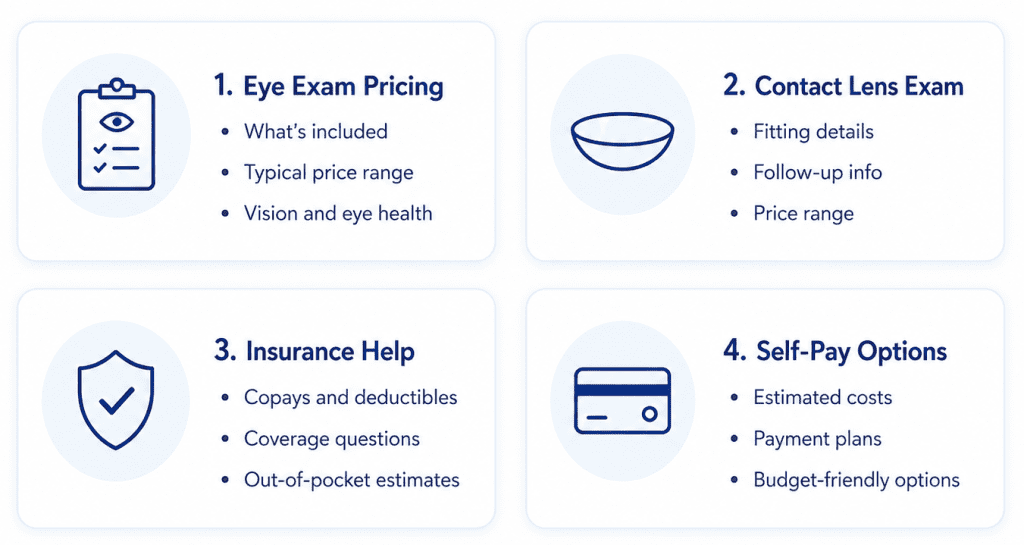
A strong page can include a short explanation of routine versus medical eye exams, what contact lens fittings typically involve, whether advanced imaging is optional or recommended, and how eyewear pricing may vary by frame brand, lens type, prescription complexity, and coatings. It should also explain whether the practice offers self-pay pricing, accepts insurance, provides direct billing, or helps patients understand benefits.
For uninsured or self-pay patients, it is also worth being aware of Good Faith Estimate requirements. Federal regulations require healthcare providers and facilities to provide good faith estimates of expected charges for uninsured or self-pay individuals upon request or when scheduling an item or service.
This does not mean every pricing page should read like a legal notice. The goal is to communicate in a way that feels helpful. A patient should leave the page thinking, “I understand what questions to ask, what may affect the cost, and how this practice will help me avoid surprises.”
How can transparent pricing improve PPC and SEO performance?
Transparent pricing can improve PPC and SEO performance by increasing relevance, reducing wasted clicks, and helping high-intent patients feel ready to act. A patient searching for eye exam costs, contact lens exam pricing, or affordable eye care is already showing financial intent. If your ad or landing page answers that concern better than competitors, the patient has a stronger reason to stay.
For PPC campaigns, transparent pricing can improve landing page confidence. A vague landing page may generate clicks but lose patients before the form submission. A clear landing page can explain what the appointment includes, what pricing variables exist, and how the office helps patients understand insurance or self-pay options. This aligns well with PPC Google Search Ads for optometrists and ophthalmologists, where every click should support a realistic path toward booking.
For SEO, transparent pricing creates opportunities to rank for useful search queries. Patients often search questions like “How much does an eye exam cost?”, “What is included in a contact lens exam?”, or “Does insurance cover retinal imaging?” Practices that answer these questions with helpful, localized, patient-friendly content can build visibility and trust. This supports a broader SEO strategy for eye doctors by matching real patient questions with useful content.
How can practices present prices without making care feel transactional?
Practices can present prices without making care feel transactional by pairing cost information with clinical context. Patients do not only want the lowest price. They want to know whether the care is thorough, whether the provider is trustworthy, and whether the recommendation is necessary.

For example, instead of listing retinal imaging as an add-on with no explanation, a practice can explain what the imaging helps document, why it may be recommended, and whether the patient can ask questions before agreeing. Instead of listing premium lenses as upgrades, the practice can explain which lifestyle needs they support, such as night driving, computer work, or progressive vision correction.
This approach protects both trust and perceived value. Patients are less likely to feel “sold to” when they understand the reason behind each recommendation. Clear communication also helps staff answer questions consistently, which makes the entire patient experience feel more professional.
Practices can reinforce this through content, service pages, FAQs, and appointment flows. A well-planned digital marketing strategy for eye care should treat price transparency as part of patient education, not just a billing disclosure.
Are there risks to publishing eye care prices online?
Yes, there can be risks if pricing is presented without context. Patients may misunderstand what is included, compare incomplete prices across providers, or assume that the lowest price equals the best value. However, these risks can be managed with careful language.
The best approach is to provide ranges, examples, and explanations where exact pricing depends on insurance, diagnosis, prescription needs, or product selection. A practice can also invite patients to call for a personalized estimate or benefits review. This keeps the information helpful without overpromising.
Healthwatch England’s 2025 research found that 14% of respondents had avoided eye care due to cost in the previous two years, and people who had been offered additional paid services were twice as likely to say they avoided eye care compared with those who had not experienced this. This reinforces why pricing communication should feel supportive, not sales-driven.
FAQ
What is eye care price transparency?
Eye care price transparency is the practice of clearly explaining expected costs, pricing ranges, insurance factors, and payment options before a patient books or receives care.
Does transparent pricing mean publishing every exact price?
Not always. Some prices depend on insurance coverage, medical findings, eyewear choices, or specialty testing. Transparency means explaining expected costs and variables clearly enough for patients to make informed decisions.
Can transparent pricing help patients book faster?
Yes. When patients understand what they may pay and what is included, they are less likely to delay booking because of uncertainty or fear of surprise costs.
Should eye care practices include pricing on PPC landing pages?
Yes, when appropriate. Even a pricing range, cost explanation, or “what affects your price” section can improve trust and help PPC traffic convert more confidently.
Is price transparency useful for insured patients too?
Yes. Insured patients still want to understand copays, deductibles, covered services, out-of-pocket estimates, and which services may not be included in their plan.
Ready to Make Pricing Clarity Part of the Patient Experience?
Patients want to feel informed before they book. When an eye care practice explains pricing clearly, it removes friction from the decision-making process and helps patients feel respected from the first website visit. That confidence can lead to more appointments, stronger trust, better reviews, and fewer billing-related frustrations.
For eye care practices, transparent pricing is not about competing only on cost. It is about communicating value clearly. When patients understand what they are paying for, why it matters, and how your team supports them, they are more likely to move forward with confidence.
Why Visiclix is Your Ideal Choice for Patient Trust Marketing?
Visiclix helps optometry and ophthalmology practices turn patient trust into measurable growth. As a marketing agency focused on the eye care industry, Visiclix understands that patients are not just looking for a provider; they are looking for clarity, confidence, and a reason to choose your practice before they ever walk through the door.
Through custom marketing services, SEO, PPC advertising, web design, and reputation management, Visiclix helps eye care practices communicate value more effectively online. That includes building websites and campaigns that answer patient questions, reduce uncertainty, and guide high-intent visitors toward booking.
Build a More Trustworthy Patient Journey With Visiclix
If your practice wants to attract more confident patients, improve appointment conversions, and make your online presence feel clearer and more patient-centered, Visiclix can help. Explore Visiclix marketing packages or contact Visiclix to start building a digital strategy that turns transparency into patient trust.