
Review your eye clinic marketing before next quarter by auditing what actually produced booked appointments, kept visits, qualified calls, and patient inquiries—not just clicks, impressions, or social activity. A strong review compares your spend, channels, website performance, local visibility, paid ads, tracking accuracy, and patient acquisition quality against your growth goals. The purpose is not to prove that every campaign worked. It is to identify which marketing efforts deserve more budget, which need correction, and which should be stopped before they drain another quarter.
An eye clinic marketing audit should be practical, technical, and tied to business outcomes. Your next plan should come from evidence: appointment data, call tracking, Google Business Profile activity, website behavior, campaign performance, and front-desk feedback. Google Business Profile performance data can show how people discover your clinic on Search and Maps and what actions they take, such as clicks and other interactions.
What should an eye clinic review before building the next quarter’s plan?
An eye clinic should first review the gap between marketing activity and patient demand. Start with the simplest question: did your marketing help create more of the right appointments? Separate routine eye exams, optical sales, dry eye consults, cataract evaluations, contact lens fittings, myopia management, and emergency eye care because each service has a different search intent, value, and booking pattern.
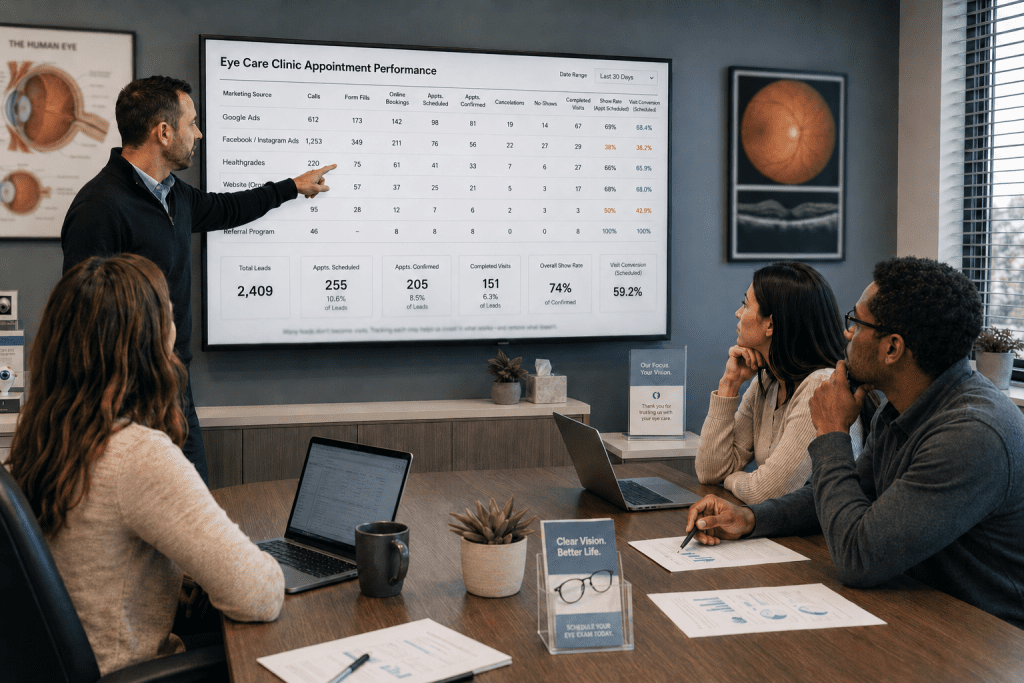
Next, review your main acquisition channels: organic search, local SEO, Google Ads, referral campaigns, email, social media, display ads, and website traffic. Do not treat all traffic as equal. A blog visitor researching symptoms is different from a patient clicking “call” after searching for an eye exam near them.
This is where a structured partner can help. Visiclix’s SEO services for eye doctors focus on visibility, user experience, keyword research, and performance tracking for optometry and ophthalmology practices, which makes SEO easier to evaluate during a quarterly review. Visiclix states that its SEO audit evaluates technical SEO, content, structure, metadata, backlink profile, competitors, and keywords.
How should you audit appointment performance and lead quality?
Audit appointment performance by matching each marketing source to real patient actions. Track calls, form fills, online bookings, appointment confirmations, cancellations, no-shows, and completed visits. A campaign that generates many low-quality leads may look successful in an ad dashboard but still fail operationally if those leads do not become scheduled patients.
For phone-heavy clinics, call tracking is critical. Google Ads phone call conversion tracking helps show how ad clicks lead to calls, and website call conversion tracking can identify calls made from your site after an ad click. Google also notes that call reporting can provide details such as call duration, start and end time, caller area code, and whether the call connected.
During the audit, listen for front-desk patterns. Are callers asking about insurance? Are they confused by pricing? Are they calling after hours? Are they asking for services your ads promote but your website barely explains? These details reveal whether the issue is marketing, messaging, scheduling, or operations.
How do you evaluate Google Ads, SEO, and local visibility?
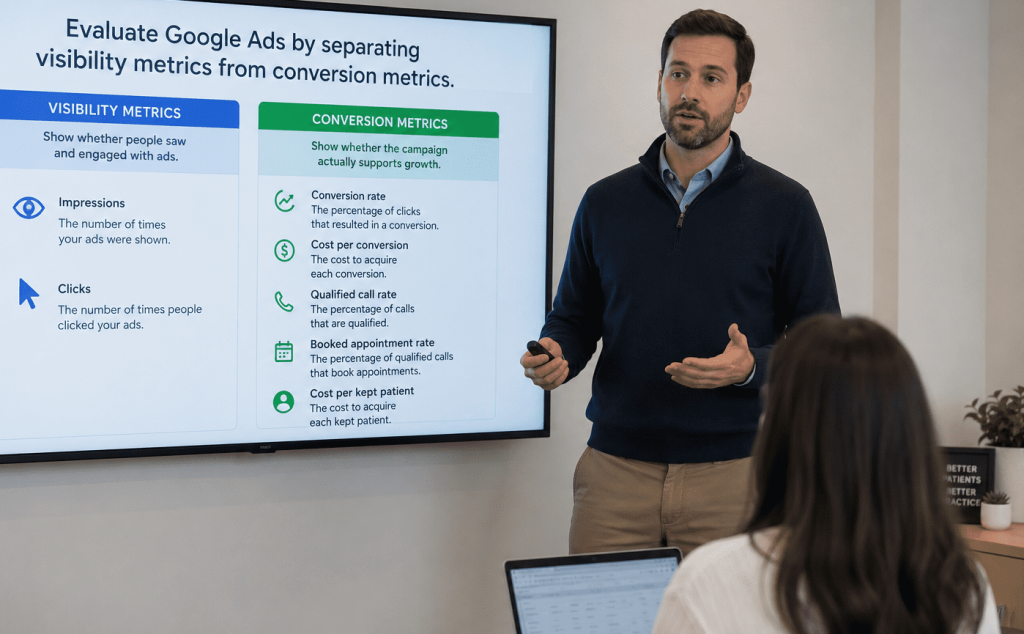
Evaluate Google Ads by separating visibility metrics from conversion metrics. Impressions and clicks show whether people saw and engaged with ads. Conversion rate, cost per conversion, qualified call rate, booked appointment rate, and cost per kept patient show whether the campaign actually supports growth.
For PPC, review search terms, negative keywords, location settings, device performance, ad copy, landing pages, and call assets. Visiclix’s Google PPC Ads service emphasizes keyword research, ad targeting, optimized landing pages, campaign monitoring, CTR, Quality Score, conversion rate, and cost per conversion for eye care practices.
For local SEO, audit your Google Business Profile, review velocity, service categories, photos, appointment links, and location-page accuracy. Visiclix’s reputation and local citation services focus on review monitoring, accurate listings, NAP consistency, and ethical review collection, all of which matter when patients compare nearby eye care providers.
Why should your website and landing pages be audited before budget decisions?
Your website should be audited before budget decisions because it is where most marketing traffic either converts or leaks. A clinic may increase ad spend, publish more content, or run display campaigns, but if pages load slowly, lack clear calls to action, bury insurance information, or make mobile booking difficult, the next quarter’s budget will inherit the same conversion problem.
Review your homepage, service pages, landing pages, appointment forms, phone number placement, mobile usability, page speed, and trust signals. Google’s Search Central documentation explains that Core Web Vitals measure real-world user experience, and Google’s broader page experience guidance says its ranking systems seek to reward content that provides a good page experience.
Visiclix’s website design and hosting services are built around mobile-optimized design, fast-loading pages, tap-to-call functionality, clear navigation, high-quality content, and SEO-driven site structure. These are exactly the areas an eye clinic should inspect before approving another quarter of traffic generation.
How do you check tracking, compliance, and reporting accuracy?
Check tracking accuracy by confirming that every key patient action is measured consistently. That includes calls, forms, bookings, appointment requests, map clicks, direction requests, and high-value service inquiries. Your audit should also flag duplicate conversions, broken forms, untracked phone numbers, missing UTM parameters, and dashboards that mix leads with actual patients.
Healthcare tracking needs extra caution. HHS guidance explains that tracking technologies collect and analyze how users interact with regulated entities’ websites or apps, and HIPAA-regulated entities may face penalties for failing to comply with HIPAA rules.
A critical audit should ask: Are tracking tools configured appropriately? Are third-party scripts reviewed? Are forms sending sensitive information into platforms that should not receive it? Are marketing reports showing only what is compliant, useful, and decision-ready?
What should you change before the next quarter begins?
Change only what the audit proves needs changing. Increase budget where patient quality, conversion rate, and appointment value justify it. Reduce or pause campaigns that produce weak inquiries, irrelevant traffic, or expensive leads that do not book. Rewrite pages where search intent and content are misaligned.
Build the next quarter around a short list of priorities: one PPC improvement, one SEO improvement, one website conversion improvement, one local visibility improvement, and one reporting improvement. Visiclix’s targeted display advertising can support retargeting and local audience reach, while its broader eye care marketing services can help connect SEO, ads, web design, and reputation into a clearer growth system.
FAQ
How often should an eye clinic marketing audit be done?
An eye clinic should complete a focused audit every quarter and a deeper annual audit once per year. Quarterly reviews keep campaigns from drifting too far from patient demand, budget realities, and competitive changes.
What is the most important metric in an eye clinic marketing audit?
The most important metric is usually cost per booked or kept appointment, not cost per click. Clicks matter only if they lead to qualified patient actions.
Should SEO and PPC be audited together?
Yes. SEO and PPC should be reviewed together because they often reveal the same intent patterns. PPC search terms can expose high-converting keywords, while SEO pages can improve long-term visibility for those same services.
Can an audit reveal front-desk problems?
Yes. If marketing produces qualified calls but few appointments, the problem may be call handling, scheduling friction, insurance questions, or slow follow-up rather than campaign performance.
What should your next step be after the audit?
Use the audit to make fewer, sharper decisions. A good quarterly review should not produce a chaotic list of marketing wishes. It should produce a prioritized plan that protects budget, improves tracking, strengthens patient acquisition, and makes your next quarter easier to measure.
The clinics that benefit most from quarterly planning are the ones willing to be critical about their own data. Review what worked, fix what blocked conversions, and enter the next quarter with a marketing plan built on evidence instead of assumptions.
Why Visiclix is Your Ideal Choice for an Eye Clinic Marketing Audit?
Visiclix specializes in helping optometrists and ophthalmologists attract more patients through strategic digital marketing. Its services cover the areas that matter most in a quarterly review: SEO, Google Ads, local visibility, web design, reputation management, display advertising, and performance-focused strategy. That specialization matters because eye care marketing has unique patient intent, service categories, and local competition patterns.
Visiclix also brings a practical growth lens to auditing. Instead of reviewing channels in isolation, the team helps eye care practices connect visibility, traffic, landing pages, calls, and booked appointments into one clearer performance picture. That makes the next quarter’s plan more accountable, more focused, and easier to optimize.
Plan Your Next Quarter With Visiclix
Ready to see what your current marketing is really doing for your practice? Contact Visiclix to start the conversation and get a clearer plan for improving visibility, patient inquiries, and appointment growth next quarter.